Boring Marketing found 51.7% brand-owned citations. Featured found 1.7%. The contradiction disappears when their measurement frames are separated.
AI citation research is producing a confusing set of headlines.
Boring Marketing's live dataset reports that 51.7% of the citations classified in its audit environment point to brands' own product and company pages. Featured reports almost the opposite: brand-owned websites accounted for 1.7% of the citations classified in its Perplexity GEO audits.[2][3]
Trendos has now added a third view. Its sponsored Search Engine Journal analysis draws on an underlying dataset of 107 million AI answers. Among the leading sources examined for IT and solutions services, brand, retail and owned sources represented 2%. In consumer goods, the figure was 46%.[1]
Which number should marketers believe: 51.7%, 1.7%, 2% or 46%?
Potentially all of them.
The studies do not measure the same prompt sets, engines, categories, source universes or units. They are not competing estimates of one universal citation mix. They are observations from different measurement frames.
That distinction is more useful than another benchmark. It suggests that AEO strategy should move beyond asking which websites an AI system cites and begin asking what evidence the system needs for a particular question, which sources are credible for providing it and whether the evidence can survive changes in retrieval.
<h2>The 107-million-answer headline needs a denominator</h2>
Trendos' article was published as sponsored content in Search Engine Journal and written by the company's co-founder. Trendos says its underlying 2026 dataset contains 107 million AI answers.[1]
The percentages in the published industry comparison do not describe 107 million individual citations. Trendos selected three industries, identified the top ten citation sources across ChatGPT, Perplexity, Gemini and Google AI Overviews, classified those leading domains into three groups, and weighted the four engines equally.[1]
In IT and solutions services, community and UGC represented 51% of the leading-source mix, brand, retail and owned 2%, and independent editorial and reference 47%. In consumer goods, the mix was 50%, 46% and 4%. In communication services, it was 50%, 10% and 40%.[1]
The rows are rounded and describe the average share of each engine's top ten sources. They are not category-wide citation shares across the full underlying dataset.
This is exactly why <a href="/articles/ai-visibility-no-common-denominator">AI visibility has no common denominator</a>. A percentage can be mathematically correct while still being unsuitable for comparison with another percentage whose universe was defined differently.
<h2>Why 51.7% and 1.7% can coexist</h2>
Boring Marketing's live research comes from user-requested brand visibility audits. Its system generates buyer-intent questions for the brand's category, tests them across ChatGPT, Perplexity, Claude and Gemini, classifies each returned citation, and audits the brand's website for machine readability.[2]
On 27 August, the page reported 14,298 AI-platform checks and 14,192 classified citations. Brand and product pages represented 51.7% of those citation instances.[2]
That is a consequential finding within that environment, but the environment is centred on brands that requested an audit and questions generated around those brands' buying categories.
Featured measured something different. Its report covers 405 user-initiated GEO audits, 378 brands, 344 industries, 1,983 buying questions and 22,881 citations from Perplexity. Within its classified citation sample, brand-owned content represented 1.7%.[3]
Featured's study also exposes an unusually fragmented source environment. Its 22,881 citations were spread across 11,499 distinct domains, and 76% of those domains appeared exactly once.[3]
The two studies differ in engine coverage, prompt construction, audit population and classification design. One cannot be used to invalidate the other. Neither supports a universal first-party versus third-party ratio.
> There is no credible universal statistic for the percentage of AI evidence that comes from first-party versus third-party sources.
<h2>Category and engine matter before strategy begins</h2>
Trendos' 2% versus 46% contrast is not evidence that one industry has discovered the correct AEO strategy. It is evidence that category context can produce very different leading-source mixes.
Yext's analysis of 17.2 million distinct citations adds an engine-level warning. The Q4 2025 research found SearchGPT citing official hotel websites at 38.1%, compared with 16.7% to 22.4% for the other models in the comparison. Claude relied on review and social sources at two to four times the rate of competing models across the sectors analysed.[4]
Yext did not establish why those differences occurred, and the patterns may have changed since Q4 2025. But the practical point survives: a category average can hide both engine variation and substantial differences within the category itself.
The same source can also change in importance quickly. <a href="/articles/reddit-chatgpt-citation-share-source-concentration-risk">Promptwatch observed Reddit's share of ChatGPT Search citations falling from a 3.83% average to 0.52% over the compared windows</a>, an 86.4% relative decline.[6] The cause remains unconfirmed, and visible citation loss does not prove that ChatGPT stopped retrieving Reddit. The episode nevertheless shows why a strategy tied to the current prominence of one domain is fragile.
<h2>A working hypothesis: evidence functions</h2>
The studies establish that source composition varies. They do not prove that AI systems assign fixed epistemic jobs to different source classes.
But the variation supports a useful question: might different prompts require different kinds of evidence?
Consider two questions about the same camera system.
“Will this Canon lens work with this Canon camera?” asks for an objective specification. Canon's own technical documentation may be the most authoritative source available.
“Is this Canon lens worth the money?” asks for judgement. A credible answer may require independent testing, professional reviews, photographers' experience, retailer comparisons or community discussion.
The first-party versus third-party distinction is not enough. The more useful question is:
> What must be established, and which source has legitimate authority to establish it?
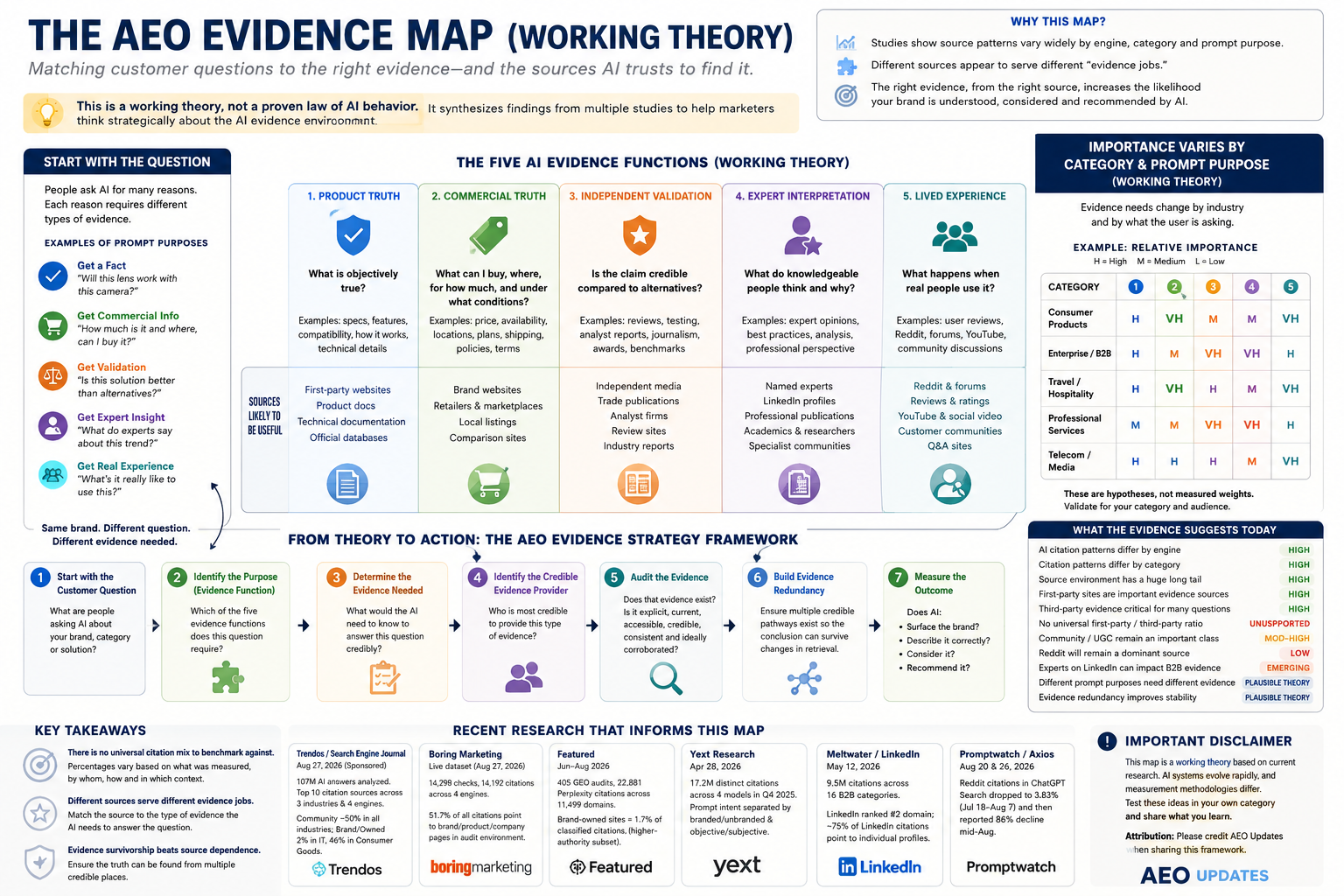
Based on the accumulated evidence, AEO Updates proposes five working evidence functions.
<strong>Product truth.</strong> What is objectively true about the product or organisation? Potential sources include first-party websites, technical documentation, specifications and official databases.
<strong>Commercial truth.</strong> What can be bought, where, for how much and under which conditions? Potential sources include brand sites, retailers, marketplaces and local listings.
<strong>Independent validation.</strong> Is a claim credible relative to alternatives? Potential sources include journalism, analysts, independent testing, directories and review platforms.
<strong>Expert interpretation.</strong> What do knowledgeable people conclude, and why? Potential sources include named experts, professional publications, academics, specialists and professional networks.
<strong>Lived experience.</strong> What happens when people actually use it? Potential sources include reviews, forums, Reddit, YouTube and customer communities.
This is a strategic framework, not a measured model of retrieval. The functions overlap. A specialist retailer may provide commercial information and expert comparison. A brand's original research may establish a fact while still requiring independent scrutiny before it supports a broader market claim.
The point is not to assign each source type a permanent job. It is to make the evidence requirement explicit before deciding where a brand needs to appear.
<h2>First-party pages are the product-truth layer</h2>
Boring Marketing's findings make one responsibility clear: brands need to be excellent sources of truth about themselves.
Among the 2,225 pages crawled in its live audit dataset, 36% were described as thin or non-extractable, 20.9% lost their content without JavaScript rendering, 77% lacked a visible date and only 21.2% showed author signals.[2]
The practical implication is not that a corporate website can independently validate every claim a company wishes to make. It is that facts such as specifications, features, pricing, availability, locations, compatibility, service areas, policies and integrations should be explicit, current and machine-readable.
A vendor is authoritative about what its product does. It is less independent when declaring that the product is the best. That broader conclusion may require another evidence function.
<h2>Third-party sources provide corroboration, not decoration</h2>
Trendos found independent editorial and reference sources representing 47% of the leading mix in IT and solutions services.[1] That does not prove that AI systems universally trust third parties more. It is, however, consistent with the evidence demands of a complex B2B decision.
If an enterprise software company claims that its implementation is the fastest in the category, the website establishes that the company makes the claim. Independent testing, customer outcomes, analyst evaluation, credible journalism or named technical experts may be needed to corroborate it.
That makes third-party visibility more than a public-relations objective. It can form part of the evidence architecture around the brand.
The Meltwater and LinkedIn research adds an identifiable-expertise dimension. Its B2B-focused report says 75% of LinkedIn citations went to member profiles rather than Company Pages.[5] The research was conducted in partnership with LinkedIn and should be read accordingly, but it suggests that a named expert's history, affiliation and published reasoning can create a different evidence signal from anonymous corporate copy.
The durable strategy is not “post on LinkedIn because AI likes LinkedIn”. It is to build identifiable expert authority in the territories where the brand needs credible interpretation.
<h2>Source classes are more durable than individual platforms</h2>
Reddit illustrates the danger of confusing a source with an evidence function.
Its visible ChatGPT citation share fell sharply in Promptwatch's August data. Yet Trendos still found community and UGC representing roughly half of the leading mix in all three industries it analysed. Boring Marketing's audit environment continued to show Reddit and YouTube among recurrent third-party domains.[1][2][6]
The reasonable conclusion is not that Reddit is finished or that first-party websites are back. It is that lived experience remains useful while the prominence of any one platform can change.
Publisher licensing creates another conditional relationship. A Press Ranger and OtterlyAI analysis of 129.3 million citations found pages from OpenAI-licensed publishers earning 10.2 ChatGPT citations per cited page, compared with 6.9 for unlicensed publishers, a 48% premium.[7] But the vendor study was correlational, the effect was not universal across licensors, and news represented 7.2% of its citation dataset.
<a href="/articles/openai-publisher-licensing-chatgpt-citations">A licensing relationship can coincide with more citations without proving preferential treatment</a>. Platform relationships belong in the measurement frame, not outside it.
<h2>Evidence redundancy may matter more than source dominance</h2>
Featured's long tail makes “get onto every site AI cites” an impossible operating model. There are too many sources, and most appeared only once in its sample.[3]
A more resilient strategy would ask whether important evidence exists through more than one credible pathway.
If an AI system does not retrieve a product page, can it find the same specification in a retailer listing or technical directory? If Reddit loses prominence, does authentic customer experience exist in reviews, forums, videos or other communities? If one publisher's article disappears, is the same claim independently substantiated elsewhere?
We have called this idea <strong>Evidence Survivorship</strong>: the capacity for an important, truthful brand conclusion to remain supportable when an engine, source or retrieval pathway changes.
This remains a hypothesis. No study reviewed here directly tests whether evidence redundancy improves the stability of brand representation or recommendations. But source volatility and fragmentation make it a valuable proposition to test.
<h2>How to use the AEO Evidence Map</h2>
The map begins with the customer question, not the channel.
First, identify the prompt purpose. Is the person seeking a fact, commercial information, independent validation, expert judgement or lived experience?
Second, define what a credible answer would need to establish. Then identify who has legitimate authority to provide that evidence.
Third, audit whether the evidence is explicit, current, accessible, credible and consistent. Independent corroboration should be added where the claim requires it.
Fourth, reduce dependence on one page, publisher or platform by building evidence redundancy across credible pathways.
Finally, measure the outcome. Does the brand appear? Is it described accurately? Does it own the intended association? Does it enter consideration or earn a recommendation?
Citations matter, but they are not the business outcome.
<h2>What the accumulated evidence supports today</h2>
The studies support several firm conclusions. Citation patterns differ materially by engine and category. The source environment can be extremely long-tailed. First-party websites can be important evidence sources. Third-party and community evidence remain important, particularly for comparative and recommendation questions. A universal first-party versus third-party ratio is unsupported.
Other conclusions require more care. Named experts appear increasingly relevant in B2B evidence environments, but the current research is platform-partnered and category-specific. Community and UGC remain important as a class, but the role of any one platform is unstable.
The evidence-function framework and Evidence Survivorship remain working theories. They explain the observed variation and generate practical tests. They should not be presented as settled retrieval science.
<h2>The strategic question is bigger than citation share</h2>
The industry has spent considerable energy asking which websites ChatGPT cites.
That question is becoming less useful on its own.
> What evidence would an AI system need to independently reach the conclusion we want it to reach about our brand?
If a company wants to be known as the easiest enterprise CRM to implement, repeating that sentence across its website does not create persuasive evidence. The site should establish the product truths behind the claim: implementation process, integration requirements, migration tools, training needs and time to deployment.
The broader positioning may require customer outcomes, comparative research, credible reviews, expert commentary and genuine user experience.
Different evidence. Different sources. Different functions. One intended conclusion.
That connects AEO to one of marketing's oldest questions: what should the brand stand for?
AI adds another: does enough credible evidence exist for a machine to independently reach that conclusion?
That is a bigger problem than earning another citation. It may be what strategic AEO is ultimately about.
[1] <a href="https://www.searchenginejournal.com/ai-search-citation-sources-trendos-spa/586289/">Trendos / Search Engine Journal, “We Analyzed 107 Million AI Answers,” August 27, 2026</a>
[2] <a href="https://boringmarketing.com/ai-visibility-statistics">Boring Marketing, “The State of AI Visibility,” live dataset checked August 27, 2026</a>
[3] <a href="https://featured.com/press/research/ai-citation-report-august-2026">Featured, “Featured AI Citation Report, June-August 2026,” August 21, 2026</a>
[4] <a href="https://www.yext.com/research/ai-citation-behavior-across-models">Yext Research, “AI Citation Behavior Across Models,” April 28, 2026</a>
[5] <a href="https://www.meltwater.com/en/resources/linkedin-gen-ai-visibility-report">Meltwater / LinkedIn, “How LinkedIn Content Wins in AI Search,” May 12, 2026</a>
[6] <a href="https://promptwatch.com/data/reddit-citations-are-dropping-in-chatgpt">Promptwatch, “Reddit Citations Are Dropping in ChatGPT,” August 18, 2026</a>
[7] <a href="https://markets.businessinsider.com/news/stocks/press-ranger-and-otterlyai-release-study-showing-publishers-with-openai-deals-earn-48-more-ai-citations-on-chatgpt-1036478455">Press Ranger / OtterlyAI, “Publishers With OpenAI Deals Earn 48% More AI Citations on ChatGPT,” August 20, 2026</a>