Primary sources cited
This article links directly to the primary documentation, paper, filing or original reporting used for its material claims.
AI answers can change bank shortlists and account comparisons. Deposit migration remains a scenario, making accuracy and customer authority central.
Banks should separate monitored AI answers from customer and balance outcomes.
Author: Ian Ash
Published: October 20, 2026
Category: Analysis
AI search changes more than how a consumer finds a bank account. When someone asks an assistant where to keep cash, which account to open or whether a rate is competitive, the system can choose the competitors, interpret the terms and frame a recommendation. If execution capabilities mature, the same interaction could eventually help prepare an application or, with appropriately granted permission, initiate an action. That makes AI search a distribution, relationship and deposit-economics issue for banks, not only a visibility issue.
The evidence does not show universal agent adoption or widespread autonomous bank switching. It does show a tension: assistants may surface competitors outside a bank's familiar search set; some consumers are open to financial assistance; and bank leaders disagree about how quickly technology could lower the friction of moving surplus cash. Banks should separate monitored AI answers from customer and balance outcomes.
McKinsey says its undisclosed research found that large language models were “much more likely than traditional web searches” to suggest institutions such as digital-native lenders, fintechs and credit unions for queries such as “best savings account”. [1] This is an attributed finding, not a reproducible cross-market benchmark: the article does not disclose models, prompts, sample, dates, markets or coding. Yet it identifies an immediate issue: a bank's conventional-search competitor set may differ from the one an assistant presents.
Recommendation and citation are different measures. A bank may be cited for rates or eligibility without being selected, while a recommendation can arise from a comparison that excludes it. Monitoring should capture eligible answers, appearing competitors and stated reasons for selection, not treat an answer count as people or market share.
A primary personal chequing relationship can connect payroll, bill payments, cards and routines. Those ties may make a full relationship move difficult even where a better rate exists. A savings balance may be easier to relocate without dismantling everyday payments. Banks should therefore analyse surplus-balance migration separately from personal chequing retention.
McKinsey illustrates the potential with a hypothetical instruction to maintain a $1,000 checking-account balance, move excess cash to high-yield savings and top up checking below $500. It says this “could become routine”. [2] This is an illustration, not proof of a deployed product, customer adoption, or resolved consent, liability, timing, overdraft and eligibility issues. The U.S. term “checking account” does not establish a Canadian personal-chequing product.
McKinsey offers a separate conditional scenario: if 5 to 10% of global checking balances, not all deposits, moved to higher-yield accounts, the banking industry's total deposit profits could decline by 20% or more. [1] Its cited reference base is $23 trillion in near-zero-rate checking within $70 trillion in global consumer deposits. This is neither an observed result nor a Canadian forecast; its rate spread, horizon, geographic breakdown and profit-model mechanics are not public. [7]
On JPMorganChase's October 13, 2026 earnings call, Jamie Dimon said the firm uses agents internally, will use them for customers and treats them as tools. He also said customers should understand the risk, including “a liability transfer”, and that the bank would not allow “just any outside agents” in because it was too risky for clients and JPMorgan. [3] This is commentary, not a complete policy or a permanent block on every external agent, but it makes permissions, data use and accountability central.
Wells Fargo chief executive Charlie Scharf was more sceptical about near-term deposit disruption. He said agents causing “mass movement to higher-rate alternatives” was overdone for the period Wells Fargo could see. He pointed to primary payments activity, wholesale services and reluctance to authorise unilateral moves to unfamiliar institutions or terms. [4] This is a time-bounded executive assessment, not proof that agents cannot change behaviour.
Assistant interest is distinct from money authority. Accenture reports that 65% of respondents in its 10,000-person, ten-country survey were open to a GPT-like financial assistant through a generative-AI platform or digital wallet. Separately, 71% would welcome an AI assistant in their primary bank's app. [5] Fieldwork ran from September to November 2025, covering banking consumers in ten countries, including Canada and the United States. [8] These attitudes are not actual use or consent to move money, pay, trade or switch banks. EY similarly says deposits could become programmable as agent-native models scale, based on stated research involving more than 3,500 consumers and 50,000 simulated agentic-AI journeys. Its unpublished methodology and geography mean its scenario is not evidence of current widespread autonomous switching. [6]
Track eligible account-shopping answers that surface the bank, appearing competitors, and whether an answer mentions or recommends it. The unit is a monitored output under defined prompts, models and markets, not a person. Record the use case and recommendation prominence.
Capture whether selection reflects rate, recurring fee, promotional offer, service, payment functionality, eligibility or a persistent brand assumption. This exposes cases where a short introductory yield is framed as ongoing or a benefit ignores the stated need.
Test whether the comparison is like for like. Review promotional versus ongoing fees and yields, minimum balances, withdrawal limits, eligibility, fee-waiver conditions and freshness. The aim is to find material errors that could affect a customer's choice.
Log cited sources, retrieved bank pages, comparison publishers and stale or missing information. Citations explain provenance, not recommendation, and a recommendation may not cite the bank. That distinction guides authoritative product pages and machine-readable data without mistaking a citation for consumer preference.
Review how summaries, comparison tables and generated interfaces represent products, trade-offs and limitations. Product names, rates, fees, eligibility and material caveats must be clear enough for a fair comparison. The test is accurate representation, not favourable presentation.
Connect movements in monitored answers to product terms, content, competitor activity and AI-platform changes. Preserve collection conditions, because a revised prompt, geography, model or policy can alter results without a change in consumer sentiment or bank performance.
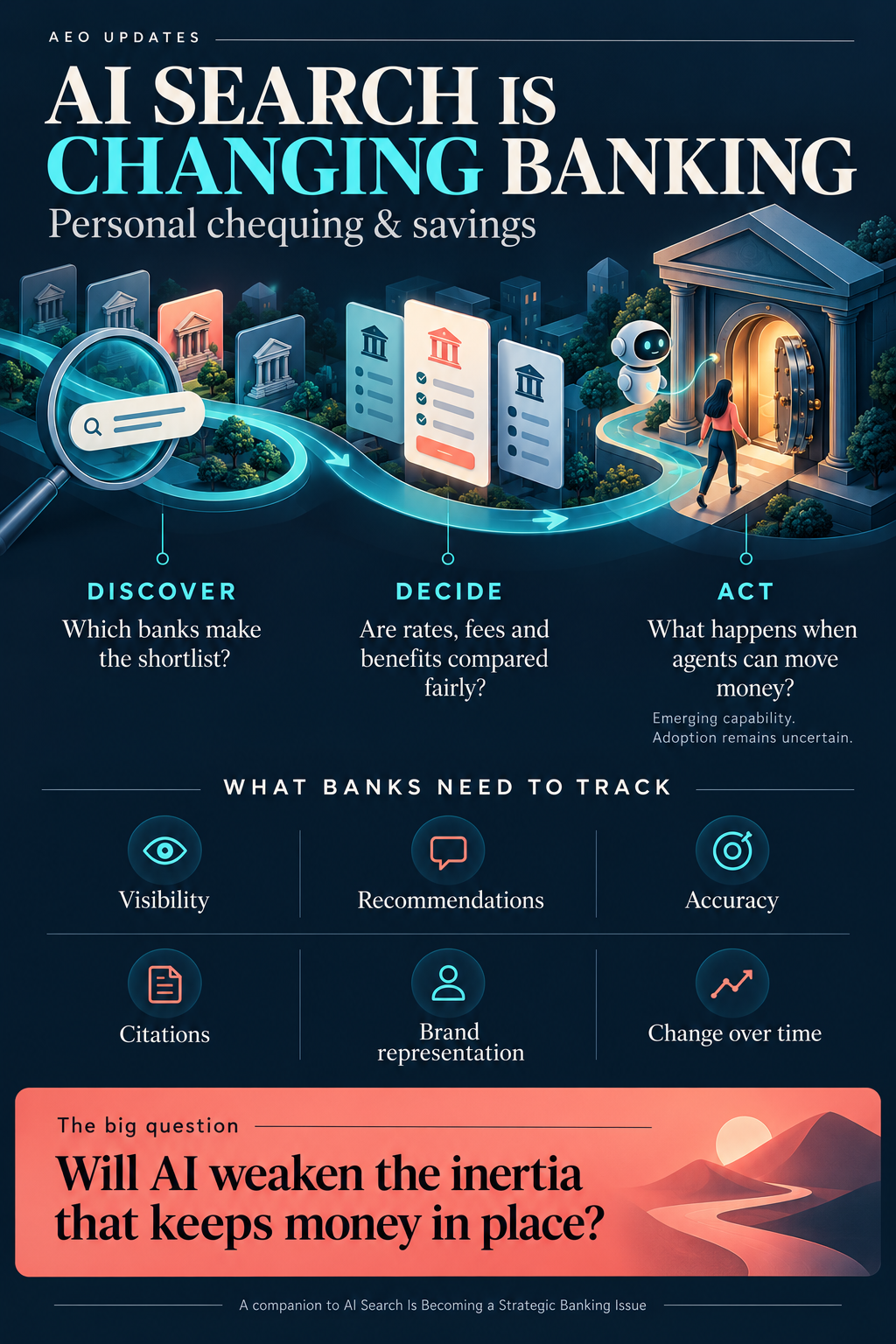
The accompanying AEO Updates infographic is conceptual. It maps discovery, comparison, recommendation and action as a measurement framework. Its “Act” stage is an emerging capability, not automatic customer authority, proof of a deployed personal-account workflow or evidence of adoption. Any action still depends on consent, permissions, execution controls and the restrictions banks and customers accept.
A visibility dashboard is necessary but insufficient. Banks need a defensible link between machine representation and matched consumer research on trust, account choice, funded balances and retention. It would be wrong to subtract an answer-share metric from a survey percentage or claim causation from parallel movements. Gaps are useful when defined carefully: strong recommendation presence with weak consumer trust may indicate a conversion or governance question rather than an AEO problem.
A proposed research approach combining Dig Insights System 0 with continuous AI-answer monitoring could pair controlled AI-answer monitoring with consumer tasks and follow-up questions, then compare answer conditions with stated understanding and choices. This is a proposed research design, not a new study or a proven causal effect. It could ask where delegation stops: explain, recommend, prepare an application, initiate a transfer or act continuously within limits. It could test whether customers distinguish promotional from ongoing fees and yields, how they respond to execution delays and access restrictions, and whether the convenience of an existing relationship preserves inertia after a better account is recommended.
Banking leaders should neither assume that an assistant will empty a primary account nor dismiss the possibility because autonomous transfers remain constrained. The practical priority is to make product information comparable, monitor the recommendations for which the bank is eligible, and understand where the machine's representation diverges from customer trust and account behaviour. Related AEO Updates analysis on JPMorgan and AI-agent customer loyalty, agent access from discovery to action, what AI might advise an existing customer, and the State of AEO 2026 offers further context. The advantage will come from treating AI search as a controlled measurement and research problem, rather than a dashboard metric or a forecast disguised as fact.
[1] How gen AI agents threaten retail banks’ customer relationships
[2] The end of inertia: Agentic AI’s disruption of retail and SME banking
[3] 3Q26 Financial Results: Earnings Call Transcript
[5] Top banking trends for 2026: Unconstrained Banking: A new age of possibility
[6] Why agentic AI in banking will make execution the measure of success
[7] Global Banking Annual Review 2025
[8] Top Banking Trends 2026: official report and research methodology
This article links directly to the primary documentation, paper, filing or original reporting used for its material claims.