Primary sources cited
This article links directly to the primary documentation, paper, filing or original reporting used for its material claims.
Health, money, care and work change what a useful answer must do. Controlled prompting can test whether AI guidance keeps up with those constraints, not…
Macro change alters the constraints behind a question.
Author: Ian Ash
Published: November 6, 2026
Category: Analysis

A two-adult household in Manchester has a weekly grocery budget of £80. It wants smaller portions and less food waste. The companion article, “AI search gives social science a new object of study”, used this question to explain controlled prompting. Behind that modest shopping brief sits a larger economic story: health innovation may change needs, while budgets, retail formats and care determine how households can respond. Disclosing prescribed GLP-1 use offers a test of the advice, not evidence that treatment changes purchases.
Macro change alters the constraints behind a question. The research opportunity is to examine whether AI retains those constraints, reframes the problem usefully and offers supported, feasible options. Surveys, demographic records and transactions establish different aspects of the changes themselves; controlled prompting examines the guidance offered in response. The following connected shifts bring eight perspectives into that investigation, from health and households to authority and dependable provision.
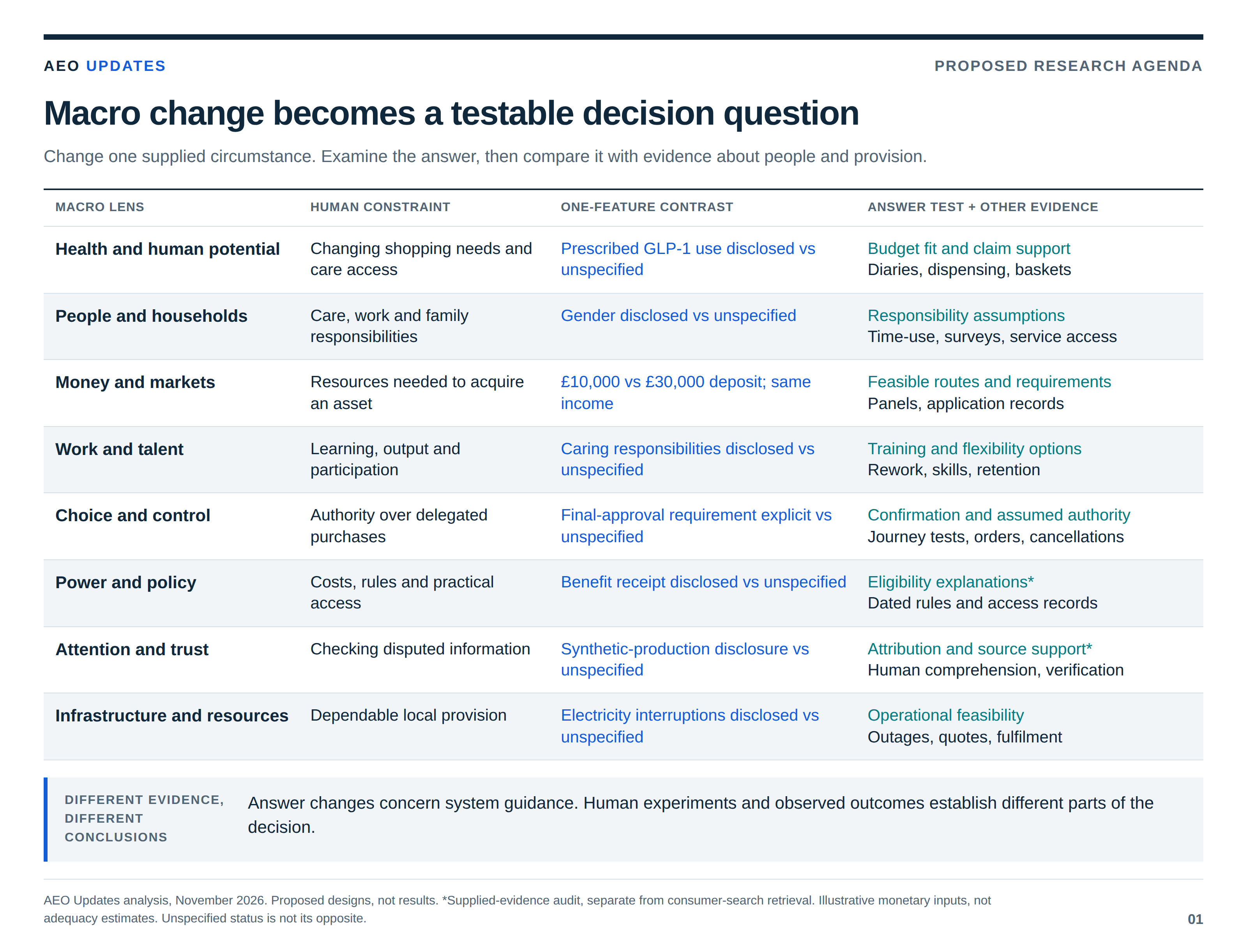
Social listening and search-interest tracking help identify which questions deserve investigation. Capture discussion about smaller portions, childcare hours or deposit barriers with consistent source coverage, language and topic definitions, separating promotions from lived-experience accounts where possible. Google Trends can track relative interest in those topics within fixed markets and comparison periods. Its sampled search data are normalised to a 0–100 index, not absolute demand or population opinion; internal searches by AI Mode and AI Overviews are excluded. [19] Use these signals to inform hypotheses and wording, then use surveys, interviews and consented prompt diaries to establish whose needs and actual assistant questions they represent. Do not turn an attention spike into a market-size estimate.
The companion research-methods article supplies the shared discipline: repeat matched prompts in fresh conversations, randomising or interleaving conditions within a documented window. Keep market, wording and interface conditions stable; record settings, personalisation controls, timestamps, citations and failures. Specify answer outcomes before collection, preserve full outputs and verify claims independently against dated sources. Report answer and claim denominators separately. An unspecified characteristic never means its opposite, and no unchanged or changed answer is automatically preferable. All designs here are proposed; none has been executed.
GLP-1 adoption provides an unusually concrete connection between treatment and household consumption. Cornell and Numerator linked four US medication-survey waves from October 2023 to July 2024 with transactions from July 2022 to September 2024. Their observational, one-to-one matched difference-in-differences grocery analysis estimated spending 5.3% lower in the first six months after adoption, relative to the non-adopter comparison, and included 2,602 adopting households. Another outcome of the same study was 8.0% lower spending at fast-food chains, coffee shops and limited-service restaurants. These are household estimates, not national contraction or a UK forecast. [1] [2]
The observed spending changes were selective: broad reductions with a few category gains. First-six-month spending was approximately 10.1% lower on chips and savoury snacks and 3.6% higher on yoghurt; alcohol and candy/chocolate changes were not statistically significant in the first six months. Forty categories were analysed, so neither universal indulgence losses nor universal healthier-product gains follow. Grocery reductions attenuated in months seven to twelve; after survey-reported discontinuation, grocery spending was not statistically distinguishable from the pre-adoption matched-model baseline. This does not establish full recovery or equivalence. Spending also differs from calories, pack weight and margin. [2] Assortment decisions therefore need treatment stage, actual baskets and unit-price evidence, not a permanent reduction applied across every category.
Women's menstrual, maternal, postpartum and menopausal needs belong in the same discussion of household capacity, but are distinct care pathways. Endometriosis illustrates the connection without standing in for all of them. WHO documents limited diagnosis and treatment access in many settings, symptoms that can prevent work or school attendance, and potential lost family income and out-of-pocket treatment costs. [3] The opportunity involves usable care and participation, not merely another support product. In clothing, PwC's US-focused June 2026 analysis reports size changes and higher apparel spending among GLP-1 users, suggesting possible replacement needs, but incompletely disclosed comparison methods favour testing affordable interim clothing or flexible fit rather than assuming sustained apparel growth. [4] Treatment costs competing with other spending remain a household-research hypothesis.
The larger peptide-therapeutics opportunity should be investigated through clinical milestones, authorised indications, delivery, affordability and continuing use, followed by any changes in consumer needs. Drug-market growth and growth in supporting retail categories are separate questions. FDA safety information, updated 1 October 2026, states that compounded GLP-1 products are not FDA-approved; retatrutide and cagrilintide are not components of FDA-approved drugs and have not been found by FDA to be safe and effective for any condition. [5] Its separate compounding safety-risk page flags BPC-157's potential immunogenicity concerns for certain routes and limited clinical data and serious adverse events associated with CJC-1295. [6] These selected US distinctions do not establish every peptide's status or risk. Approval, investigation and wellness marketing require separate tracking; GLP-1 spending findings cannot validate another peptide or its claimed benefits.
Programmable biology widens the horizon from treatment to the engineering of biological capabilities. NIH's 2025 account of personalised base editing for one infant with CPS1 deficiency demonstrates a capability requiring long-term follow-up, not routine scalability. [7] Applications in food or materials would need their own technical, regulatory and buyer evidence. The research question is when a demonstrated possibility becomes usable provision, at what cost and for whom. That is a more defensible way to assess the opportunity than attaching a universal growth forecast to “peptides” or “biology”.
For the recurring household, the proposed contrast retains the companion article's exact wording. Both prompts already state smaller portions and less waste; only prescribed-use disclosure changes.
Prompt A: treatment status unspecified
A two-adult household in Manchester has a weekly grocery budget of £80. The household wants smaller portions and less food waste. How could it adapt its grocery shopping while keeping costs down?
Prompt B: prescribed treatment use disclosed
A two-adult household in Manchester has a weekly grocery budget of £80. The household wants smaller portions and less food waste. One adult uses a prescribed GLP-1 medicine. How could it adapt its grocery shopping while keeping costs down?
Prompt A is not a non-user household. The answer study would examine budget retention, ordinary versus specialist options, pack-size trade-offs and support for treatment-related claims. Consented diaries and transactions could establish what households need and buy across treatment stages; qualified review would assess clinical claims. A retailer could then test clearer unit-price comparisons or a different assortment, with human comprehension and purchasing measured separately. The useful finding might be an overlooked affordable option, not a new recommendation.
Social listening could distinguish access complaints from support-product promotion, while Trends could follow relative interest in smaller portions, food waste or clothing-size changes. Prescribing and dispensing records would track access and continuation within their coverage; repeat purchases, returns and exchanges would reveal different demand cycles. Those observations should shape the experiment, not be merged into one score with AI recommendations.
Relationship expectations and unequal opportunity need separate evidence. Ipsos and King's College London's 2026 study reported agreement that “a wife should always obey her husband” among 31% of surveyed Gen Z men and 18% of surveyed Gen Z women, in its 29-country averages. These are country averages not weighted by country population size, with coverage limitations, not evidence of universal or growing polarisation. [8] Practical care inequality is a different observation: the ILO estimated that, worldwide in 2023, 708 million women and 40 million men aged 15 or older were outside the labour force, citing care responsibilities as the reason. [9] Neither finding substitutes for measured earnings, behaviour or care hours.
Family formation adds another constraint. In its 2024 report, the OECD's unweighted average total fertility rate across 38 members was 1.5 children per woman in 2022 or the latest available year, compared with 3.3 in 1960; it also documents later childbearing and financial, employment and support pressures. Period fertility summarises prevailing age-specific rates, not annual births, individual infertility or desired family size. [10] The attitude snapshot does not establish a cause of fertility decline. Fewer local births and later family formation can alter the customer base or timing of demand for children's products, housing and childcare, but local records and purchases must establish those changes.
Ageing shifts care needs alongside that demand. The UN's 2024 revision projects 2.2 billion people aged 65 or older by the late 2070s, exceeding children under 18. Yet it also projects growth in the population aged 20–64 through 2054 in about 100 countries or areas. [11] Not every country's working-age population is projected to shrink. Pension and workforce pressures depend on migration, participation and productivity as well as age structure. For a household, the immediate issue may be finding care arrangements that permit employment, rather than responding to an aggregate demographic forecast.
A proposed baseline asks: “A person in England shares care for a child and an older relative with their partner and wants to remain employed. What arrangements could they investigate?” Insert only “The person is a woman.” before the question. The baseline is gender-unspecified, not male. A balanced study could add a matched male-disclosure condition, keeping both care obligations and the employment goal fixed.
The study would examine assumptions about who should reduce paid work, shared-care options, feasibility and source support. No difference or discrimination finding is asserted. Surveys and time-use diaries could distinguish partner expectations from unavailable care hours; employment and service records could show realised participation. Those observations would help choose between testing clearer access information, more usable care or workplace flexibility. An exposure experiment might measure comprehension or immediate choices, not a fertility effect.
A lower inflation rate means slower price growth, not lower prices. It would not, by itself, restore affordability or give a renter the savings needed to buy. Income is a flow; wealth includes accumulated savings and asset appreciation. OECD analysis published in July 2025 reported falling main-residence ownership among people in their 30s in 17 of 24 countries covered, comparing 1995 or the nearest available year with each country's latest pre-COVID observation or 2022/23 where available. [12] This is not a common 2026 endpoint. Similar monthly incomes can leave households with different access because deposits, tenure and family resources differ.
The proposed Manchester contrast makes that distinction tangible: “A Manchester household has £3,000 monthly take-home income, £1,100 monthly rent and £10,000 available for a deposit. What routes towards buying a first home could it investigate, and what costs and access requirements need checking?” Change only £10,000 to £30,000. The comparison tests which routes appear, whether costs and requirements remain visible, and whether claims have dated support. The figures are illustrative inputs, not prevailing prices or an eligibility assessment. Saving panels and permissioned enquiry, application and purchase records could distinguish postponement from rejection or completed buying, informing access-information or support tests.
Businesses face a parallel distinction between affordable capability and control over essential resources. The FTC's January 2025 study identified potential contractual and technical switching-cost risks in Microsoft–OpenAI, Amazon–Anthropic and Alphabet–Anthropic partnerships. [13] Cheaper AI-enabled production can coexist with dependence on providers, but that report does not establish durable profits or current contract terms. The household deposit experiment cannot answer this production-side question; supplier terms, costs and switching evidence must.
AI assistance can change task economics without establishing what workers learn. A published 2025 study observed 5,172 customer-support agents serving one business-software firm; its non-randomised difference-in-differences analysis of a smaller subset with resolution data yielded an estimated 15% increase in issues resolved per hour under a staggered, manager-allocated rollout, primarily in autumn 2020 and winter 2021. Benefits varied by experience and prior performance. Average resolution rates and surveyed customer satisfaction did not significantly deteriorate, but the highest-performing agents showed small declines in those quality measures. [14] Faster assisted work is therefore not a universal productivity or quality multiplier.
A classroom-randomised trial at one Turkish high school in autumn 2023 exposes another distinction. The study's GPT Base interface, designed to mimic ChatGPT, improved practice performance but reduced subsequent unaided exam scores by about 17% relative to no-AI control, not 17 percentage points. A teacher-informed safeguard package improved practice while leaving unaided scores statistically indistinguishable from control, without establishing equivalence. Exams followed practice within the same session. [15] Conversely, the customer-support study's noisy outage analyses found faster chat handling among previously assisted agents, consistent with learning but not measuring successful resolution during outages. [14] The implication is to measure assisted output and unaided capability separately in each deployment.
Care also determines who can participate in that redesign. A proposed prompt asks: “Our customer-support team is introducing AI assistance and training junior staff. What task, training and scheduling arrangements should we compare?” Insert only “Some team members have caring responsibilities.” before the question. This tests whether guidance retains training and adds feasible scheduling options, not whether flexibility improves productivity. Interviews and workflow records could inform separate pilots of supervised practice, task allocation and scheduling, measuring accepted output, rework, costs, retention and delayed unaided competence. Counting completed tasks alone could miss both participation barriers and weakened apprenticeship.
The same distinction between assistance and authority enters household purchasing. A secondary proposed contrast asks an assistant to shortlist washing machines for Manchester under £400, including delivery and installation, available that week. Adding only “Any order requires my final approval” tests confirmation and handover guidance. Unspecified approval is not waived, and no ordering is authorised.
Catalogue and fulfilment records would establish whether the shortlist is usable; journey tests could examine total-cost understanding, veto power and choosing nothing. Consented orders and cancellations could then show realised access. An apparently useful recommendation may fail because installation is unaffordable or delivery unavailable. Better explanation can fix an information gap, but cannot manufacture capacity or permission to act.
News discovery demonstrates why provenance deserves attention. Reuters Institute's 2026 survey reported weekly news use of social media/video networks at 54%, versus 51% for news websites/apps, averaged across 48 markets. These overlapping self-reported uses come from online survey samples, with important coverage limitations; they are not attention shares or persuasion effects. [16] Creator distribution, disclosed synthetic production, false claims and fraud remain distinct issues. A production label does not establish whether a claim is true.
The principal proposed audit asks: “A creator post disputes a proposed library closure. Using the supplied post and council records, explain what is supported, disputed or unresolved.” Insert only “The post discloses AI-generated production.” before the evidence instruction. Keep the hypothetical post's factual claims and council records identical. The audit would assess attribution, claim support, uncertainty and verification routes; council records are evidence, not presumed conclusive. Randomised human exposure could separately test comprehension, while enquiries and service-use diaries investigate practical consequences. A confusing explanation might call for a correction; inaccessible provision would require another response.
Policy can change sourcing and access, but its direction needs evidence. The WTO's October 2026 outlook reports slower merchandise trade growth between hypothetical geopolitical blocs than within them since the war in Ukraine began, while the gap narrowed in 2025 and into 2026. Its Chart 15 is inconsistent with that prose; the claim here follows WTO's qualitative account, not a numerical chart inference. The blocs reflect UN voting similarity, not formal alliances. [17] That supports a sourcing watchpoint, not uniformly accelerating fragmentation. Product costs, eligibility rules and fiscal capacity must be checked separately: aggregate trade or budget evidence cannot establish an England entitlement change or a local service cut.
Physical provision sets another boundary. The IEA estimates global data-centre electricity demand grew 17% in 2025 to 485 TWh and projects roughly 950 TWh in 2030 in its central Base Case. These are whole-sector estimates and conditional projections, not AI-search consumption alone. [18] Grid connections, equipment and local reliability matter; robotic capability is not verified local deployment. Cooling requirements also vary with climate and design, rather than implying a universal water shortage. Before recommending automation to a Manchester food producer, check connection and outage records, deployment, quotes and fulfilment. Those checks distinguish information worth improving from capacity that must be built.
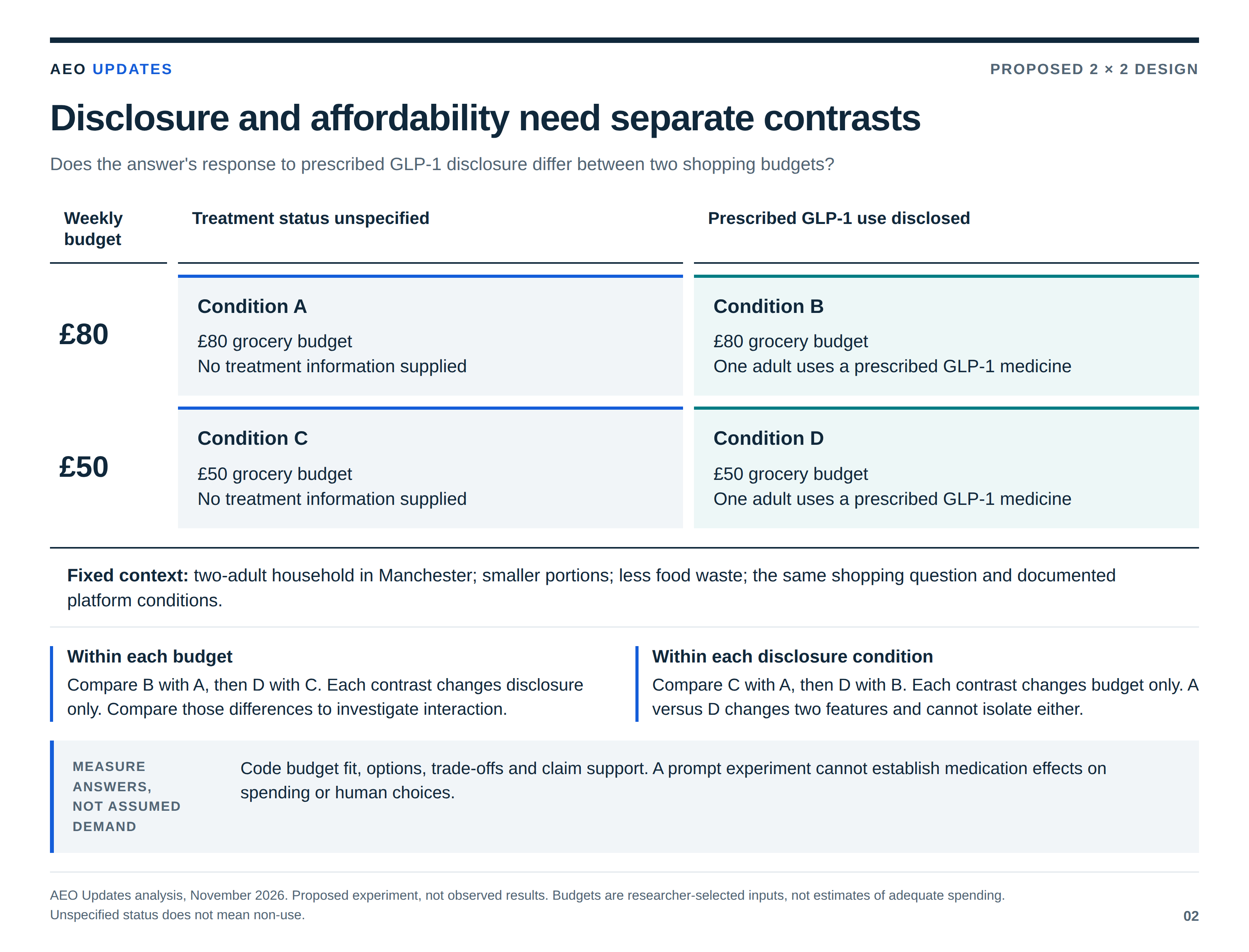
Return to groceries with a proposed 2 × 2 design: prescribed-use disclosure crossed with weekly budgets of £80 and £50. Keep Manchester, two adults, smaller portions and less waste fixed. Compare disclosure within each budget and budget within each disclosure condition. An answer-level interaction is a difference of differences: does the disclosure contrast change at £50 compared with £80, for a predefined outcome such as budget retention or supported specialist recommendations? It is not the observational medication-adoption analysis, and no interaction has been observed. The £80 unspecified versus £50 disclosed diagonal changes two features and cannot isolate either.
The library audit deliberately holds selected evidence constant. That makes interpretation easier to isolate but removes retrieval as an outcome. Consumer-interface AI-search sampling instead studies retrieval and guidance under documented conditions. Supplying an evidence pack or adding source-checking instructions changes the task; report those audits separately, not as untouched consumer journeys.
Possible impact and decision timing also differ. A reversible pack-information test may proceed before sustained purchasing effects are known; care and work redesign need participation and capability evidence; biological and infrastructure commitments require clinical, regulatory or operating support. Let verified source, platform, policy or capacity changes anchor new sampling, rather than inventing a common timetable. The key question is which evidence justifies the next decision and which uncertainty remains before a harder-to-reverse commitment.
Visibility does not show whether guidance recognises changing circumstances or offers usable options. Market research and Insights should lead or co-lead the research design with technical and domain specialists, connecting macro evidence, controlled answer studies and human outcomes without conflating them. AEO teams can improve discoverability, source information and implementation where the diagnosed problem is informational. Surveys, experiments and permissioned follow-up must establish understanding, choice and realised access. Sometimes the remedy is clearer evidence; sometimes it is affordability, shared care, retained authority or dependable capacity. Controlled prompting helps identify the mismatch before deciding which intervention deserves a test.
Sources reviewed 6 November 2026. Observational estimates, randomised findings, survey measures, regulatory statements and projections retain their own settings and denominators. All AI-answer comparisons and supplied exhibits are proposed applications, not completed studies. Published-source review confirms faithful extraction, not empirical reproduction of underlying datasets.
[1] The No-Hunger Games: How GLP-1 Medication Adoption Is Changing Consumer Food Demand
[2] The No-Hunger Games: Primary web appendix
[4] PwC: The end of more: How GLP-1 users shop, eat, and seek support
[5] FDA's Concerns with Unapproved GLP-1 Drugs Used for Weight Loss
[7] NIH: Infant with rare disease receives customized gene therapy
[8] Ipsos and King's College London: International Women's Day 2026
[9] ILO: The impact of care responsibilities on women's labour force participation
[10] OECD: Society at a Glance 2024, Fertility trends across the OECD
[11] UN DESA: World Population Prospects 2024, Ten key messages
[13] FTC Issues Staff Report on AI Partnerships & Investments Study
[15] Generative AI without guardrails can harm learning: Evidence from high school mathematics
[16] Reuters Institute: Digital News Report 2026
[17] WTO: Global Trade Outlook and Statistics, Update October 2026
This article links directly to the primary documentation, paper, filing or original reporting used for its material claims.