Primary sources cited
This article links directly to the primary documentation, paper, filing or original reporting used for its material claims.
NP Digital's large AI-visibility analysis points beyond channel tactics. AEO needs accurate claims, usable evidence, independent corroboration and…
AEO becomes an operating model when the organisation knows which claims it can defend, who maintains them and what would count as evidence that they matter.
Author: Ian Ash
Published: October 4, 2026
Category: Strategy
The next response to AI visibility data should not be a scramble to publish more listicles or buy attention on whichever channel appeared strongest in the latest chart. It should be a decision about what a brand can credibly claim, where the supporting evidence lives and how to tell whether an AI system actually uses it when helping someone choose.
NP Digital's Nikki Lam published an analysis on 30 September, updated 2 October, describing roughly nine million AI answers across nine platforms and more than 400 enterprise brands. The page title calls the corpus '9M prompts', while its introduction calls it AI answers; the public article does not reconcile those units. It also does not publish the full prompt frame, geography, source-classification rules, model-level sample sizes or underlying responses needed to reproduce its comparisons. This is a large observational account worth examining, not a controlled test of what marketing intervention works. [1]
Within that dataset, NP Digital reports that 64% of citations went to ordinary pages rather than listicle, how-to or comparison formats. For commercial-intent prompts, it says 82% of citations went to third-party sources and 3% to brand-owned pages; the article does not fully explain the remaining source categories. It also reports an association between an owned-page citation and a fivefold AI-visibility rate, but does not disclose the exact comparator or causal design behind 'lift'. The low owned-source share and stronger association can both be true without proving that one caused the other. [1]
These figures do not say to abandon owned content. Nor do they say to chase any one platform or publisher. They raise a more practical question: what system makes a brand's claims accurate at the source, credible in independent contexts and recognisable when an AI synthesises an answer?
A citation records a source link. A brand mention records whether the answer names the brand. A recommendation records whether the assistant presents that brand as a suitable choice in a defined decision. Those are distinct outcomes. NP Digital says that up to 75% of answers citing a brand-owned page did not name that brand in the response. A separate Semrush and Kevin Indig study found that 61.7% of its 3,981 domain appearances were cited without a brand-name mention. The two figures come from different corpora and denominators; they are not estimates of one universal 'ghost citation' rate. [1] [3]
The proposed AEO operating model has four linked layers. Owned evidence sets out defensible facts on an accessible company site. Independent sources may assess or repeat those facts in their own voice. AI systems retrieve and synthesise material according to a particular question and platform. People encounter an answer, consider options and may ultimately choose. The first three layers can be observed in carefully defined AI-response research. Human choice requires its own research and cannot be inferred from a citation. This extends the earlier AEO Updates analysis of the human-machine gap rather than replacing it.
The following seven actions are AEO Updates' editorial recommendations, not seven interventions proven by NP Digital's dataset. They translate the study's source patterns and measurement limits into work a marketing, insights and content team can assign, inspect and revise.
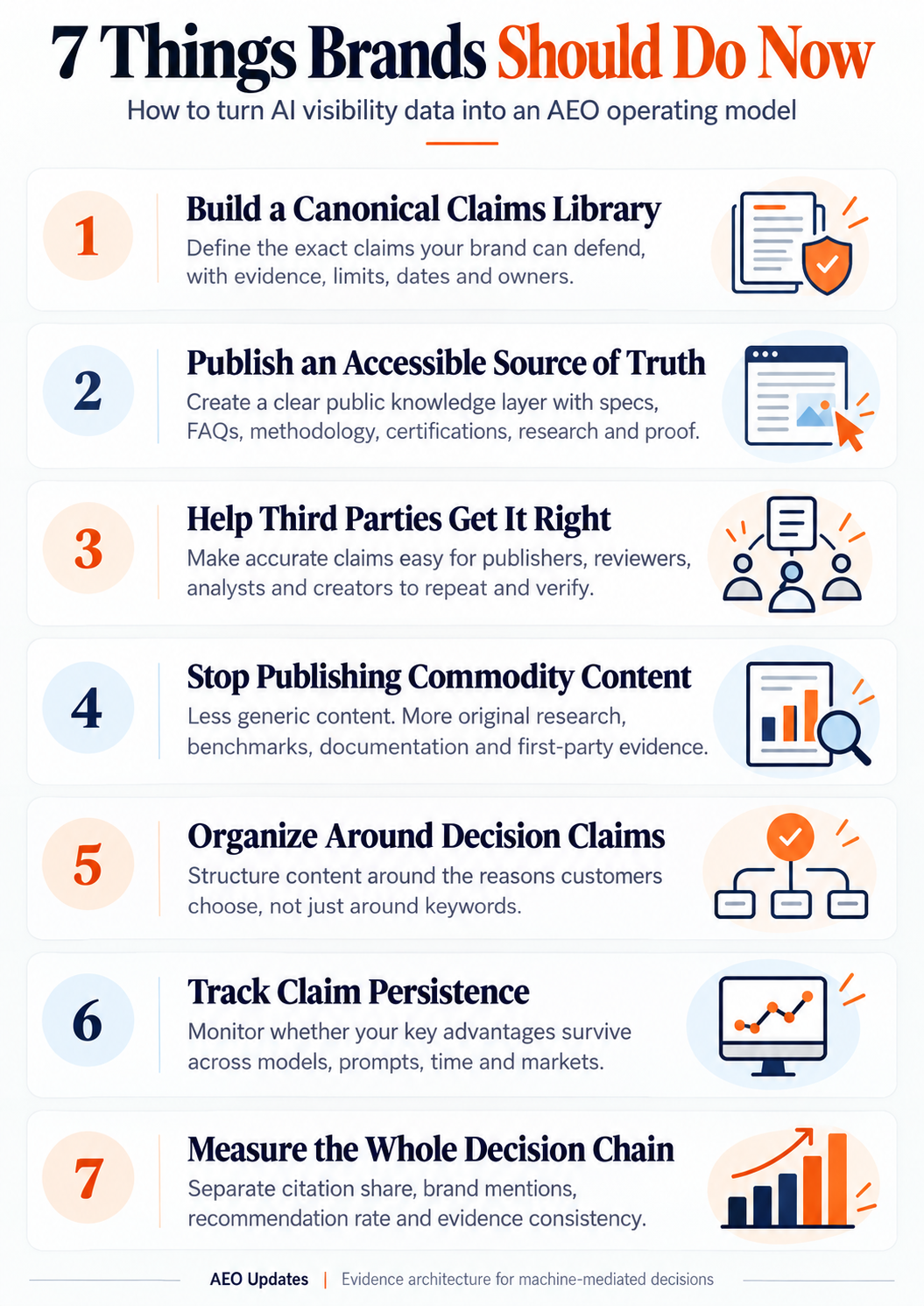
List the consequential claims a brand wants others to make about it. For each one, record the exact wording, supporting source, scope, limitations, date and responsible owner. A claim such as 'fastest setup' needs a comparison set and measurement date; an unsupported superlative is not made safer by repetition. The library should help the website, sales materials, PR and retail partners tell the same accurate story. It is an internal governance tool, not a magic file an AI engine is required to read.
Put product specifications, methods, certifications, frequently asked questions, research summaries and material caveats where a customer or independent publisher can verify them. Keep the information current and intelligible in ordinary page text. Google says there are no special optimisation requirements for inclusion in AI Overviews or AI Mode beyond its existing Search eligibility, and recommends crawlable, findable text and structured data consistent with what users see. That guidance is specific to Google Search; it does not promise inclusion on any AI platform. [2]
Independent publishers, reviewers, analysts, retailers and creators should be able to check an important claim rather than repeat a slogan. Offer the underlying specification, method or update when something changes; respect their independence and correct errors without trying to manufacture endorsements. Semrush's citation-outreach guide illustrates the practical problem of outdated product information in third-party reviews. Its workflow is advice, not evidence that outreach by itself causes more AI recommendations. [4]
NP Digital's reported 64% share for citations to ordinary pages is a warning against treating listicle formatting as a universal citation tactic. It does not mean a generic ordinary page is automatically strong evidence. Where the brand has something distinctive to contribute, invest in product documentation, reproducible benchmarks, clear research methods, useful comparisons and customer evidence with appropriate permissions. Publish material that is worth referencing even if no AI ever cites it. [1]
Start with the reasons a customer might choose one option over another: suitability for a use case, setup effort, performance, safety, price structure or a feature trade-off. Connect each important claim to a first-party source and, where available, relevant independent assessments. A page taxonomy built only around keywords may not make those decision reasons clear. This is a proposed content architecture, not a finding that any particular layout raises a recommendation rate.
NP Digital says up to 58% of citations in its data did not recur. It does not publish the observation window or repeated-prompt rules needed to turn that into a general decay rate. Teams can nevertheless track whether their priority claims survive across a fixed set of decision prompts, models, markets and time periods. Log the claim and its cited source separately from the mere presence of a URL, and record when the answer changes. [1]
Report citation share, brand-name mentions, representation accuracy, recommendation frequency and evidence consistency as distinct measures with their own denominators. If the business needs a commercial outcome, add matched human consideration and choice research, plus appropriately bounded downstream behaviour or experiments. The denominator problem does not disappear because a platform wraps unlike measures in one score. Neither a citation nor a recommendation proves a sale.
NP Digital reports stronger AI-visibility associations for YouTube than for Reddit in its sample, with LinkedIn also prominent. That is interesting, but the public article does not provide enough detail about selection, comparison baselines or controls to prescribe shifting a budget from one channel to another. YouTube may carry demonstrations and transcripts; Reddit may carry objections, comparisons and lived experience; LinkedIn may carry professional interpretation. The point is not to say the same thing everywhere. It is to make useful, verifiable evidence available in the places relevant to the buyer's actual question. [1]
The related YouTube, LinkedIn and Reddit analysis asks what different source environments contribute. The more durable lesson here is that the brand's own site should remain the reliable reference point while independent sources are free to scrutinise, challenge and corroborate its claims.
NP Digital's analysis is an argument for improving the quality of the evidence system, not proof that one content format, sentiment tactic or channel will cause better recommendations. Build a claims library, publish accessible facts, support accurate independent coverage and monitor whether important claims persist in answers to real decision questions. Then measure citations, mentions, recommendations and human choice separately.
AEO becomes an operating model when the organisation knows which claims it can defend, who maintains them and what would count as evidence that they matter. It is not a contest to accumulate the largest unqualified citation number.
[1] Nikki Lam / NP Digital, AI Visibility at Scale: Learning From 9M Prompts and 400+ Enterprise Brands, published 30 September and updated 2 October 2026.
[2] Google Search Central, AI features and your website, last updated 10 December 2025.
[3] Margarita Loktionova et al. / Semrush and Kevin Indig, Why 62% of AI citations don't lead to brand mentions, 9 June 2026.
[4] Carlos Silva / Semrush, AI citation outreach: a Semrush & Claude workflow, 21 September 2026.
This article links directly to the primary documentation, paper, filing or original reporting used for its material claims.