Primary sources cited
This article links directly to the primary documentation, paper, filing or original reporting used for its material claims.
Changing bodies, households and resources alter what “best” means. AI is becoming an intermediary in those decisions, but relevance starts with the…
A brand can become more visible while becoming less useful.
Author: Ian Ash
Published: November 7, 2026
Category: Analysis
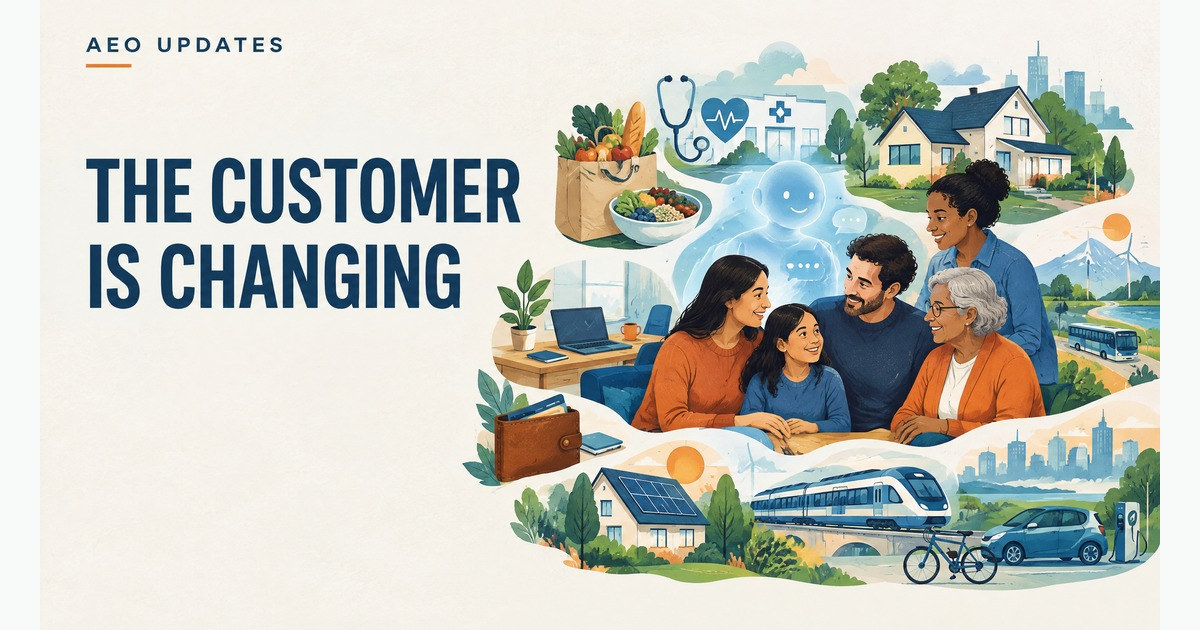
The customer is changing, not just the channel. A treatment can change a household's food purchases. Caring for an older relative can change which working hours are possible. Having a salary without a deposit can make an attractive mortgage irrelevant. These are not simply new routes to the same purchase. They change what people need, what they can afford and what a useful service must accomplish. The most important shift for brands may therefore be less about where they appear than whether their offer still fits the life of the person asking.
The preceding companions, AI search gives social science a new object of study and The macro shifts changing the questions people ask AI, explain how changing circumstances can be investigated alongside AI guidance. This article turns to the changes themselves. Eight interlocking shifts are reshaping consumer needs and category economics. AI participates as an adviser, workplace tool and potential assistant with delegated tasks; it is not the common cause of ageing, unequal wealth or unmet care.
GLP-1 medicines offer a concrete example of health innovation reaching beyond healthcare. An observational US household study estimated grocery spending 5.3% lower in the first six months after adoption, relative to a matched non-adopter comparison. Another outcome of the same study was 8.0% lower spending at fast-food chains, coffee shops and limited-service restaurants. The grocery analysis included 2,602 adopting households. These are historical household estimates, not a forecast of nationwide food-market contraction or evidence that AI advice reduced appetite. [1] [2]
The changes were selective, and grocery reductions became smaller in months seven to twelve. That matters commercially: a shift in treatment can change the pattern and timing of spending without imposing one permanent decline on every category. Spending is not the same as calories, pack weight or retailer margin. Smaller portions, flexible quantities and less waste may become more relevant propositions for some customers, but a medicine label alone does not establish demand for premium support products. [2]
Health also changes the capacity to participate in ordinary life. WHO's endometriosis account describes limited access to diagnosis and treatment, symptoms that can prevent work or school attendance, lost family income and out-of-pocket costs. [3] The wider opportunity is not simply selling another wellness item. It is making care, employment and everyday services usable for people whose symptoms constrain them. Biological innovation and unresolved health needs sit together: treatment may expand possibilities, while access determines who can benefit.
Household demand cannot be understood through a permanent picture of two parents and young children. The OECD's 2024 fertility report documents later childbearing and an unweighted average period fertility rate of 1.5 children per woman across 38 members in 2022 or the latest available year. That indicator is not a measure of desired family size or the number of children in today's households. It nevertheless describes a different demographic context for categories built around family formation. [4]
Ageing adds another dimension. The UN's 2024 projections place the global population aged 65 or older above the population under 18 by the late 2070s, although national trajectories differ. [5] Demand for independence, accessible homes and care must be considered alongside children's products and services. Smaller-household propositions can be relevant without assuming that lower fertility automatically produces smaller households everywhere. Household composition also reflects relationships, living arrangements and resources.
Care connects these shifts to employment and purchasing power. The ILO estimated that 708 million women and 40 million men aged 15 or older were outside the labour force in 2023, citing care responsibilities as the reason. [6] This is not unemployment, but it exposes the economic significance of care. For an illustrative household managing both childcare and an older relative's needs, “convenient” might mean dependable appointment times, shared access and delivery that fits care commitments. A service's usefulness can depend as much on coordination as on features.
Affordability is not exhausted by the monthly price. Income pays recurring bills; wealth can provide the deposit, security and buffer needed to enter a market. The OECD's 2025 analysis reported declining main-residence ownership among people in their 30s in 17 of 24 countries covered, comparing the mid-1990s with country-specific later observations. Those endpoints vary and are not a common 2026 snapshot. The chapter also discusses saving capacity, mortgage access and bequests or gifts. [7]
Inheritance and family assistance can therefore matter differently from wages. Two households with similar earnings can face different feasible choices if one has accumulated assets or family support and the other does not. That is an implication of the access mechanisms, not a measured matched-household result. Nor does slower inflation mean prices have returned to an earlier level. Brands that describe every constraint as price sensitivity risk overlooking the distinction between an expensive purchase and a market the customer cannot enter.
For housing and other categories with upfront requirements, “best value” may be unusable without access. Financial inclusion concerns the practical route into a service, not merely awareness of it. An AI explanation can clarify conditions or alternatives, but it cannot create a deposit or confer eligibility. The economic opportunity lies partly in offers that fit available resources and reduce avoidable entry barriers, rather than simply making an inaccessible offer more visible.
AI's consumer implications extend beyond recommendations. Work shapes income, confidence and the time available for everything else. A study published in 2025 examined customer-support agents at one business-software firm. Its smaller subset with resolution data yielded an estimated 15% increase in issues resolved per hour following a non-randomised rollout of AI assistance. Benefits varied by experience and prior performance. This is evidence of changed task economics in one setting, not a universal productivity multiplier or a forecast of job losses. [8]
Faster assisted performance also differs from acquired expertise. A classroom-randomised trial at one Turkish high school found that a GPT Base interface improved practice performance but reduced subsequent unaided exam scores by about 17% relative to the no-AI control. A teacher-informed safeguard package produced a different result, with unaided scores statistically indistinguishable from control. These were immediate mathematics assessments, not evidence of general cognitive decline or workplace deskilling. [9]
Together, the findings make the design of assistance economically consequential. AI can help people deliver work while leaving open what they can do independently. For employers, training providers and professional services, value includes both today's output and tomorrow's capability. For workers with caring responsibilities, technological assistance still sits inside a timetable and a care system. Faster tasks do not, by themselves, make employment accessible or determine whether productivity gains become higher wages, lower prices or profits.
The next shift is from explaining an option to helping carry out a task. Visa's Trusted Agent Protocol is provided to merchants and infrastructure providers to recognise and transact with Visa-approved AI agents. Cryptographic signatures verify that an agent request is authentic and unaltered; additional signatures support consumer recognition and payment information. This is infrastructure for agent-mediated commerce, not evidence of widespread consumer adoption or completed autonomous shopping. [10]
A plausible direction is bounded delegation: a customer allows an assistant to complete specified steps while retaining control over consequential decisions. That is a forecast, not an established mass behaviour. Comparing washing machines is different from choosing one, authorising payment and accepting installation arrangements. Authentication identifies a request; it does not, by itself, establish legal consent, settlement or fulfilment.
If delegation expands, the commercial distinction between a persuasive recommendation and an executable offer becomes sharper. Total price, availability, delivery, cancellation and permission to act become part of the proposition. The benefit could be less administrative work, particularly for time-constrained households. But control is also a consumer need. Assistance that makes approval, reversal or a human handover difficult may remove friction from the transaction while adding risk to the customer's life.
Innovation does not become an available option simply because it can be described. FDA safety information updated in October 2026 states that compounded GLP-1 products are not FDA-approved. It also states that retatrutide and cagrilintide are not components of FDA-approved drugs and have not been found by FDA to be safe and effective for any condition. These are specific US regulatory distinctions, not a judgement about every peptide or another country's authorisation system. [11]
Public permission and private contracts both shape provision. The FTC's January 2025 examination of three major cloud and AI-developer partnerships identified potential contractual and technical switching-cost risks for the developer partners. That historical inquiry does not establish universal lock-in or current contract terms. It does show why access to an essential supplier cannot be treated as interchangeable with access to a convenient tool. [12]
For consumers and brands, the implication is that technological possibility, lawful availability and dependable supply are different things. Cross-border sourcing adds another boundary: an imported option still has to meet the relevant market's requirements. That is a basic provision constraint, not a claim about measured tariff effects. Policy and contractual conditions help determine which offers can exist, who can provide them and how readily providers can adapt. AI can explain these boundaries; it cannot dissolve them.
Information reaches people through multiple routes. The Reuters Institute's 2026 report found weekly news use of social media and video networks at 54%, compared with 51% for news websites and apps, averaged across 48 markets. These are overlapping self-reported uses from online samples, not shares of attention or proof that creators have displaced journalism. Established news organisations also distribute through social platforms. [13]
The commercial issue is not simply that another channel needs content. Reach, credibility and suitability are distinct. A recognisable creator, a polished synthetic production and a confident AI answer can each make information easier to encounter without establishing whether a particular claim is supported. Equally, an AI-production label does not prove a claim false. Authority depends on the evidence and responsibility behind the advice, not just the format carrying it.
As decisions involve more health, eligibility and care constraints, the cost of misplaced confidence can rise. Consumers need to know who is advising them, what that advice rests on and where explanation ends and accountable professional judgement begins. Brands have a stronger proposition when clear terms and credible support accompany the message. More attention cannot compensate for advice that is unsuitable for the person's circumstances.
Digital services remain dependent on physical systems. The IEA estimates global data-centre electricity demand reached 485 TWh in 2025 and projects roughly 950 TWh in 2030 in its central Base Case. These figures cover the wider data-centre sector, not AI search alone. The projection is conditional, and the report identifies grid-connection and equipment bottlenecks. Cooling requirements also vary with climate and facility design. [14]
The important implication is not that this electricity projection measures consumer demand. It is that expanding digital capability requires provision. At household level, the same principle applies to care appointments, transport, installation and repairs: describing a service is different from having the capacity to deliver it. A cheaper or more intelligent interface does not make an unavailable appointment available.
Resilience consequently belongs inside the consumer proposition. Clear handovers, workable alternatives and dependable service matter when a digital route fails or a physical bottleneck interrupts it. The interlocking shifts sharpen that need. A person managing symptoms, care and a tight budget has less room for failed delivery or an unresolved administrative task. For that customer, reliability is not a background operational metric. It is part of what “best” means.
These shifts change the meaning of relevance. Health alters needs; households and care alter time; wealth alters access; work and delegation alter capability and control; rules, credibility and infrastructure determine which options can be trusted and obtained. AI sits between those circumstances and the offers people encounter, but it does not replace them. A brand can become more visible while becoming less useful. The stronger proposition fits changed consumer circumstances and has the real capacity to deliver. In an AI-mediated market, the answer worth appearing in is one the customer can actually use.
AI search gives social science a new object of study establishes the research perspective. The macro shifts changing the questions people ask AI applies it to changing circumstances. This companion explains the shifts reshaping consumer needs.
Sources reviewed 7 November 2026, reusing the source checks completed for the companion analysis on 6 November. Published findings retain their original populations, periods and limitations. Commercial implications are editorial interpretation, not measured market forecasts. Source review does not reproduce underlying datasets.
[1] The No-Hunger Games: How GLP-1 Medication Adoption Is Changing Consumer Food Demand
[2] The No-Hunger Games: Primary web appendix
[4] OECD: Fertility trends across the OECD: Underlying drivers and the role for policy
[5] UN DESA: World Population Prospects 2024, Ten key messages
[6] ILO: The impact of care responsibilities on women's labour force participation
[7] OECD: Demographic change, economic growth and intergenerational inequalities
[9] Generative AI without guardrails can harm learning: Evidence from high school mathematics
[10] Visa: Trusted Agent Protocol
[11] FDA's Concerns with Unapproved GLP-1 Drugs Used for Weight Loss
[12] FTC Issues Staff Report on AI Partnerships & Investments Study
This article links directly to the primary documentation, paper, filing or original reporting used for its material claims.