Primary sources cited
This article links directly to the primary documentation, paper, filing or original reporting used for its material claims.
Walmart needs to capture whole shopping missions, Loblaw must defend repeat baskets and loyalty, and Dollarama needs its local value to be verifiable.
The best AI shopping strategy is not the most elaborate assistant; it is the one that wins a commercially valuable shopping mission.
Author: Ian Ash
Published: November 16, 2026
Category: Analysis
A parent planning a birthday party can ask an AI assistant for snacks, decorations and tableware within a fixed budget without naming a shop. That creates a practical question for Walmart, Loblaw and Dollarama: which parts of the mission should each retailer try to win? Walmart's announced shopping tools point towards assembling more of the basket. Loblaw's integrations raise questions about repeat grocery purchases, own brands and loyalty. Dollarama's third-party channels suggest a different priority: making local value easy to discover and verify. These are three commercial tests, not a league table of technological sophistication. [4][7][9][17][22]
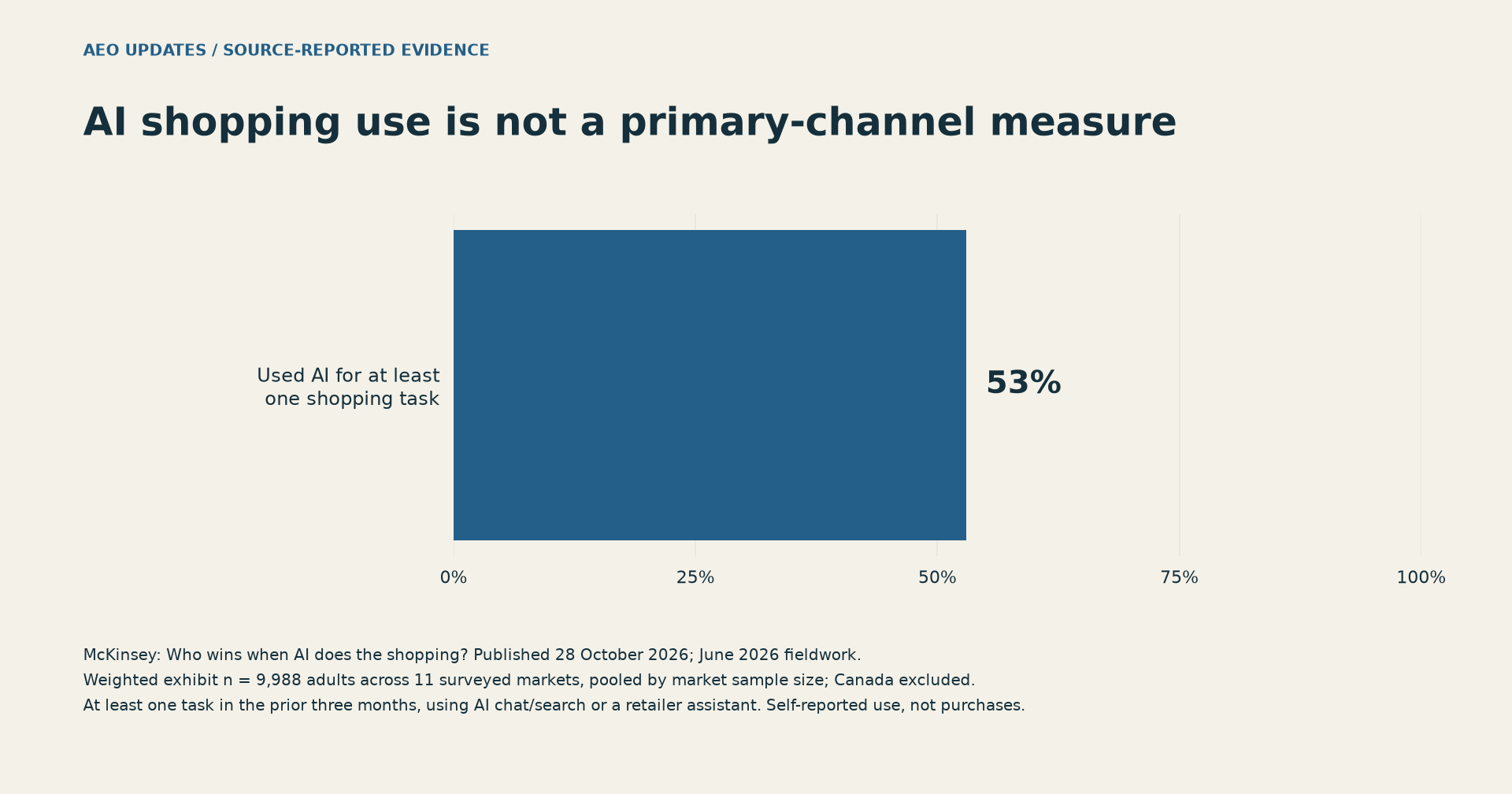
McKinsey's October 28 report provides a useful starting point. Its June 2026 survey covered approximately 21,000 consumers across 11 markets, excluding Canada. The report says 53% had used AI for at least one shopping task in the preceding three months, including AI chat or search tools and retailer assistants. The relevant exhibit covers adults aged 18 and above, with weighted n = 9,988 and markets pooled in proportion to sample size. It does not say AI was their primary shopping channel, nor establish a world-population-weighted adoption rate. [3]
Adobe supplies a different signal: visits to US retail websites. Its June 17 publication reports May 2026 AI-referred traffic growth of 138% year over year, a conversion rate 54% higher than non-AI traffic and an engagement rate 15% higher. The last two figures are relative rate advantages, not percentage-point increases. Adobe's companion report also uses visit-share wording in its charts; the published material does not provide the raw counts needed to reconcile that wording with the traffic-growth prose. These are not counts of unique shoppers. [1][2]
The conversion comparison is observational, not proof that AI caused incremental purchases. Higher-intent shoppers could be overrepresented in the referral cohort. For retail strategy, the distinction is decisive: helping research, influencing a shortlist, preparing a cart, authorising payment and completing an unattended transaction are separate outcomes. Answer engine optimisation, or AEO, concerns whether AI answers can find and accurately represent a retailer's relevant information. AI share of voice measures its presence in monitored answers. Neither measure alone establishes that the retailer gained a customer or a profitable basket. [1][2][22]
Walmart Canada announced Sparky's national availability on Walmart.ca and its app on October 29, in English and French. Its release describes conversational product discovery, comparisons, review summaries and shopping lists. Image-based shopping, recipe inspiration and everyday-essentials help were explicitly planned, without launch dates. The following day's US announcement described additional capabilities, including photographed lists converted to carts, recipes with cart-ready ingredients and Shop to Light navigation using store maps and flashing shelf labels. Those US claims do not establish Canadian feature parity; voice was expected chainwide by year-end, not confirmed as already deployed. [4][5]
The commercial hypothesis is that an assistant can help Walmart win a larger share of a mixed shopping mission. A birthday-party request might combine food and non-food requirements, while a dinner plan might lead to additional household purchases. Walmart should test whether assistance adds a genuinely useful category or consolidates purchases that otherwise would go elsewhere. A faster route through an existing basket is a different benefit. This makes incremental basket contribution, fulfilment success and repeat purchase more informative objectives than conversation totals or cart-building activity. The announcements do not report those incremental outcomes. [4][5][22]
Walmart is also preparing for customers who start outside its own interface. Reuters reported its external-agent initiative on October 21, while Walmart's official announcement set Agent Profiles for launch the following month. Completion by November 16 is not established. The Agent Gateway landing page describes an invitation-only early beta, not general availability. Walmart says approval is required by default, customers can set spending controls, and agents receive no payment-card information and cannot add or change payment methods. The strategic choice is therefore not simply autonomy versus resistance: it is how to admit authorised outside agents while preserving customer control and a workable checkout relationship. [6][7][8][22]
Loblaw said it launched the PC Express app in ChatGPT for Canadians on February 12. The issuer release describes menu exploration, ingredient curation and selection of suggested products from a local store. Its promotional demonstrations support a user-selected recipe-to-cart workflow and a handoff to retailer checkout, rather than an unattended transaction or proven payment completed entirely inside ChatGPT. The demonstrations do not show a final purchase confirmation. This is an important distinction for grocery: a suggested meal, a selected basket and a successfully fulfilled order should not be treated as interchangeable achievements. [9]
Its Google route has a separate chronology and product scope. On February 19, Loblaw announced that health, beauty and apparel shopping through AI Mode and Gemini would be available soon. Google subsequently reported a Canadian checkout rollout beginning on November 4, explicitly including Shoppers Drug Mart among eligible retailers. That supports a rollout start, not nationwide completion or coverage of every Loblaw banner, product and account. The February release also described accelerating a continuing transformation into an AI-native enterprise through further Vertex AI use. It did not declare that corporate transformation complete. [10][11]
Loblaw's own-brand portfolio and PC Optimum programme make the commercial question more specific than whether a chat interface attracts attention. Its corporate material identifies President's Choice and no name alongside grocery and pharmacy operations, and describes rewards tailored to purchasing. A useful test would ask whether meal planning retains an existing customer's next basket, changes national-brand versus own-brand selection, or encourages consolidation across missions. A competing hypothesis is that independent assistants make cross-retailer comparisons easier. None of the reviewed integrations establishes access to private loyalty or pharmacy records, so any proposed personalisation must depend on explicit permissions and an actually documented integration. [12][22]
Loblaw's August 5 agreement with Criteo illustrates an existing commercial asset, not an AI-adoption result. The announcement reported more than 18 million active PC Optimum members, 2,500 store locations and approximately 25 million opted-in emails deployed each week. Those are announcement-era company counts: members are not AI users, and weekly email deployments are not unique reach or purchases. The agreement made Criteo a preferred demand partner and direct sales agent for email display placements across Shoppers Drug Mart, PC Optimum and PC Express newsletters. It does not establish sponsored AI answers or independent AI product recommendations. [14]
The tension is structural. A retailer may want an assistant to make relevant recommendations, reinforce loyalty and preserve advertising income, while a shopper wants suitable products at a defensible total cost. If an answer narrows the choice to a few items, the commercial meaning of inclusion becomes more important. National brands should ask whether they are competing on suitability, sponsorship, retailer margin or a mixture of those factors. Retailers should disclose commercial placements separately from relevance-based advice and test whether that distinction affects trust and basket selection. These are editorial recommendations, not findings that any named assistant currently biases its answers. [22]
BCG's October 21 article, modified October 26, reported that 95% of surveyed retailers saw retail media as a major source of future profit growth. That is an expectation, not measured current profitability. It helps explain why external discovery and retailer-controlled interfaces can create competing incentives. Loyalty could become stronger if useful assistance reduces shopping effort, or weaker if multi-retailer advice exposes a cheaper basket. Measuring retention, switching and net basket contribution would distinguish those possibilities; repeating a loyalty-membership count would not. [21][22]
Dollarama should not be assessed as a failed version of Walmart's assistant strategy. Its official, undated online-shopping FAQ says customers can buy units through Skip, Instacart, Uber Eats and DoorDash. Most stores, it says, participate in two or more platforms, with regional availability varying. Its adjoining product FAQ says bulk or full-case purchasing is no longer offered and that store capacity and availability create slight selection differences. These pages were retrieved on November 16; neither the transition date nor partner-launch dates are established. Case-only ecommerce is not the current model described by those sources. [17][18]
The business also has substantial operating scale. For the 52-week fiscal year ended February 1, 2026, Dollarama reported C$6.80 billion in Canadian-segment sales, versus C$7.26 billion consolidated, including Australia. The Canadian segment includes certain Dollarcity sourcing sales, so its total is not exclusively purchases by Canadian consumers. Full-year Canadian comparable-store sales rose 4.2%, and the year closed with 1,691 Canadian stores. These historical issuer results are not a November trading update and do not measure AI-driven market-share loss, or prove its absence. [15][16]
For a value mission such as inexpensive party supplies, the proposed opportunity is an AI recommendation that leads to a store visit or a viable partner basket. A tighter request for matching items, specified quantities and collection before a deadline requires verifiable local information. The hypothesis is an AI-verifiability gap: a retailer may satisfy a need in reality but lack information an assistant can confidently check. The FAQs do not quantify such a gap for Dollarama. Accurate locations, category descriptions and feasible partner feeds could be a better initial investment than a proprietary assistant, but that choice should be tested against incremental trips, fulfilled purchases and margin after delivery or service costs. [17][18][22]
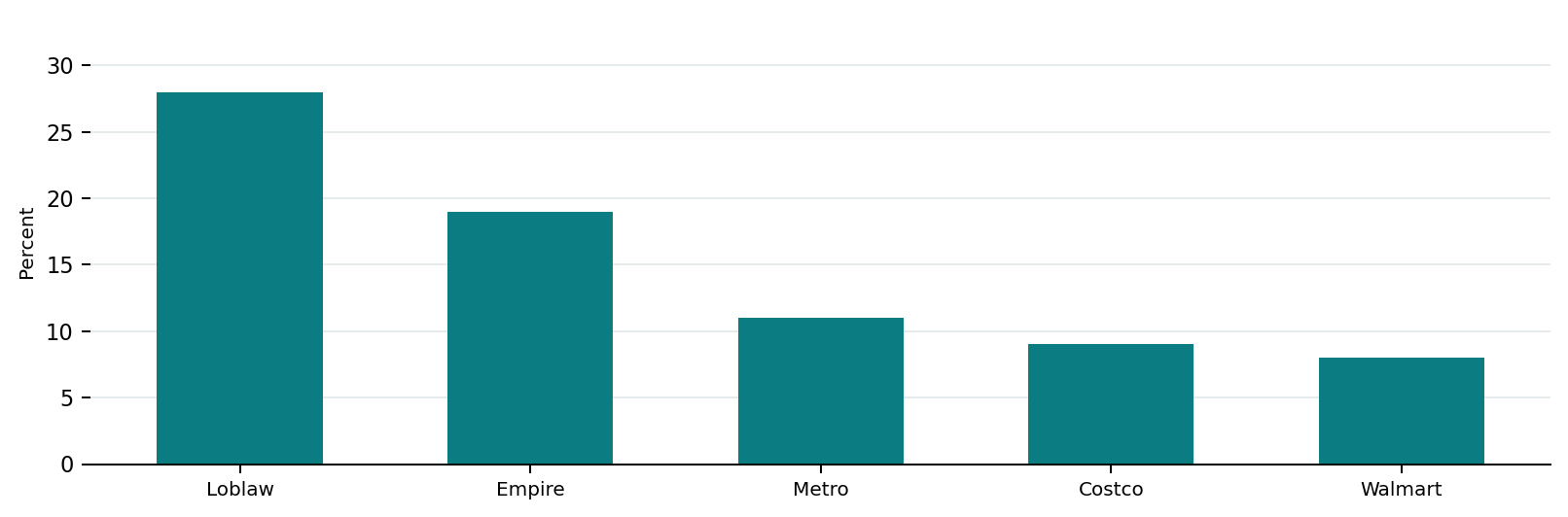
A June 11, 2026 Agriculture and Agri-Food Canada strategy reproduced USDA estimates for Canadian grocery retail sales in 2023: Loblaw 28%, Empire/Sobeys 19%, Metro 11%, Costco 9% and Walmart 8%. The chart and Canadian restatement put those five at about 75% combined. These are historical structural estimates, not a current November 2026 ranking or evidence of changes caused by AI. The underlying chart's exact numerical denominator and company food-only numerators are not disclosed. Dollarama's broad merchandise revenue cannot be inserted into the same comparison as a like-for-like grocery share. [13]
Canadian consumer evidence adds another boundary. Ipsos's October 8 publication draws on July 2026 Omnibus research among 2,000 Canadians aged 18 to 59. It reports 44% had used AI for a shopping-related task in the previous six months, mostly research. In its grocery-assistant context, 61% would try an AI-suggested brand and 26% would let AI make the final purchase decision. It also reports 90% willingness to try a brand recommended by a trusted person, with that comparison's separate wave and item base unclear. Final purchase decision is not payment authorisation; willingness is not observed behaviour. [19][20]
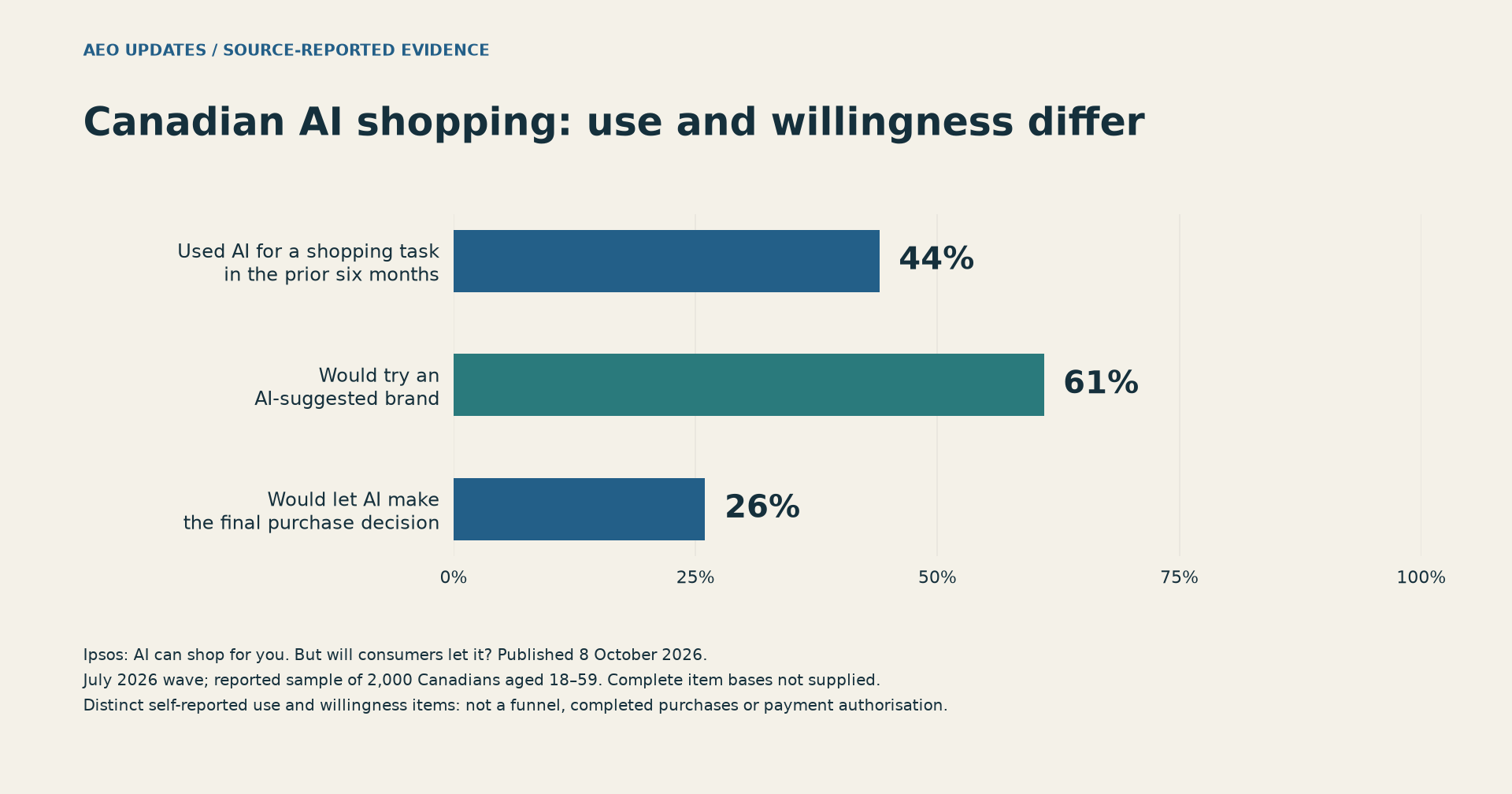
These results justify measuring consideration separately from delegation. They cannot be assembled into a shopping funnel or projected onto Canadians aged 60 and above. Nor can Ipsos's six-month task measure be subtracted from McKinsey's three-month measure to estimate a Canadian adoption gap: populations, markets and questions differ. Concentration makes retailer choice worth studying, but the commercial effect of an assistant remains a question for linked Canadian evidence, not an inference from foreign referrals and historical shares. [3][13][19][20][22]
Retailer selection and product selection are related but different contests. An assistant asked for affordable family dinners might shortlist a grocer and then suggest products from its assortment. A national brand could remain well known yet lose inclusion in that particular basket if a suitable own-brand alternative better meets the stated budget. Equally, explicit requirements for taste, ingredients or an established favourite could favour a national brand. Loblaw's President's Choice and no name assets make this a relevant test, but their existence does not prove systematic preferential treatment by its connected assistants. [12][22]
A brand audit should therefore compare suitable alternatives rather than count mentions indiscriminately. It should hold the mission, price, pack size and availability as constant as possible, record restrictions and distinguish shopper preferences from retailer-assortment effects. For Walmart and Loblaw, proposed own-brand recommendation share should mean own brands among qualifying product recommendations. For Dollarama, the more immediate question may be whether a category mission produces a credible local retailer choice. These denominators answer different commercial questions and should not collapse into one visibility score. [22]
BCG's 2026 research surveyed 50 leading retailers and 100 leading brands, alongside interviews. Among surveyed retailers, 42% structured product data for any agent to discover and retrieve, 32% gave selected agents access through direct feeds, 20% were undecided and 6% blocked access. These are product-data policies, not permission for unrestricted customer-record access or automatic checkout. Publication in October does not establish October fieldwork, and item-specific bases and weighting are not fully disclosed. The sample should not be presented as an industry census. [21]
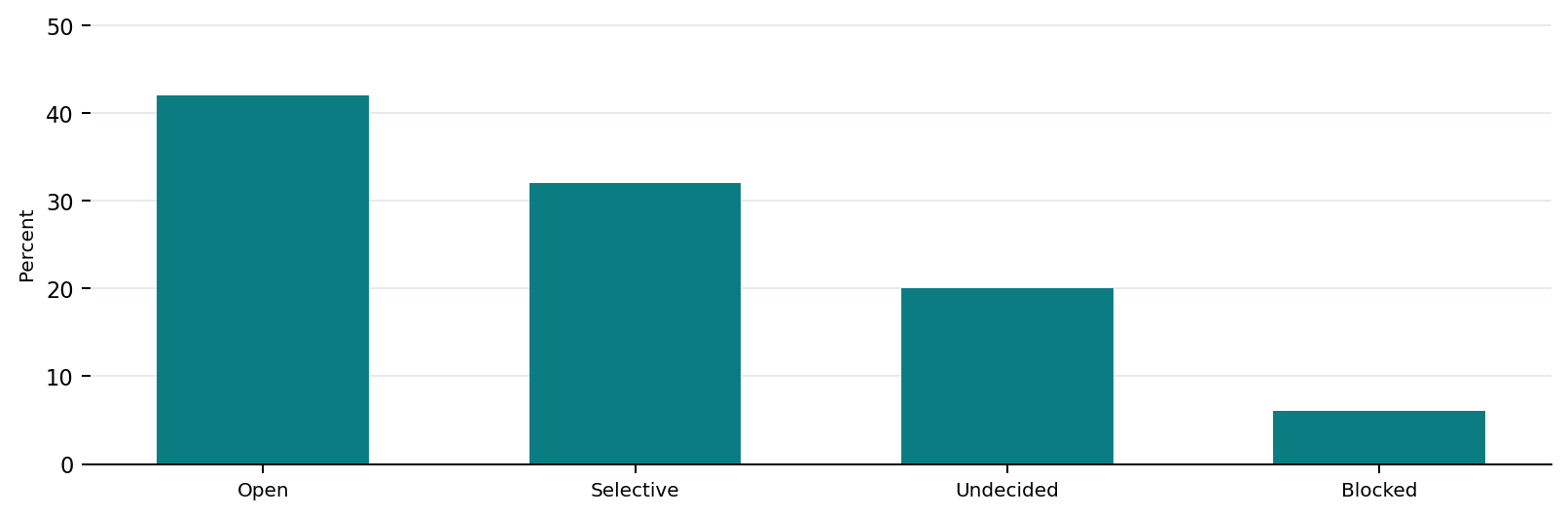
The practical trade-off is where to be discoverable and where to retain control. Walmart's Gateway strategy anticipates authorised external demand; Loblaw's integrations connect particular channels and assortments; Dollarama's partner model raises local catalogue and fulfilment questions. Open information could help outside assistants recognise a retailer's suitability, while connected commerce may preserve checkout, loyalty and media relationships. The right balance depends on the mission's economics and customer permissions. Product access, personal-data access and purchase authority should be governed separately, rather than treated as one decision to be open or closed. [7][8][9][11][17][21][22]
AEO Updates proposes Retailer Choice Intelligence as a research framework linking human retailer preference, machine recommendations and observed outcomes. It is not an existing validated standard, a proven predictive score or a study already completed. A recommendation audit could measure how often a retailer enters a qualifying shortlist, appears first, and covers particular missions. It should also assess product, price and local-availability accuracy, then record cart handoff and fulfilment separately. Recommendation frequency is useful diagnostic evidence; it is not itself revenue. [22]
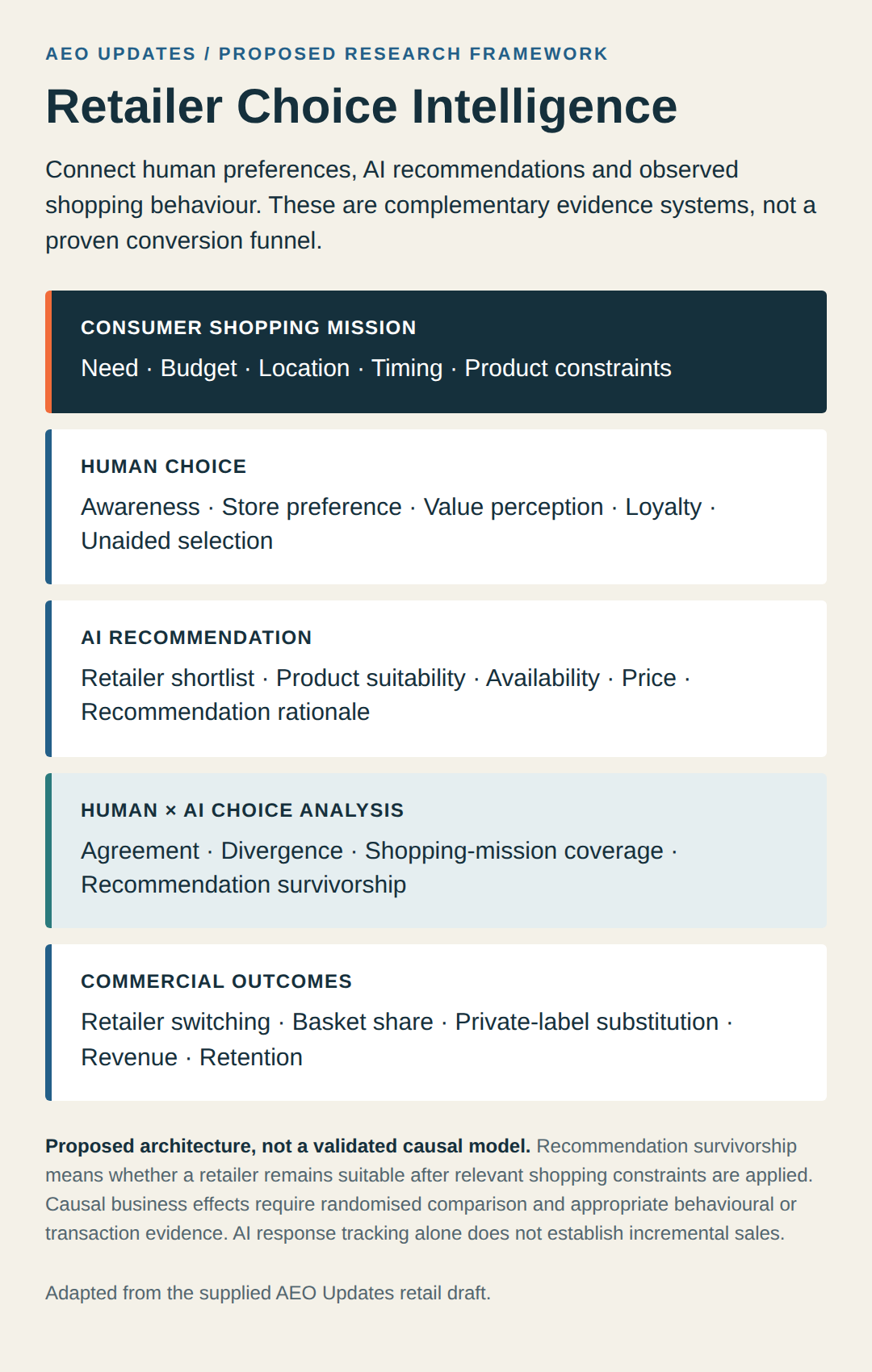
Human research would establish unaided retailer preference, considered alternatives, perceived value, trust, convenience and expected availability for the same missions. Comparing those responses with assistant shortlists could reveal alignment or divergence. A retailer with strong human preference but weak AI inclusion faces a different problem from one frequently recommended but rarely selected. Commercial measurement should then examine actual switching, basket composition, own-brand substitution, spend, repeat purchase and contribution after costs. Any claim of incremental change requires an appropriate comparison, not a before-and-after mention count. [22]
The proposed framework should preserve distinct denominators and avoid a composite score until sampling, weights, reliability and external validation are disclosed. It would also distinguish organic recommendations, retailer-owned assistance and paid placements, recording whether each response cites a source or merely names a retailer. That matters because an accurate citation supports provenance, while the eventual shopping choice depends on suitability, price and fulfilment. The proposed framework connects questions to investigate; it does not assert a measured causal path between the existing studies. [22]
The starting point should be concrete missions: weekly groceries under C$150, a birthday party, household cleaning essentials, family health and beauty, school supplies under C$75, or seasonal decorations. Relevant competitors would vary by mission, rather than forcing Walmart, Loblaw and Dollarama into every comparison. A hypothetical baseline could run 100 prompts across five AI systems daily for 30 days: 100 × 5 × 30 = 15,000 prompt executions per market. That is a proposed machine workload, not 15,000 people or independent observations. Prompt weights, category denominators, location, language, budget, timing, model version and account context should be logged, with repeated-output dependence reflected in analysis. [22]
A separate human sample would answer the same mission questions before exposure to recommendations. Participants could then be randomised among unaided selection, independent multi-retailer AI assistance, and retailer-connected assistance with a restricted assortment. Assignment should preserve comparable task constraints and record eligible products and retailers. Where feasible, a matched restriction comparison would help separate the effect of AI advice from the effect of narrowing the catalogue. Actual or incentive-compatible choices, followed by consented purchase and fulfilment evidence, could measure retailer selection, switching, basket mix, own-brand substitution, spend and confidence. The design would need its own sample-size and power assessment; the machine execution count supplies neither. [22]
Machine tracking should continue, while human surveys and actual outcomes are periodically refreshed as integrations, catalogues and fulfilment change. Walmart's test would focus on incremental whole-mission basket contribution. Loblaw's would examine repeat baskets, loyalty and product substitution. Dollarama's would examine incremental local trips and completed value purchases, including whether planned lists alter spontaneous additions. Researchers could then test whether recommendation movements anticipate later choice, without assuming they do. A defensible causal conclusion would require suitable randomisation or another credible identification design, disclosed attrition and appropriate uncertainty, not attribution of existing sales growth to an assistant announcement. [22]
The best AI shopping strategy is not the most elaborate assistant; it is the one that wins a commercially valuable shopping mission. Walmart should test whether its owned and external-agent routes capture useful additional basket value. Loblaw should test whether connected discovery strengthens repeat purchases without obscuring the interests of shoppers, own brands and retail-media advertisers. Dollarama should test whether accurate local information and partner channels turn value-seeking recommendations into profitable purchases. These are editorial priorities derived from distinct retail models, not established winners or evidence that AI has already redistributed Canadian sales. [22]
For AEO practitioners, the next step is to identify the missions each retailer can credibly fulfil, make the supporting information accurate and retrievable, and connect answer monitoring to human preference and actual outcomes. An assistant mention can reveal discoverability; a verified purchase can reveal commerce. The strategic advantage lies in understanding the distance between them, and whether closing it improves the economics of the retailer and the experience of the shopper. [22]
Sources were reviewed as of November 16, 2026. Verification confirms published wording, dates and disclosed methods, not independent empirical reproduction of Adobe analytics, surveys, issuer metrics or historical market-share estimates. Underlying datasets, full survey questionnaires and transaction logs were not accessed; retailer capability announcements and promotional demonstrations were not independently tested. Same-publisher companion documents are not independent replications. The sources have different populations, periods and units and were not statistically pooled or treated as a single funnel. Retailer Choice Intelligence and the Canadian study design are editorial proposals, not completed research or a validated industry standard. Source-specific limits accompany material claims and exhibit captions.
[2] Q3 AI Traffic Trends Report: Adobe Digital Insights June 2026
[3] Who wins when AI does the shopping? New evidence on agentic commerce
[4] Meet Sparky: Walmart Canada’s New AI-Powered Shopping Assistant
[5] Sparky Makes Holiday Magic Real
[6] Walmart launches tools for AI agents to shop for customers
[9] Loblaw advances AI in Canadian retail with first-of-its-kind shopping app in ChatGPT
[12] What we do: Helping Canadians Live Life Well
[13] National Food Security Strategy
[14] Criteo and Loblaw Advance™ Partner to Expand Advertiser Access to Premium Retail Media Network
[15] Dollarama reports fourth quarter and fiscal year 2026 results
[16] Annual Information Form for the fiscal year ended February 1, 2026
[18] Product Availability & Lottery
[19] AI can shop for you. But will consumers let it?
[20] AI can shop for you. But will consumers let it?: October 2026 research paper
[21] How Retailers Can Reinvent the Digital Flywheel for Agentic Commerce
[22] Retailer Choice Intelligence: editorial methodology and proposed Canadian study
This article links directly to the primary documentation, paper, filing or original reporting used for its material claims.