Primary sources cited
This article links directly to the primary documentation, paper, filing or original reporting used for its material claims.
Surveys show AI entering mortgage research. The next question is whether easier comparisons change renewal decisions, not whether assistants replace…
The first mortgage opinion may come from AI, even when a broker, adviser and lender remain essential to the decision.
Author: Ian Ash
Published: October 22, 2026
Category: Analysis

A borrower can form a view of a mortgage before speaking to a broker or lender. An AI assistant can explain repayment options, frame a comparison and suggest questions about an existing offer. Canadian and U.S. surveys show reported AI use at this information stage, making the quality of that first opinion a competitive issue for mortgage teams. The evidence does not show that assistants are replacing licensed brokers or causing borrowers to switch lenders. The more immediate challenge is whether a lender's products are represented accurately when customers begin deciding what to consider.
The longer-term exposure may extend beyond new applications. If assistants make it easier for existing borrowers to scrutinise a renewal offer, they could reduce the effort needed to investigate alternatives. That is a loyalty hypothesis worth testing, not an observed mortgage-switching effect. It extends the distinction between AI-shaped comparisons and customer-authorised financial action explored in AEO Updates' recent banking analysis.
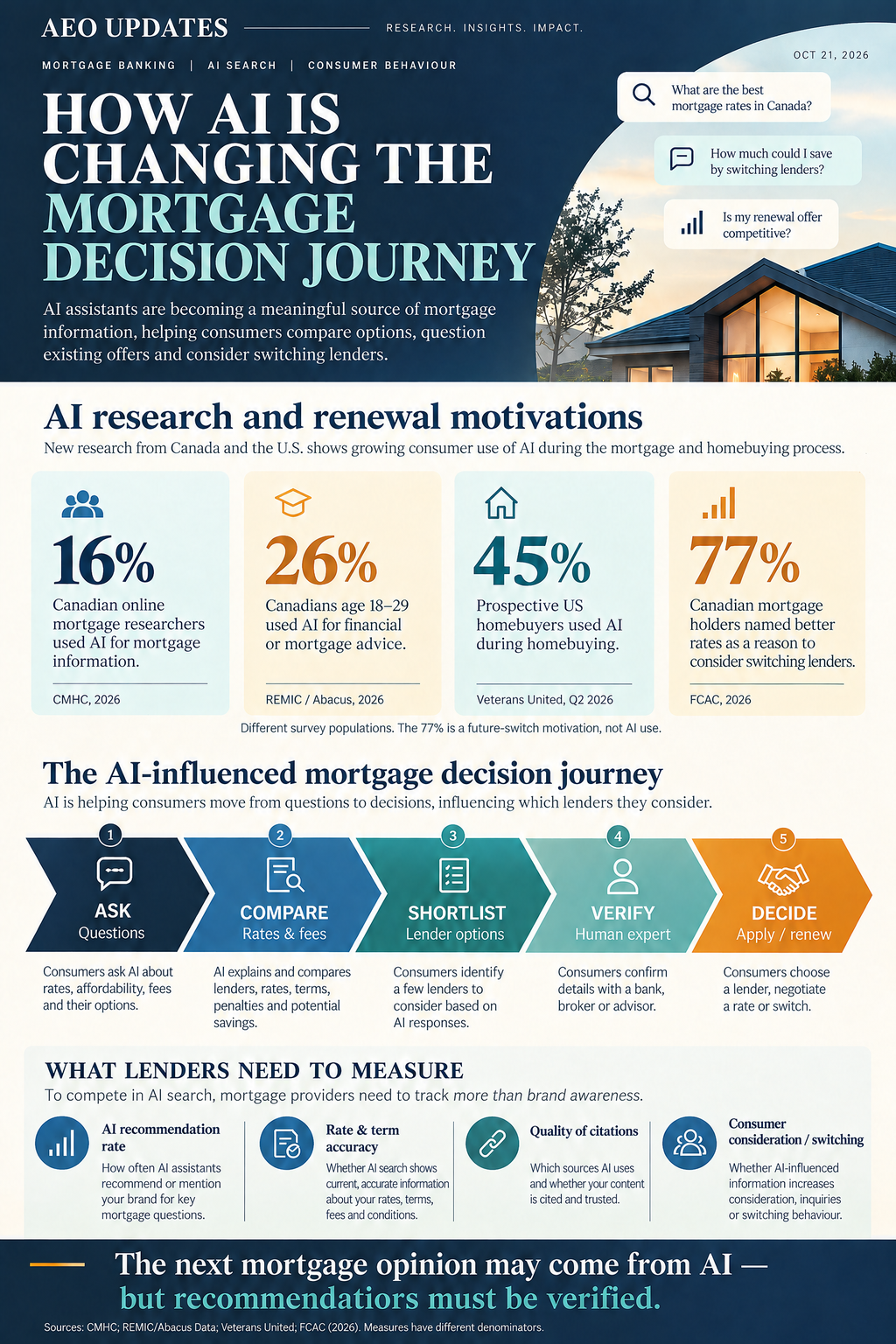
Canada Mortgage and Housing Corporation's 2026 Mortgage Consumer Survey reports that 16% of mortgage consumers who searched online used AI to obtain mortgage-related information. In the same online-searching population, 33% used interest-rate comparison websites, 32% mortgage-broker websites or services and 31% lender websites or services. These are reported uses of information sources, not exclusive channel shares or percentages of all mortgage consumers. CMHC surveyed 4,112 mortgage consumers from January 7 to February 1, 2026; respondents were household decision-makers who had undertaken a mortgage transaction in the previous 18 months. This was its first year asking about AI research, so the result does not establish a Canadian year-on-year trend. [1] [8]
A REMIC-commissioned Abacus Data survey provides a different view. It reports that 26% of Canadians aged 18–29 used AI tools for financial or mortgage advice in the past year, compared with 17% who used a licensed mortgage broker or financial advisor. The survey covered 1,910 Canadian adults through an online panel, fielded May 28 to June 2, 2026, and released on July 20. Its age-subgroup base is not disclosed in the reviewed release. Financial and mortgage advice are combined, and the channels need not be mutually exclusive. The comparison does not show that young borrowers replaced a broker with AI. [2]
Veterans United reports that 45% of prospective homebuyers used AI during their home search or homebuying process, compared with 37% in Q2 2025. Its commissioned Sparketing online surveys had 859 respondents in Q2 2026 and 900 in Q2 2025. The 2026 fieldwork ran June 1–17, rather than on the page's July 2 update date. The published page does not disclose the exact prospective-buyer subgroup counts or fully reconcile the headline with a separate AI-platform-use measure. Its examples include estimating monthly mortgage payments, shopping for the best interest rate and comparing mortgage-lender reviews. These are reported research activities, not evidence of completed lending or switching. [3]
Zillow's October 14 buyer report uses another conditional base: among buyers who use AI in general, 61% used it for homebuying. Among buyers who used AI while shopping for their home, 74% used it to learn about the buying process and 65% to answer personalised questions about the transaction. Zillow's broader 2026 research was fielded March–July through online opt-in panels, with weighting to demographic and housing benchmarks. Its more than 144,000 responses span several housing audiences and modules; that total must not be presented as the denominator for these buyer-AI figures. The reviewed methodology does not publish the exact AI-module cell counts. [4] [9]
Together, the surveys support AI's presence in information seeking across different audiences. They do not yield a pooled mortgage-AI adoption rate. Canadian mortgage consumers, younger Canadians seeking broad financial advice, prospective U.S. buyers and successful buyers who already use AI are different populations answering different questions.
A homeowner approaching renewal could ask an assistant to explain a quoted rate, estimate illustrative savings, identify costs of switching or prepare questions about prepayments and portability. This is a possible comparison workflow, not a claim that an assistant can determine a personalised offer, approve credit or execute a lender switch. Borrowers still need verified current terms and appropriate professional advice.
Financial Consumer Agency of Canada research shows why investigating comparison behaviour may be useful. Its mortgage-holder data story reports that 37% chose their lender primarily because they already banked there, 20% had not compared lenders at all when shopping for their current mortgage, and 13% did not know negotiation of rates or terms was an option. The page draws on research interviews and a weighted survey of mortgage holders in its Monthly Financial Well-being Monitor, but does not disclose the exact mortgage-holder bases or fieldwork for these results. Existing bank affiliation is a reported reason for lender choice, not proof of renewal inertia. [5]
Asked what would motivate a future lender switch, 77% selected better interest rates, 21% better product terms, 18% perks or offers and 13% better service. These are multiple-response, hypothetical motivations, not observed switching and not AI-use figures. AI could lower the effort required to examine an alternative, but none of these sources establishes that it actually increased mortgage switching. A useful next study would follow the same borrowers from research through lender comparison, advice, application and renewal outcome. [5]
Contextual questions may expose different product trade-offs from a generic rate search. A borrower who might sell within three years and values flexible prepayments needs more than the lowest advertised five-year rate. Mortgage teams should test whether assistants preserve the relevant conditions when they summarise lenders or suggest a shortlist, rather than assuming a citation indicates a recommendation.
In a September 2 HousingWire commentary, mortgage broker Morgan Hardy described asking seven AI platforms essentially the same question about a debt service coverage ratio, or DSCR, loan in Knoxville, Tennessee. He reported that his own business appeared in none of the recommendations. He also described city- and product-targeted pages among surfaced businesses, while noting that many did not appear to have a Knoxville connection. This was one practitioner's informal exercise in one product and market; platform names, run dates and complete outputs were not disclosed. It illustrates a question about retrieval and suitability, not a general AEO benchmark or proof that particular pages caused recommendations. [6]
Lower reports a Pollfish survey of 1,000 U.S. consumers, fielded September 9 and published September 16, 2026. It found 76.8% comfortable with AI comparing mortgage rates and options, 71.8% comfortable with it recommending a mortgage type and 49.2% comfortable with AI approving or denying an application. These weighted responses concern comfort with possible tasks, not actual use, permission, accuracy or evidence that AI made lending decisions. [7]
When respondents considered an unexpected issue that could delay or prevent closing, 54.4% selected a human loan officer and 28.4% a human officer working with AI. Lower combines these into 82.8% choosing an option involving a human. The finding supports keeping human escalation distinct from research assistance. It does not establish that trust is growing faster than reliability: the survey measures neither a longitudinal trust trend nor the factual quality of AI advice. [7]
Monitor defined first-time-buyer, renewal, refinancing, switching and prepayment questions in relevant markets. Record appearing lenders, recommendation prominence and stated reasons for selection. Use eligible monitored answers as the denominator, preserving model, prompt, geography and collection date. A citation, a mention and a recommendation should remain separate measures; none is a person or funded mortgage.
Check advertised versus personalised rates, promotional versus ongoing terms, qualification conditions, fees, prepayment rules and penalties. Record what the assistant actually says and the source it cites where available. Review calculations against disclosed assumptions and appropriate lender documentation. Publishing a clear explanation does not guarantee retrieval, a citation or a correct answer.
Publish dated product explanations, complete eligibility conditions, worked examples with assumptions and accessible source documents. Describe geography, product expertise and credentials accurately. Improve factual comparability rather than engineering favourable claims. An answer should help a borrower understand why a mortgage could fit, and where verification or professional advice remains necessary.
Pair AI-output monitoring with consumer research in the same decision context. Test whether clearer information, fee assistance, a proactive renewal review or service commitments change understanding, trust, consideration and stated choice. Human–machine gaps can be useful diagnostics when populations and questions are defined carefully; a recommendation percentage must not be subtracted from a consumer-preference percentage. Controlled experiments can test specific interventions, while parallel movements alone do not establish causation.
Keep research use, broker engagement, lender comparison, qualified enquiries, applications, funded loans and renewal outcomes distinct. Where lawful and feasible, follow these stages with consent and explicit denominators. Do not label an increase in citations as additional mortgage business. Separate a change in AI representation from product pricing, eligibility, borrower circumstances and other factors affecting outcomes.
The companion infographic illustrates a possible decision journey, not a mandatory sequence. Its separate research and switching-motivation findings have different populations. In particular, the 77% FCAC card is not AI adoption. Human verification does not guarantee correctness, and the final decision still depends on verified terms, eligibility and the applicable advice and lending process.
A future permissioned assistant connected to financial-management tools might flag an approaching renewal and suggest investigating alternatives. Access to appropriate data, privacy, accurate calculations, eligibility, regulation and customer authority would still matter. This article does not identify a deployed mass-market product that completes that workflow, or a measured effect on lender retention. The scenario connects with earlier AEO Updates analysis of proactive bill review, not a forecast of automatic mortgage switching.
For mortgage teams, the strategic question is therefore broader than acquiring the next applicant. What happens when an existing borrower arrives at a renewal conversation with an AI-generated comparison already in mind? That is a question for evidence-led monitoring and research, not a reason to assume either permanent loyalty or inevitable displacement.
The first mortgage opinion may come from AI, even when a broker, adviser and lender remain essential to the decision. Mortgage teams should make their offers understandable and comparable, test eligible AI recommendations for material inaccuracies, and connect those observations to matched consumer research and separate commercial outcomes. The evidence supports preparing for an additional source of borrower information. It does not yet prove broker replacement, autonomous approval or AI-caused lender switching.
[1] 2026 Mortgage Consumer Survey
[2] More young Canadians now use AI than licensed brokers for financial advice
[3] AI and homebuying survey: Q2 2026
[4] Buyers: Consumer Housing Trends Report 2026
[5] Mortgage Renewal Decisions
[6] Mortgage AEO is still SEO: Morgan Hardy commentary
[7] Nearly half of Americans are comfortable with AI approving or denying their mortgage
[8] 2026 Mortgage Consumer Survey: official report and methodology
This article links directly to the primary documentation, paper, filing or original reporting used for its material claims.