Primary sources cited
This article links directly to the primary documentation, paper, filing or original reporting used for its material claims.
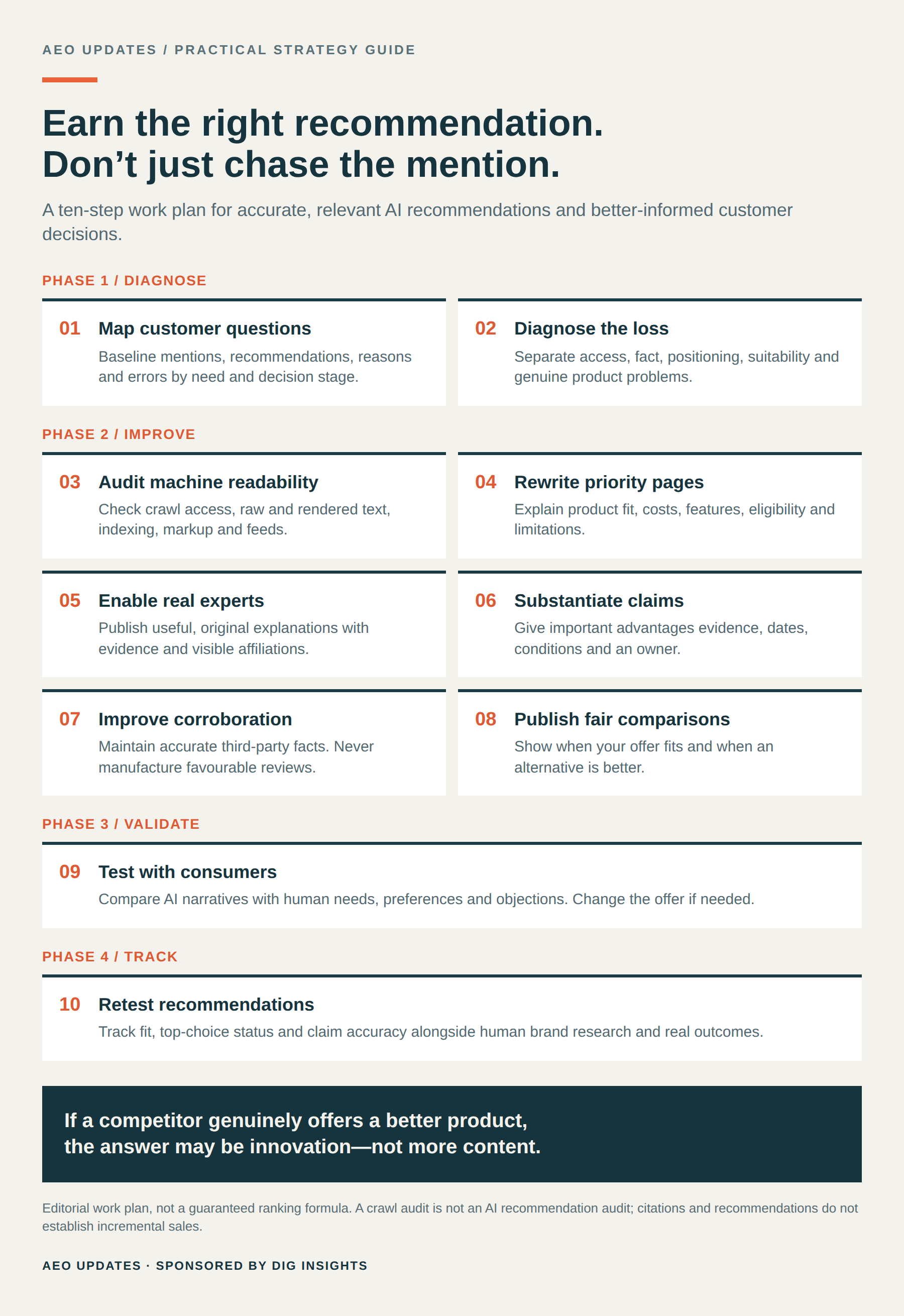
Diagnose what AI says. Make product information machine-readable. Activate experts and evidence.
The strongest practical addition is recognising that not every recommendation problem is a content problem.
Author: Ian Ash
Published: November 18, 2026
Category: Strategy
A consumer asks ChatGPT which SUV suits a family. A homeowner asks Google AI Mode which mortgage renewal options are worth considering. A shopper asks Perplexity which skincare product might fit a particular need. These are requests for advice, not just links. A brand needs to know whether it enters the answer, how its product is described and whether the proposed choice makes sense for that customer.
The companion analysis, AI is choosing who speaks for your brand, explains why expert commentary and independent sources can shape that evidence, and why visible citations can change sharply by platform. The practical response combines customer insight, product facts, sound web engineering, useful expertise and repeated measurement. It does not begin and end with publishing more content. [1]
A company can be absent from the shortlist, mentioned but rejected, or recommended for the wrong customer. Those are different problems. The objective is to give AI accurate, credible and relevant reasons to recommend the right product to the right customer, then check whether the result reflects what people value. The pilot sizes and timetable below are suggested starting scopes, not validated thresholds or promises of results.
Start with positioning. Define the customer, need, geography, budget, eligibility and material constraints the product should fit. Then assemble a starting panel of 50–100 distinct questions spanning exploration, comparison, evaluation and selection. Use customer research, search queries, sales conversations and service questions to choose them. Keep some unbranded, some comparative and some about whether an existing customer should stay or switch. The number can be smaller for a tightly focused pilot; it does not make the panel representative of the market. [8]
For mortgage renewal, those stages could ask which lenders to consider, how renewal terms compare, whether switching is worth the cost and which offer fits a stated set of circumstances. Run the questions repeatedly on the AI products the audience uses. Use fresh conversations for the baseline and record platform, version where available, date, market, search mode and relevant settings. Keep later conversational tests separate.
Action and measure: build a prompt-by-platform baseline saving the full answer, sources, brand mentions, recommendation inclusion, explicit top-choice status, competitor positioning, stated reasons and factual errors. Measure results by customer need and decision stage. A link to the brand’s website in an answer recommending a rival is not a recommendation win; stated reasons are observable explanations, not proof of the system’s internal ranking process.
Low recommendation performance may reflect poor discovery, conflicting facts, unclear differentiation or a genuine product disadvantage. Treat the answer log as a starting point for investigation, not a diagnosis by itself. Check the offer and its evidence before deciding that the solution is another article.
Swipe or use the left and right arrow keys to see all columns.
Action and measure: classify the most consequential losses by likely cause, affected need and commercial importance. Give each an owner and a testable next action. If the competitor really offers a better fit, a communications programme cannot substitute for fixing the proposition.
Use an established technical audit tool such as Ahrefs Site Audit to inspect indexability, redirects, links, metadata, robots.txt, sitemaps and structured-data issues. If important content is generated through JavaScript, Ahrefs provides an optional ‘Execute Javascript’ setting for a new crawl and inspection of raw and rendered HTML and text. That shows what its audit crawler can retrieve under the selected settings, not what every AI crawler can access or whether an assistant will recommend the brand. [11] [12]
Go beyond a generic technical SEO score. Here, machine readability means that the information needed to assess the product is retrievable, understandable and verifiable, rather than merely visible to someone using the interface.
Swipe or use the left and right arrow keys to see all columns.
Begin with a five-page test: compare what a customer sees with the HTML and text the audit retrieves for five commercially important product pages. Can the retrieved material identify the specific product, intended customer, cost, differentiators and limits? Where useful, extend the audit to 10–20 priority pages. Check unauthenticated access under ordinary crawler restrictions; a successful audit that ignores robots.txt or uses a supplied login does not demonstrate public accessibility. [12]
For Google AI Overviews and AI Mode, a supporting page must be indexed and eligible for a Google Search snippet. Google says there are no additional technical requirements, no special AI schema and no need for a new AI text file for these features. For ChatGPT search, inspect OAI-SearchBot access separately from GPTBot, which concerns foundation-model training. Allowing a crawler does not guarantee inclusion or recommendations. [2] [3]
Action and measure: ask the technical team for an access and readability report on the priority pages, with screenshots or retrieved-text evidence and a fix owner. Track resolved barriers, available product facts and subsequent answer accuracy. A clean SEO audit is a useful foundation, not an AI recommendation certificate.
Retain the brand story, but add what a customer needs to choose. Explain what the product is, who it suits, what need it solves, what it costs, what is demonstrably different and what it does not do. A mortgage page needs conditions and suitability; software needs pricing, implementation and integration detail; an appliance needs maintenance, ownership costs and warranty terms. Put material restrictions beside the claim they qualify.
Use direct answers, meaningful headings and links to supporting evidence. Keep commercially important facts in accessible text and align applicable structured data with that text. For ecommerce, keep relevant Merchant Center data consistent with the offer; a Google feed is not a universal requirement for every AI assistant. Do not put stronger claims in markup than the customer can see. [2] [4] [5]
Action and measure: rewrite five high-value pages, or a smaller initial set where resources are limited. Track whether relevant answers preserve the correct facts and include the product in appropriate comparisons. The earlier mortgage content playbook provides a category-specific example. [9]
The brand, product and numbers below are entirely fictional. They illustrate writing choices, not a real recommendation or measured result.
‘MapleDesk gives ambitious businesses a smarter, simpler way to grow’ provides a tone but almost no basis for deciding whether the offer fits. A usable description adds the criteria:
MapleDesk Starter is a cloud CRM for small Canadian businesses needing contact management and task reminders for up to three users. It costs C$29 per account per month, before tax, on month-to-month billing. The plan includes CSV contact imports and shared contact records. It does not include automated sales workflows or more than three user seats. A business needing those features should compare a different plan or another product.
The additions are the customer, geography, user limit, billing basis, features and exclusions. A real page would add approved cancellation terms, compatibility and evidence for any performance, security or data-residency claim. None of those claims should be invented to fill a template.
The team can test a question about a three-person Canadian business under C$40 a month needing contacts and reminders but not automation. For six users needing automated workflows, the same plan should not be treated as suitable. Improving the right-fit recommendation and reducing the wrong-fit recommendation are both useful outcomes.
Identify people who genuinely understand the questions: product managers, engineers, advisers, researchers or customer specialists. Give each a clear topic and approved source material, then invite distinct explanations rather than identical promotional scripts. An automotive safety specialist could explain driver-assistance limits; a service expert could explain maintenance costs; an engineer could discuss charging trade-offs.
Publish useful articles, comparisons and explainers on the corporate site and relevant professional or industry channels. LinkedIn is a potential source for professional topics, not a universal answer for every category. Meltwater’s clarification supports substantive decision guides but says paid boosting and comments were not tested as citation mechanisms. Show relevant credentials, evidence, methods, dates and the author’s relationship to the company. [6]
Action and measure: pilot three experts producing two substantive pieces each over 90 days, adapting the scope to capacity. Track relevant source use, answer accuracy and associated recommendation patterns without attributing all change to the posts. Disclose employee, paid or other material affiliations in the content where required; US FTC guidance says an employer listed only on a profile is not sufficient disclosure for an employee endorsement. Check applicable local rules too. [7]
Create one approved product facts and claims register, prioritising the ten advantages most likely to influence the decision. For each claim, record the approved wording, source, date, method or calculation, scope, exclusions, owner and public evidence location. ‘Lower total cost’ needs its assumptions; ‘higher reliability’ needs testing conditions or credible research; ‘more flexible mortgage’ needs current terms and eligibility. If the evidence does not exist, collect it or narrow the claim rather than repeat it more often.
A content-readiness review can help writers find gaps. CITABLE is Discovered Labs’ framework, not a Dig Insights framework. It covers entity clarity, intent, third-party validation, grounded answers, extractable sections, freshness and entity relationships. Use it as a named diagnostic alongside the facts register and technical audit, not as a proven shortcut to algorithmic preference. Its usefulness does not establish that a good score creates an appropriate recommendation or a sale. [13] [14]
Action and measure: assign owners and review triggers to the essential claims, then publish the decision-relevant evidence. Track completeness, consistency and whether answers accurately retain the important facts where those facts are relevant. Do not demand that every answer repeat every claim.
Identify the external sources that recur in the target answers. Software questions may draw on specialist review platforms; automotive questions on tests and ownership research; financial questions on comparison publications or consumer guidance. Let the observed question set guide the source map rather than copying another category’s domain ranking.
Review the ten most relevant sources as an initial scope. Correct documented pricing or specification errors, maintain legitimate profiles and offer editors useful research. Invite honest customer reviews without steering towards praise. Do not fabricate testimonials, disguise employee promotion or purchase a favourable verdict presented as independent judgment. US FTC rules prohibit fake reviews and positive-review-conditioned incentives; disclosed paid placement is not automatically an independent endorsement, and local rules and platform policies also matter. [10]
Action and measure: maintain an authority map with coverage, discrepancies, supporting documents, correction requests and owners. Track source accuracy and how the evidence appears in relevant answers. Correct facts, not genuine criticism; independent sources can also be wrong.
Write guides around the customer’s actual trade-offs: price, performance, eligibility, service, implementation, long-term cost and material limitations. Compare genuine alternatives on a like-for-like basis, state the assumptions and explain when a different offer is preferable. For the fictional CRM, distinguish an account price from a per-user price rather than declaring the cheapest headline number the winner.
Differentiation becomes useful when it is specific. If the product suits smaller teams, first-time buyers or high-mileage drivers, explain why and support that case. If the evidence only covers one condition or customer group, do not turn it into a universal ‘best’ claim. A clear comparison can support better decisions without guaranteeing how an AI system will use it. [6]
Action and measure: publish three focused buying or comparison guides for priority needs, scaling the pilot if necessary. Check recommendation suitability and reasons within those needs, not just links to the guides.
An assistant may describe a bank as low-cost while borrowers care more about advice and switching effort. It may compare insurance coverage accurately while customers place greater weight on claims experience. Those are illustrative possibilities, not findings from the cited study. AI visibility cannot tell the team which needs or claims actually persuade people.
Compare the AI narrative with human research on awareness, consideration, brand associations, needs, objections and switching barriers. Test alternative claims, communications and product concepts. Validate the three most important recommendation gaps first. If AI accurately prefers a rival whose offer customers also value more, consider changes to price, features or service. If the product is strong but its advantage is poorly understood, positioning or communication may need work instead.
Dig Insights’ combination of brand and concept research with AI visibility work is relevant to that brief. A System 0-style programme treats AI as a potential intermediary in choice and examines machine representation alongside human preference; it should not assume those are the same thing. The practical design here is editorial advice, not evidence of vendor superiority or completed experiments.
Action and measure: establish a human baseline early, then use comparable waves to track associations, claim credibility, consideration, recent exposure, AI use and verification. Where feasible, separately randomise exposure to answer or message variants to test effects on perceived suitability. Reported recall is not verified exposure, and direct effects on actual decisions need appropriate outcome research. Do not wait until the end of the programme to discover that the wrong customer need was chosen.
Repeat the stable prompt panel after changes, allowing time for retrieval and processing. Retain complete answers and record changes to models, source lists, search settings or detection rules. Run monthly scorecards and a quarterly intervention review as a starting cadence. More displayed citations may reflect a longer source list, not a stronger recommendation. [1]
Swipe or use the left and right arrow keys to see all columns.
Define each denominator and keep results by platform, need and market. Do not treat the first item in an unordered list as an explicit top choice. Prompt-answer rates describe the tested questions, not the proportion of consumers choosing the brand; human survey rates have different units and should not be pooled with them.
Action and measure: log the intervention, expected effect and result. A comparison group or phased rollout may help interpretation, but neither automatically removes confounding; randomisation is stronger where feasible. An after-update improvement alone does not establish causation, and a recommendation gain does not establish incremental sales.
Use the timetable to organise work, not promise a ranking change by day 90. Establish the human baseline near the start and plan comparable follow-ups; focused validation later in the programme should build on it, not replace it.
Swipe or use the left and right arrow keys to see all columns.
The quantities are suggested pilot scopes, not sample-size calculations. If the new material has not been discovered, investigate access and allow more time. If the evidence shows a genuine product disadvantage, move the issue to the product team rather than increase the content quota.
Are customers seeing the brand when they ask AI for advice? Are the product facts and claims accurate? Is the offer recommended for needs it should legitimately serve? And do those recommendations reflect what real customers value and choose? An effective review should answer all four, not substitute one aggregate visibility score.
Diagnose the loss, fix access and facts, explain the offer through credible experts and fair comparisons, then validate the proposition with people and retest. The strongest practical addition is recognising that not every recommendation problem is a content problem. Sometimes the brand needs clearer evidence; sometimes it needs a better product.
Brands cannot force independent AI systems to prefer their offers. They can make the case for choosing those offers accurate, accessible and relevant, while measuring whether it survives into suitable recommendations and meaningful customer outcomes.
AEO Updates is sponsored by Dig Insights. Ian Ash is a co-founder of Dig Insights. The fictional product, pilot scopes and proposed measurement designs are editorial illustrations. Ahrefs documentation supports the stated audit features, not AI recommendation outcomes; CITABLE belongs to Discovered Labs. Platform documentation supports the specified access and product-data guidance, while FTC sources establish US advertising safeguards rather than AI ranking factors.
[1] AEO Updates | AI is choosing who speaks for your brand
[2] Google Search Central | AI features and your website
[3] OpenAI | Overview of OpenAI Crawlers
[4] Google Search Central | Introduction to Product structured data
[5] Google Merchant Center | Product data specification
[6] Meltwater | LinkedIn and AI visibility: Your GEO questions answered
[7] FTC | Endorsement Guides: What People Are Asking
[8] AEO Updates | How to choose the right prompts for AI visibility tracking
[9] AEO Updates | How to make a mortgage offer make sense to AI and customers
[10] FTC | Consumer Reviews and Testimonials Rule: Questions and Answers
[11] Ahrefs | Site Audit product documentation
[12] Ahrefs | How should I configure my Site Audit Settings?
[13] Discovered Labs | CITABLE: The AEO content framework
[14] AEO Updates | CITABLE is an important piece of the AI optimisation puzzle
This article links directly to the primary documentation, paper, filing or original reporting used for its material claims.