Primary sources cited
This article links directly to the primary documentation, paper, filing or original reporting used for its material claims.
A ten-step mortgage AEO playbook: use human research, approved facts, useful content and ongoing AI tracking to compete for the right borrower decisions.
Human and AI measurement are both needed, throughout the programme.
Author: Ian Ash
Published: October 27, 2026
Category: Strategy

A bank does not win AI search simply because an assistant mentions its name. The useful result is more specific: when someone asks a relevant mortgage question, the assistant can find the bank's offer, explain it accurately and recognise when it might—or might not—fit that person's needs. Better content can support that goal. It cannot make an unsuitable mortgage suitable or guarantee a recommendation.
This guide applies answer engine optimisation (AEO): improving the evidence and content that AI systems can find, understand and use when answering relevant questions. It follows one fictional Canadian offer from the strategic brief to the finished content and follow-up checks. It builds on AEO Updates' analysis of what gets brands mentioned in AI search. The lender, rate and terms are invented examples, not a live offer, research findings or personal mortgage advice. [1]
Before asking for a webpage, the mortgage team should finish this sentence: “This offer is for this type of borrower, facing this decision, who values this benefit.” “People who need a mortgage” is too broad. Keeping an existing customer at renewal is also different from attracting someone switching from another lender.
For fictional Lender A, a starting target could be Ontario homeowners renewing without borrowing more, who expect to stay in their home through a three-year term. They want predictable payments and the option to make occasional extra repayments. Those are choices to test, not conclusions already supported by research. The team should check that the market is worth pursuing and that the product genuinely fits it.
The positioning to test might be “three-year payment certainty with clear rules for extra repayments”. That does not mean the offer is unique or better than every alternative. A claim such as “most flexible” needs a fair comparison and proof. A borrower likely to move in 18 months may need a different offer. Sometimes the right first decision is not to target that borrower with this mortgage.
A survey on Dig One can help choose the target and message. Start with people who make mortgage decisions and are at the relevant stage. Find out what they are trying to achieve, which lenders they would consider and what they already associate with each. Ask those questions before showing the sponsor's name or the proposed message, so the research does not hand respondents the answer.
Then test the trade-offs. Would someone accept a different rate for more useful repayment options? Do they understand what happens if they move early? Show complete, balanced offers and ask what they would consider, reject or need to verify. A statement that “flexibility matters” is less useful than knowing which kind of flexibility matters enough to change a choice.
Ask about AI directly, too: did they ask it to compare lenders, explain an offer or recommend one? Which tool did they use? Did they check its answer elsewhere, and what did they do next? A prompt is the question or instruction someone enters into an AI assistant. Optional, redacted examples can reveal what borrowers actually ask. They should not include account numbers or private application details. These are reported experiences, not proof that AI caused a lender choice. Results for one bank's customers or a small group of AI users must not be presented as all Canadian borrowers.
AI visibility tracking means repeatedly checking how selected AI tools describe or recommend a business. Record a mention when an answer names the lender, a citation when it references a source such as the product page, and a recommendation when it suggests the lender or offer as an option. These are different outcomes, and none counts how many customers have seen the answer. The questions to track should come from the target customers' needs, research answers, adviser conversations and the decisions the lender has chosen to compete for—not just the questions where the bank already performs well.
For this offer, start with an unbranded question such as “Which lenders should an Ontario homeowner compare for a three-year fixed mortgage renewal?” Then make the need clearer: “What should an Ontario borrower compare if they want predictable payments and expect to make an annual lump-sum repayment?” Relevant content should answer the actual question; Chen and Koudas' research supports testing that principle, but does not prove it wins Canadian mortgage recommendations. [3]
Track different jobs separately. “Using Lender A's product page, explain its extra-payment rules” tests accuracy after the lender is supplied. “What should an existing Lender A customer check before accepting a renewal?” tests the incumbent's offer. “What changes if the borrower may sell in 18 months?” tests where the product may not fit. Naming the lender in a question cannot show that AI would have discovered it on its own.
Use the tools the target audience reports using, alongside any others needed for a broader check. Keep a fixed set of questions for comparisons over time. Record the tool and mode, search setting, language, location, date and information supplied. Keep new experimental questions separate. A small, deliberately chosen question set is useful, but it is not a measurement of every mortgage search in Canada.
The research now answers two different questions: Do the intended customers value the offer? Does AI represent it properly? To compare them usefully, keep the borrower situation and product facts consistent. A separate test can show people and AI the same complete offer cards and ask them to explain their choices. That is different from asking AI to search the open web. Giving a model a borrower description does not turn it into a real consumer.
If people value the offer but AI overlooks or misdescribes it, investigate the evidence: is it missing, hard to find, out of date or poorly explained? If AI recommends it but people do not value it, investigate the offer and customer experience rather than celebrating visibility. In either case, the difference is a clue, not proof of the cause.
If both are weak, reconsider the customer group, price, offer or message before ordering more copy. If both are strong, protect the accurate information and test what happens next. Judge “strong” against sensible benchmarks within each study. A percentage of people considering a lender and a percentage of AI answers recommending it are not the same measure; subtracting them does not reveal lost customers.
This is a practical way to connect System 0 research with ongoing AI visibility tracking. An initial System 0 study could help identify the customer need, test the offer and compare human choices with AI answers in the same situation. Ongoing tracking can then flag changing recommendations, sources and errors. Follow-up human research checks whether a change helped people understand or choose. Dig's System 0 framing connects human choice with AI's growing role in decisions; the specific programme here is a proposed application, not an existing mortgage study. [11]
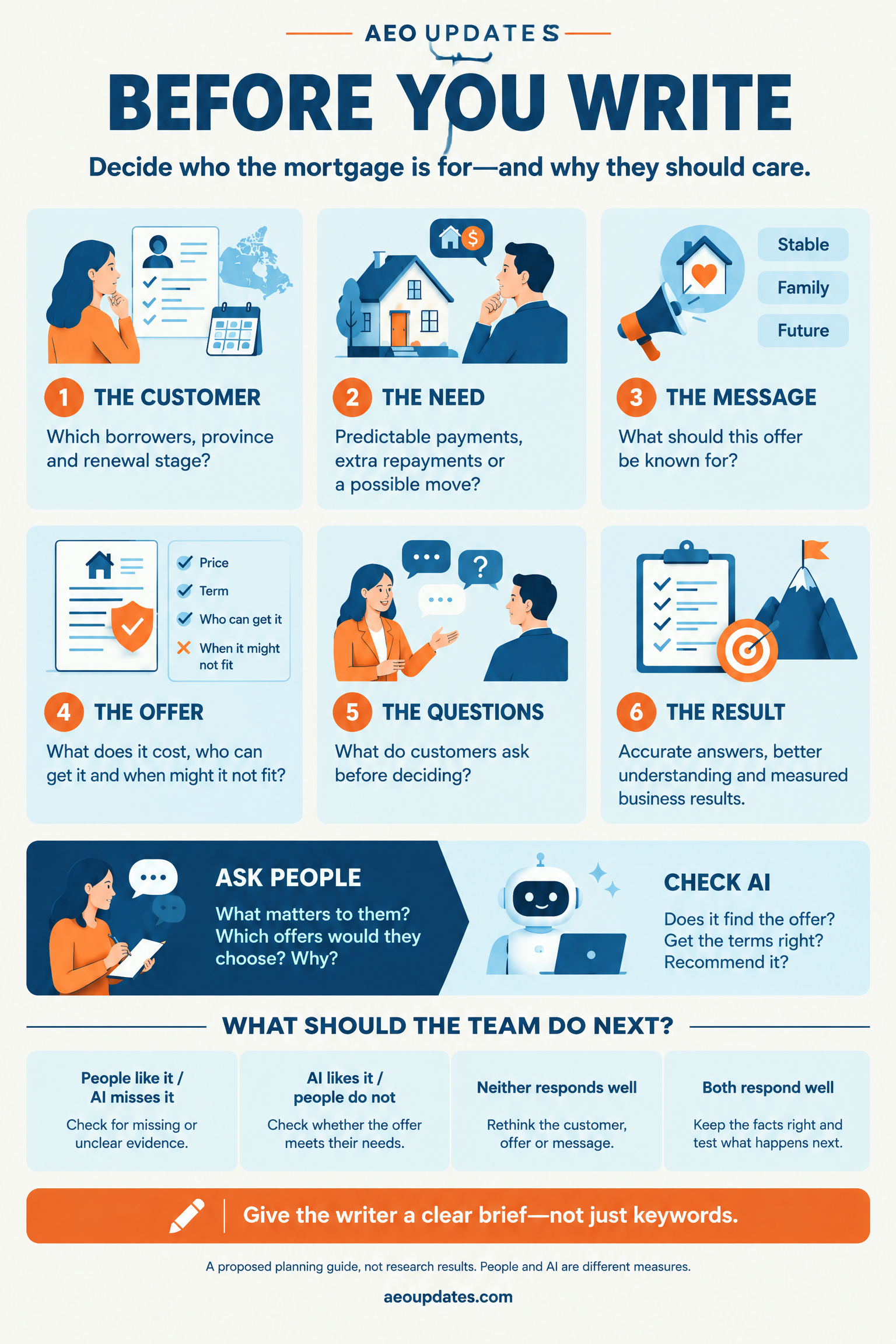
The writer's brief should now be specific: “Explain Lender A's three-year fixed offer to eligible Ontario renewers who want predictable payments and may make annual extra repayments. Show exactly what the repayment rules allow. Do not claim lowest cost or unrestricted flexibility. Explain why an early move could change the decision. Use the approved facts, answer the tracked questions and link to the relevant terms.”
The writer should not have to invent the target customer, product advantage or offer conditions. The product team confirms what is available. Marketing chooses the audience and intended message. Research supplies evidence about customers and AI answers. Product, legal and compliance reviewers check the copy and required disclosures. A named owner keeps it current.
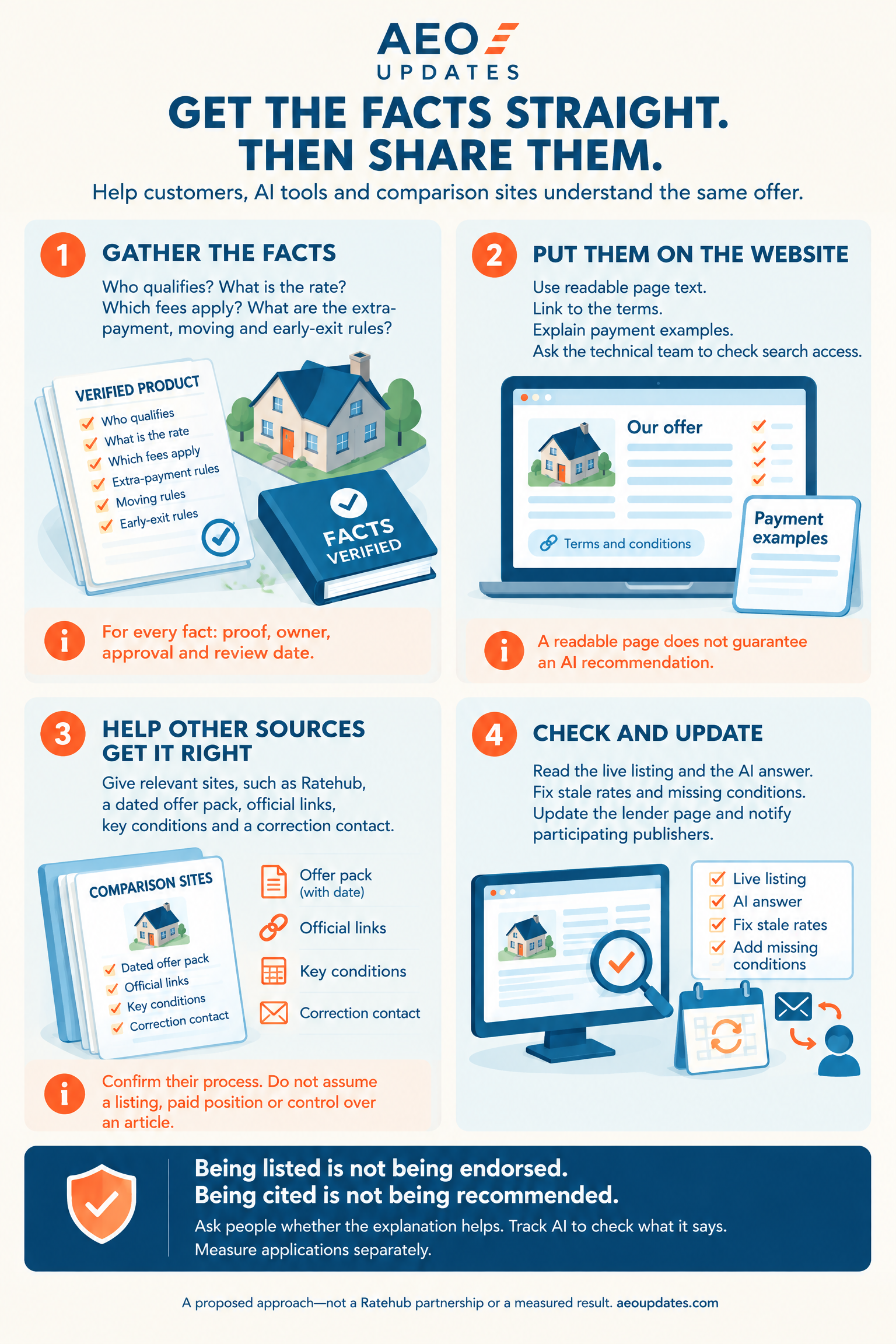
Start with who the offer is for: the exact lender and product, province, property type, occupancy rules, purchase or renewal or switching conditions, and other eligibility requirements. Distinguish an advertised rate from a personalised approved offer. Then collect what the borrower pays: interest rate and rate type, applicable borrowing-cost disclosures, fees, incentives, term, remaining repayment period, payment frequency and calculation assumptions. Include when the offer starts, expires or can change.
Next collect what happens after signing: extra-payment limits, when those payments can be made, how the limit is calculated, whether unused room carries forward, porting rules and early-repayment charges. Porting means moving the existing mortgage to another property, subject to the lender's conditions. The writer also needs reasons the product may not fit. FCAC advises comparing needs, terms and switching costs, and explains that prepayment rules vary by contract. [2] [4]
Keep a simple spreadsheet or content system with one material fact per record. Record the product, fact, important conditions, exact supporting document, accountable owner, approval status, effective date and next review date. For example: “Annual extra payment up to 15% of the starting principal; only on the term anniversary; unused room does not carry forward; supported by the product terms, prepayment section.” In this article that is fictional; a real record needs the genuine terms and approval.
Finally, collect the proof behind the message. A claimed advantage over other offers needs a defined, dated comparison. A claim about customers needs proper research, including the question asked, people surveyed and sample size. If the proof is missing, research it or remove the claim. Keep private customer information and internal review notes out of the public pack. When a fact changes, the owner should know which pages and outside publishers also need updating.
Assume Lender A has a fictional three-year closed fixed mortgage at 4.50%, for an Ontario homeowner renewing or switching at maturity without borrowing more. The example balance is $400,000, with 20 years remaining to repay the loan. That repayment period is called the amortisation; it is not the same as the three-year mortgage term. All dollar figures are Canadian. The rate is invented and is not a live quote or a complete borrowing-cost disclosure.
“Closed” means early repayment is restricted and may lead to a charge. The example allows one extra lump-sum payment on each term anniversary, up to 15% of the principal at the start of the new term. Unused room does not carry forward. Porting needs approval, and leaving early may produce a charge. A customer who may move in 18 months remains an important test: the page should reveal the concern, not automatically recommend this product. [4]
The original sales copy might say: “Make your next move with confidence. Enjoy a great fixed rate, flexible payments and expert support. Apply today.” The problem is not its tone. It leaves the useful questions unanswered. Here is a more informative opening, using the same fictional offer.
Lender A’s three-year fixed mortgage: what to compare before renewing
Lender A’s illustrative three-year closed fixed mortgage has a 4.50% annual interest rate. On a $400,000 balance with 20 years remaining to repay the loan, the estimated monthly principal-and-interest payment is $2,521.62. The rate is fixed for three years; the mortgage is not paid off at the end of that term.
This example uses semi-annual interest compounding and equal monthly payments. It excludes fees, mortgage insurance premiums, property taxes and extra payments. An actual payment schedule depends on the approved loan and the lender’s calculations. These invented figures are not a live offer or a complete borrowing-cost disclosure.
Under this example contract, a borrower may make one extra lump-sum payment on each term anniversary, up to 15% of the principal—the loan balance—at the start of the new term. On a $400,000 starting balance, the limit is $60,000. Unused room does not carry forward. This does not allow unrestricted repayment or guarantee that selling before the term ends will be penalty-free.
If a move before the three-year term ends is possible, ask Lender A about early-repayment charges and the conditions for moving the mortgage to another property. That transfer requires approval. Ask for a written charge estimate and its assumptions, because the amount may change with the repayment date and other contract factors.
Compare another offer using the same balance, remaining repayment period and payment frequency. Review the rate alongside fees, extra-payment rules, porting conditions and early-exit costs. Obtain a personalised written offer and the applicable documents before deciding.
The useful change is specificity. “Flexible” has become an amount, timing rule and limit that a reader can check. The explanation also says when the feature is not enough. For a likely early mover, the comparison needs actual alternative offers and cost estimates—not a claim that the lowest rate must be best.
A supporting article can answer the early-move question in more detail and link to the offer. OtterlyAI observed that comparison questions often cited comparison pages; that supports testing a useful comparison, not assuming the format guarantees a citation. Likewise, Peec's case study changed both the summary copy and supporting technical markup; it did not isolate the effect of a summary box or prove improved recommendations. [5] [6]
There is no single upload that teaches every AI tool the offer. For web-enabled answers, retrieval is the step in which the system finds and fetches source information to help build its reply. Finding a page does not mean it will cite it or recommend the offer. Publish the approved facts in visible webpage text, with clear headings and direct links to the product terms. Important conditions should not appear only inside an image, a login or a calculator result that cannot be read as page content. Supporting PDFs can add detail; they should not force a reader to assemble the basic offer from scattered documents.
Ask the technical team to check that the page works, is linked from other pages and permits the intended search access. Crawling means an automated service visits and reads a page; indexing means adding information about it to a search system’s organised records. Neither guarantees selection for an answer. Google says its AI search features do not require special AI files or special schema—structured data labels in the page’s code that describe its content. Any labels used should agree with the visible facts. OpenAI separately identifies its search crawler, OAI-SearchBot, and its training crawler, GPTBot. The security team should make deliberate access decisions, not disable protection or assume that allowing search requires allowing training. Access still does not guarantee inclusion. [9] [10]
A lender's private AI assistant can use an approved library of internal documents, but that is separate from making public information discoverable. A data feed, supplying structured product updates to a comparison publisher, is separate again. None updates every public AI model. The practical rule is to make the important facts readable, consistent and current. Metadata describes a page outside its main body text; Open Graph tags are one type, commonly used for link previews. The earlier Open Graph research tested access to that information, not whether those tags won recommendations. [7]
Check which sources appear in the tracked AI answers. Some questions may draw on comparison sites; others may use brokers, regulatory guidance or journalism. Do not assume that one site is always the most important. The aim is to help relevant sources describe the real offer accurately, not to scatter promotional claims across the internet.
Ratehub is a useful example, not a guaranteed route to publication. Its public disclosures explain that it does not show every Canadian offer and that commercial arrangements can affect prominence. Its product-update policy discusses partner information and credit-card updates; that is not a published mortgage onboarding process. The reviewed public pages do not establish an open mortgage feed that any lender can upload to. Confirm the appropriate process and participation requirements with the publisher. [12] [13] [14]
For a real approved offer, prepare a short, dated pack: lender and product name, official product link, who qualifies, rate and term, fees, extra-payment and porting rules, calculation assumptions, effective and withdrawal dates, and a correction contact. If an existing listing is wrong, identify its exact page and filters, the incorrect fact, the replacement and the official proof. If the lender wants a new listing, ask separately whether participation is possible, what format is needed and how updates and compensation are handled. This is a suggested pack, not a Ratehub template.
Keep three conversations separate: correcting facts, buying or negotiating placement, and seeking editorial coverage. A paid listing is not an independent endorsement. A factual correction does not give the lender control over an article. Genuine original research can support a separate editorial pitch, but should not be invented to promote the offer. Connective3's findings concern whether brands survive article summaries, not guaranteed coverage or recommendations. [8] [12] [13]
Human and AI measurement are both needed, throughout the programme. Human research checks whether the target, positioning and offer still fit borrowers, what information reaches them and how it affects understanding and consideration. AI research checks how the offer is represented, how it compares with alternatives and whether important conditions survive. Start with both baselines and repeat both; neither can substitute for the other. Keep the findings connected without merging them into one “AEO success” score.
Run the agreed prompts repeatedly through the selected AI tools. Daily or weekly collection, a monthly review and a quarterly human-research wave could be a practical starting schedule—not a universal rule. Match the cadence to the budget, how quickly the offer changes and the decisions the team needs to make. Keep a stable core of prompts, competitors, languages and locations so the trend is interpretable. Record rate changes, content updates, publisher corrections and major tool changes alongside the results.
Visibility: how often does the lender appear? This is generally a percentage of monitored answers that mention the brand. Check the denominator: Peec describes visibility across AI responses, while Profound's documented Visibility Score uses responses mentioning at least one brand. Keep the chosen definition consistent and show its base. If brand-free answers are excluded from the platform score, report them separately so the team can see how often the question produces no lender at all. Visibility is not a measure of how many people saw those answers. [15] [16]
Share of Voice: how much of the competitive conversation does the lender receive? This measures the lender's share of brand appearances relative to the comparison set, across the defined answers. It is different from Visibility: an offer can appear frequently while competitors also appear frequently. Keep the brand set and counting rule fixed, and explain any exclusions. A better share may reflect competitors appearing less rather than the bank appearing more; report absolute presence alongside it. This is share within the monitored answers, not mortgage market share. [15] [16]
Rank: where does the lender stand? State which rank is being used. A leaderboard rank compares brands by a metric such as Visibility or Share of Voice. Answer position describes where a brand appears within the response; Peec reports an average position when the brand appears. Neither is the same as a webpage's Google ranking. Read position together with frequency: being first in the few answers that mention the lender does not mean it performs well across the whole panel. Do not force an ordinal ranking onto an unordered answer, and do not interpret first mention as an explicit first-choice recommendation. [16] [17]
Owned Citations: are the lender's own pages being cited? Define the owned-domain list, then track how many valid answers explicitly cite at least one page on it. Report a rate as well as a count, so collecting more answers does not manufacture improvement. If also reporting the bank's share of all citation occurrences, label that separately: it answers a different question. A Ratehub citation is third-party, even if the bank supplied the underlying facts. An owned page can be cited without the lender being recommended; a recommendation can also occur without an owned citation. [16]
Add two checks that the headline metrics can miss: appropriate recommendations and factual accuracy. For Lender A, an answer should preserve the extra-payment limit and the early-move warning. An accurate decision not to recommend the offer can be better than an enthusiastic but misleading endorsement. Retain the answer text and source URLs so changes can be investigated. Separate collection failures from valid answers, and keep valid refusals and no-recommendation answers visible rather than quietly dropping them. Review results by prompt family and AI tool before looking at any combined number.
Take a human baseline before the new work, then repeat the core survey among a comparable target audience. For this example, keep the Ontario renewal criteria, decision stage, lender-relationship definitions, wording, recall period and language approach consistent. Maintain comparable recruitment, quotas and weighting too. Track consideration and the intended positioning alongside comprehension of material terms, reported AI tasks and subsequent actions. Ask the unprompted brand and outcome questions before showing the new content or a favourable AI answer. Check uncertainty and subgroup sizes before calling a movement a change in strategy performance. [18] [19]
The standing human survey should include brand associations, claims and exposure in every wave. This is ongoing brand tracking, not a requirement to run a new content experiment each time. Keep the tracking core stable; use content tests as separate studies or clearly separated modules when there is a specific question to resolve.
Brand associations: track which lenders people associate with the target benefit, first without prompting and then using a consistent set of attributes. For Lender A, that could include payment certainty and clear extra-repayment rules. Compare the association with competitors and distinguish a change among existing customers from a change among prospective switchers.
Claims: track spontaneous message recall, recognition of specific claims, which lender people attribute them to, and their credibility and relevance. Check understanding of material qualifications as well. Believing a claim is not evidence that it is factually true; check the claim against the approved product record. Ask recall before showing the claim, and keep any subsequent recognition questions consistent across waves.
Exposure: track reported contact with the lender’s mortgage information through AI answers, its own website, comparison sites, advisers, advertising and other relevant channels, using a consistent recall period. Allow multiple sources and uncertainty. Read exposure alongside associations and claim measures to investigate whether messages are reaching people and being understood. These observational patterns do not by themselves prove that exposure caused a change.
Fresh samples show how the target market is changing. Recontacting the same people can instead help follow individual journeys, but drop-out and familiarity with the research need managing; do not silently treat those designs as equivalent. Preserve a stable core for trending while adding a small number of diagnostic questions. For example, if more renewers expect to move soon, the three-year offer may need a different target or proposition—not simply stronger “flexibility” copy.
Use each wave to check whether the strategy still makes sense. Are the target's priorities changing? Is the lender gaining the association it intended? Are more people asking AI to compare offers rather than just explain mortgage terms? Do bank-level differences reflect genuine movement or small samples? Use those answers to update research priorities and exploratory prompts, while retaining the original prompt panel as a separate trend. Survey waves keep the strategy grounded in people; AI tracking shows how the information environment is changing between waves.
Measure two routes without assuming they are mutually exclusive. AI-mediated exposure means a borrower encounters the information through an AI answer, with or without clicking a source. Direct exposure means the borrower reads the lender page or relevant third-party content themselves. A journey may include both: an assistant raises the offer, the borrower checks the bank page and then consults a broker. Do not force that journey into a single “winning” channel.
In the survey, ask what sources people used for a defined recent mortgage decision, which assistant they used, what they asked and whether they opened or read the linked material. After the unprompted measures, ask what information they remember and whether they recognise specific content. Compare reported AI-only, direct-reading-only and combined journeys, while retaining “not sure” rather than coding it as no exposure. These are self-reported groups, not verified histories or randomly assigned audiences. Their differences can reveal useful patterns but do not prove which route caused consideration or choice.
Use privacy-appropriate website analytics to add evidence about identifiable AI referrals, page visits and onward actions. Those signals do not prove attentive reading, and AI influence without a click will not appear as a referral. The bank also cannot infer actual readership of a Ratehub article from its own analytics; that needs publisher data or appropriately qualified research. A citation in a monitored model answer establishes neither human exposure nor a visit. Do not join browsing, survey and customer records without the necessary consent and safeguards.
Separately, test whether the content works when people encounter it. A randomised study could show eligible borrowers the lender page, a factual AI answer drawing on its information, or an appropriate control. Keep the offer facts consistent, document what differs and measure understanding, accurate brand associations and consideration. If testing the rewrite itself, compare old and new copy within the same route. For AI-answer stimuli, record how the answers were obtained and select them transparently, not just the most flattering one. These tests estimate responses to the material shown; they do not establish its natural reach or prove an increase in funded mortgages.
Review the AI scorecard alongside the latest human wave, with the same target decision in mind. If owned citations rise but the bank's intended positioning does not, check what the cited pages actually say and how AI uses them. If AI representation improves but human understanding remains weak, investigate reach, the explanation and the proposition before producing more of the same. If direct reading helps comprehension but AI answers drop a critical condition, improve how that fact is expressed and investigate the sources behind the omission. These are diagnostic leads, not automatic causal conclusions.
Finally, retain separate measures for qualified enquiries, applications, approvals and funded mortgages. Rate changes, media activity, distribution and lending criteria can affect those outcomes too. Agree in advance what would trigger a correction, more research, a content test or a product decision. The aim is a repeatable way to keep the offer, evidence and strategy aligned with borrowers—not a dashboard that declares success because one number went up.
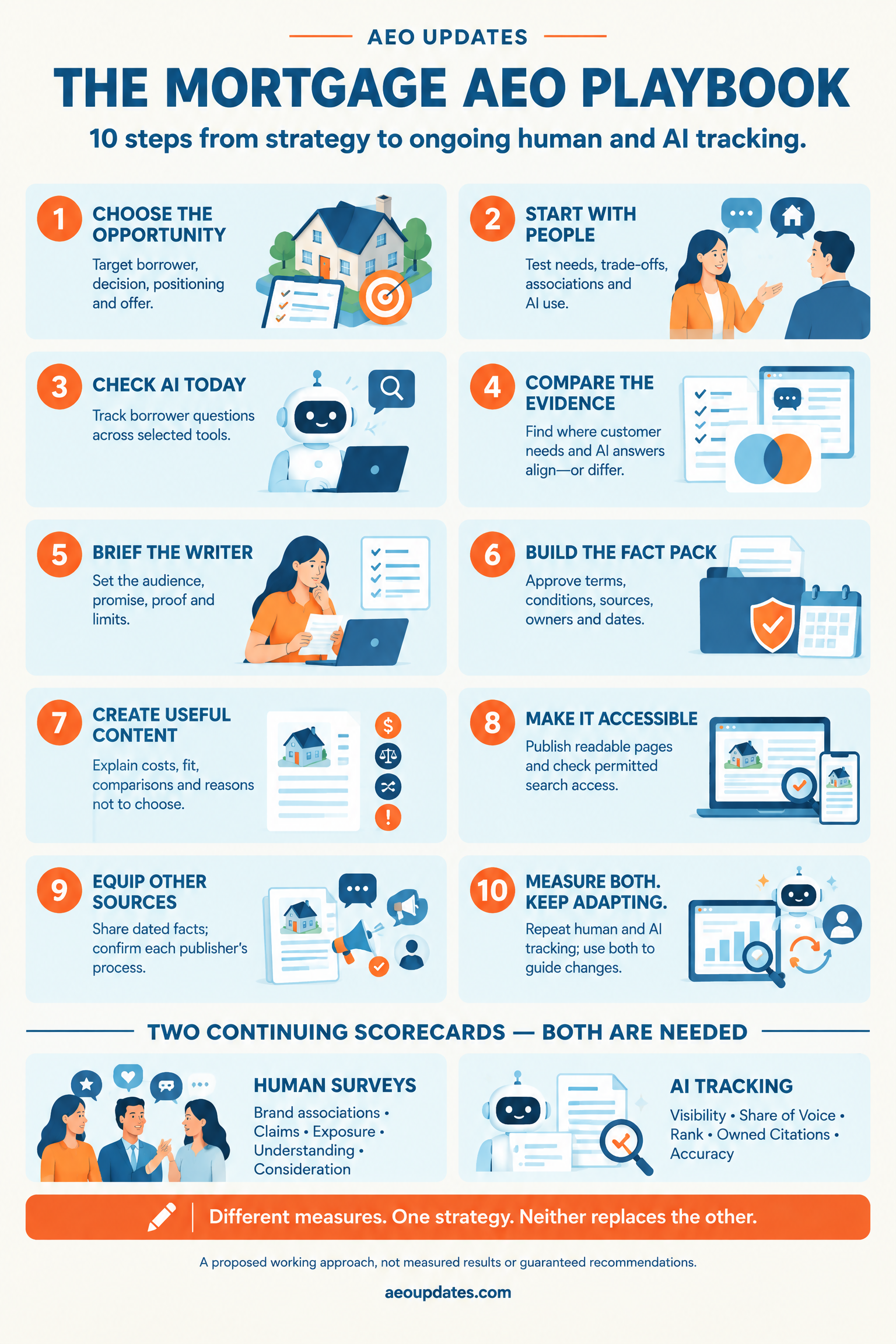
The process begins with the mortgage strategy, not the writing. Use these ten steps as a working guide, then keep revisiting the choices as customer needs, offers and AI answers change.
Two continuing scorecards are essential. Visibility, Share of Voice, Rank, Owned Citations and accuracy show what happens in monitored AI answers. Human survey waves show what people associate with the lender, which claims they remember and believe, and what information they report encountering. Neither replaces the other, and commercial outcomes need separate measurement. The objective is accurate consideration for the right borrower—not a recommendation to everyone.
This is an evidence-informed approach, not a promise that a particular page format will win mortgage recommendations. Its components draw on published experiments, observational studies, official guidance and established survey practice. The ten-step combination is a practical proposal to test; it has not been independently validated as a complete programme for Canadian mortgage acquisition. The supporting evidence is strongest when each finding is tied to the specific decision it can inform.
In CMHC's 2026 Mortgage Consumer Survey, 16% of mortgage consumers who searched online reported using AI for mortgage-related information. That is not 16% of all mortgage consumers, and using AI for information does not establish that it selected the lender. AEO Updates examined this distinction in The first mortgage opinion may come from AI. [21] [22]
The finding gives the guide a Canadian starting point: AI is already part of some borrowers' research, so institutions have a reason to understand what it says. Human research is still needed to establish the task, exposure, understanding and subsequent action. The story's proposal to compare human and AI findings in the same mortgage situation is a research design to apply—not proof that a measured human–AI difference causes switching.
Aggarwal and colleagues' GEO: Generative Engine Optimization, published at KDD 2024, introduced a 10,000-query benchmark and tested content changes such as adding source references, quotations and statistical information. The paper reported up to 40% improvements in its defined source-visibility measures under the tested conditions, with results varying by domain. This supports investigating what evidence and explanations a page supplies, rather than assuming wording never matters. It is not a forecast of a 40% gain for a bank, a measure of human reach or proof of mortgage-choice effects. [20]
More recent evidence points towards relevance rather than a universal template. Chen and Koudas' 2026 preprint, covered in What actually gets brands mentioned in AI search, associated question-to-paragraph relevance with citations in within-site analysis. FAQ blocks, summary boxes and schema were not significantly associated with more citations in those within-site comparisons. The study concerned two US non-mortgage markets and was observational. It supports testing whether the content answers the borrower's actual question, not declaring a guaranteed mortgage-ranking rule. [1] [3]
Peec's OnBoard case study followed one changed page and a comparable unchanged page over six weeks. The treatment combined a clear takeaways section with supporting schema. Peec reported a 61% increase in its citation-rate metric for the changed page, compared with roughly 7% for the control. But the changed page's reported visibility fell over the period. The metric's exact formula was not supplied, and the combined changes do not isolate the effect of schema or summary copy. [5]
That is a useful reason for the guide's measurement discipline. Test a defined change, keep a comparison where feasible and report citations, visibility and accuracy separately. A positive result on one metric should not become a claim that everything improved. This small vendor case does not establish an expected effect for a Canadian lender.
AEO Updates' The prompt is not the market. Why one question cannot measure AI visibility examined research in which commercial recommendation sets varied across repeated identical prompts and varied further under paraphrase. The underlying Jack and colleagues paper is a preprint, with findings bounded by its tasks and tested model families—not a census of mortgage searches. [23] [24]
The practical implication is still important: preserve the question set, repeat observations and separate borrower situations. A renewal query and a first-time-buyer query are not interchangeable simply because both concern mortgages. Profound and Peec's documentation also distinguishes brand presence, competitive share, position and citations, supporting the use of separate measures rather than one catch-all result. Vendor documentation defines the measures; it does not prove that improving them causes customer acquisition. [15] [16] [17]
Google's official guidance says important content should be available in textual form and structured data should match the visible page; it does not require a special AI schema or guarantee inclusion. FCAC's mortgage guidance reinforces the need to compare terms, suitability and switching costs—not just a headline rate. Those are direct foundations for the guide's readable product facts, qualifications and worked comparisons. They are not evidence of a specific AEO uplift. [2] [4] [9]
AEO Updates' What makes a brand show up in AI? Five studies point to its evidence environment brings together evidence about on-site information and third-party recognition. One underlying Webflow study assessed 2,000 websites and reported that evidence-backed on-site authority had the strongest association with its AEO mention measure. Its proprietary observational assessment cannot establish that those features caused the mentions or that the result applies to mortgages. [25] [26]
This supports treating accurate owned information and relevant independent corroboration as things to investigate and maintain—not buying a supposed citation shortcut. Ratehub's own disclosures provide a separate practical boundary: factual updates, commercial participation and editorial coverage are different processes. Neither a listing nor an outside article guarantees an AI recommendation. [12] [13] [14]
Pew Research Center's question-design guidance and AAPOR's survey standards support comparable wording and survey context, careful question order and transparent reporting of samples and uncertainty. These principles underpin the guide's continuing human tracker: brand associations, claim recall and credibility, reported exposure, understanding and consideration. They do not constitute evidence that a particular AEO intervention changed those measures. [18] [19]
That is why the programme needs both streams. AI monitoring observes selected systems' answers; surveys investigate what people encountered and took from the information. Controlled exposure tests can address a narrower effect question, while ordinary tracking alone cannot establish causality. Dig's System 0 framing supplies a way to connect human choice with AI's role in decisions; the particular mortgage programme remains a proposed application rather than a proven acquisition formula. [11]
The defensible conclusion is that the steps provide a grounded way to choose, publish, distribute and test mortgage evidence. The studies and guidance support specific components, with different levels of certainty; they do not collectively prove guaranteed recommendations, conversion or funded-loan gains. AEO Updates coverage helps interpret the underlying work, but a story and the study it covers are not two independent replications. The appropriate next step is a measured programme that reports improvements, failures and unchanged results in both human and AI measures.
[1] What actually gets brands mentioned in AI search — AEO Updates
[2] Renewing your mortgage — Financial Consumer Agency of Canada
[4] Mortgage fees: Prepayment penalties — Financial Consumer Agency of Canada
[5] How two teams run their own GEO experiments — Peec AI
[6] What Content Do AI Engines Cite? — OtterlyAI
[7] Do AI Engines Read Your Open Graph Tags? — OtterlyAI
[9] AI features and your website — Google Search Central
[10] Overview of OpenAI Crawlers — OpenAI
[12] Ratehub Product Updates and Policy — Ratehub.ca
[13] Disclaimer and commercial disclosures — Ratehub.ca
[14] About Ratehub.ca and mortgage-rate advertising disclosure — Ratehub.ca
[15] About Answer Engine Insights — Profound
[16] Metrics Overview — Peec AI
[17] Glossary: Visibility Rank and Share of Voice Rank — Profound
[18] Writing Survey Questions — Pew Research Center
[19] Best Practices for Survey Research — AAPOR
[20] GEO: Generative Engine Optimization — Aggarwal and colleagues, KDD 2024
[21] The first mortgage opinion may come from AI — AEO Updates
[22] 2026 Mortgage Consumer Survey — CMHC
[23] The prompt is not the market. Why one question cannot measure AI visibility — AEO Updates
[25] What makes a brand show up in AI? Five studies point to its evidence environment — AEO Updates
This article links directly to the primary documentation, paper, filing or original reporting used for its material claims.