Primary sources cited
This article links directly to the primary documentation, paper, filing or original reporting used for its material claims.
Six recent studies sharpen the difference between citations and recommendations, with practical tests for cards, mortgage renewals and savings decisions.
The goal is not simply to get a product page cited, but to understand whether the institution is included, accurately represented and relevant to the customer.
Author: Ian Ash
Published: October 27, 2026
Category: Analysis
A brand can earn more citations in AI search without becoming more visible in the way its marketers intended. Recent research sharpens the distinction between being used as a source, being named in an answer and being recommended for a customer's decision. For financial institutions, that distinction changes the brief: the goal is not simply to get a product page cited, but to understand whether the institution is included, accurately represented and relevant to the customer.
A Peec AI case study illustrates the problem. Software company OnBoard added a section of concise takeaways and supporting schema to a page. Over six weeks, its reported citation-rate metric improved, but retrievals ended lower and the reported visibility measure declined. This was a single changed page with one unchanged comparison page, not evidence of a universally effective tactic. [1]
University of Toronto researchers Mahe Chen and Nick Koudas examined 158,099 AI-generated answers containing 468,037 citations across two US markets: home internet and niche architecture, engineering and construction proposal-and-business-development software. Their 10 October arXiv preprint found that, when comparing pages within the same website, paragraphs semantically aligned with the monitored questions were associated with more citations. Title matching was also associated with citations in the pooled consumer analysis, but not for ChatGPT considered separately. The questions were written for monitoring programmes, not sampled from user traffic logs. [2]
FAQ blocks, structured data and summary boxes were not significantly associated with more citations in the within-website comparison. That does not establish that they never help. In a separate ChatGPT API replay analysis covering 6,178 pages on 362 websites, retrieval variables explained 32% of within-website variation in 90-day citation counts, compared with 2.8% for measured page features. Those figures describe explanatory power in that analysis, not a predicted improvement from changing a page or an all-engine benchmark. The authors also report that 46% of ChatGPT mentions of brands absent from the question lacked a cited page naming the brand; this is narrower than saying those mentions had no citations at all. [2]
The useful implication is to start with the customer's decision and test whether the available evidence answers it. “Best credit card” and “Which card makes sense if I spend $800 a month on groceries and rarely travel?” require different explanations. Relevance must survive the actual constraints, not just match a generic category keyword.
OtterlyAI's 14 October analysis covered 617,985 citations across seven engines and five US industries during September. The sample included a Finance and Insurance report, but the aggregate findings do not establish effects for Canadian banks or financial-product choice. Its prompt set leaned heavily towards ranking questions: 295 of 400 prompts across four reports used terms such as best, top or cheapest. [3]
The question-to-format relationship is more useful than a blanket instruction to publish listicles. For ranking prompts, 73.2% of cited pages were listicles; for comparison prompts, 62.3% were head-to-head comparisons. These are observed patterns, not evidence that changing a page's format causes a citation gain. Among the 450,473 citations with an identified publisher type, brand publishers represented 38.9% and publishers publicly disclosing possible commissions for recommendations represented 36.6%. Those are not shares of the entire corpus, and a citation does not establish that the source is impartial. [3]
A practical content programme should therefore support discovery, comparison, eligibility and decisions about staying or switching. Publishing more “best” articles is an incomplete response if the commercial opportunity depends on explaining a detailed trade-off.
A company can contribute information to an article yet disappear when the article is summarised. Connective3's 6 October research analysed more than 3,500 digital-PR links across 170 brands and 224 campaigns. It reports that 43% of brand mentions were not retained in AI-generated article summaries. Placements in the highest band of its proprietary Brand Citation Score retained the brand about 4.75 times as often as those in the lowest band. [4]
This was a summarisation test, not proof that an AI-search engine would retrieve the article or recommend the company. The source does not disclose the exact models, prompts or repeat-run design. Its practical question is nevertheless useful: what makes the brand essential to the story? Original research, a substantive explanation or distinctive expertise may give a journalist a reason to discuss the company meaningfully. An incidental link is not equivalent to that contribution.
A separate arXiv preprint by Qi Liu and colleagues, submitted 8 October, examined 17,211 citation instances across 10 AI-search platforms using a controlled query panel. A citation instance was one cited URL in one answer. The top 20 domains accounted for between 20.5% and 70.8% of citation instances within individual platforms, not across a combined market. [5]
Its publication experiments involved fabricated or low-competition concepts. The research examined citation security and publication governance; it excluded financial and investment guidance, including loan advice. It is not a commercial rule that one article on a favoured platform is worth 20 elsewhere. The defensible implication is to inspect the sources repeatedly informing relevant answers and review their provenance. Source concentration is not proof of trustworthiness, and fabricated evidence or source poisoning is not a legitimate AEO strategy. [5]
OtterlyAI's Open Graph experiment, updated 22 October, placed distinct markers in visible text and metadata. In 504 automated questions that supplied a URL and asked for its Open Graph title or description, none of the seven engines returned the correct metadata marker. Automated collection ran 6–18 October. Manual logged-in tests on 16–17 October produced an exception: Claude returned the correct marker when its page-fetch capability supplied the metadata. The article also describes a possible indirect route through some unnamed search indexes, not a verified universal mechanism. [6]
The test concerned information access, not ranking, citation gains or improved brand descriptions. It does not show that metadata is worthless. The narrower lesson is to keep material information in accessible, approved page content rather than relying on Open Graph fields to carry it into an answer.
For financial institutions, the useful application is not to publish more generic “best bank” content. It is to make the institution's relevance demonstrable in a specific financial decision. A credit-card comparison should explain how spending categories, reward limits, annual fees and eligibility affect the result. A mortgage-renewal explanation should distinguish an advertised rate from a personalised offer and make penalties, portability and prepayment conditions understandable. A savings comparison should preserve promotional expiry dates, ongoing rates, balance requirements and fees. These are proposed applications of the wider research, not evidence that the cited interventions have been tested on Canadian banks.
The content should support discovery and detailed comparison without assuming every customer follows the same journey. Important conditions need to appear in accessible page text, with dated supporting documents where appropriate, rather than only in metadata or a promotional headline. Comparable worked examples should disclose their assumptions, with product, legal and compliance review appropriate to the institution. Independent coverage and comparison sites deserve the same scrutiny: does the article make the bank's relevant expertise or product difference central enough to survive a summary, and are commercial relationships disclosed? A source citation is not proof of impartiality, suitability or a recommendation.
The bank's research brief should specify the question, the relevant customer situation and the result it wants to test. For example: does an assistant include the institution in a card comparison, preserve a material mortgage condition or correctly explain when a promotional savings rate ends? Record mentions, recommendations, cited sources and material factual errors separately across defined tools, languages, locations and dates. A prompt that names the bank can test its representation, but cannot establish that it earned inclusion in an unprompted shortlist. Better representation does not itself establish an additional application, account or funded mortgage.
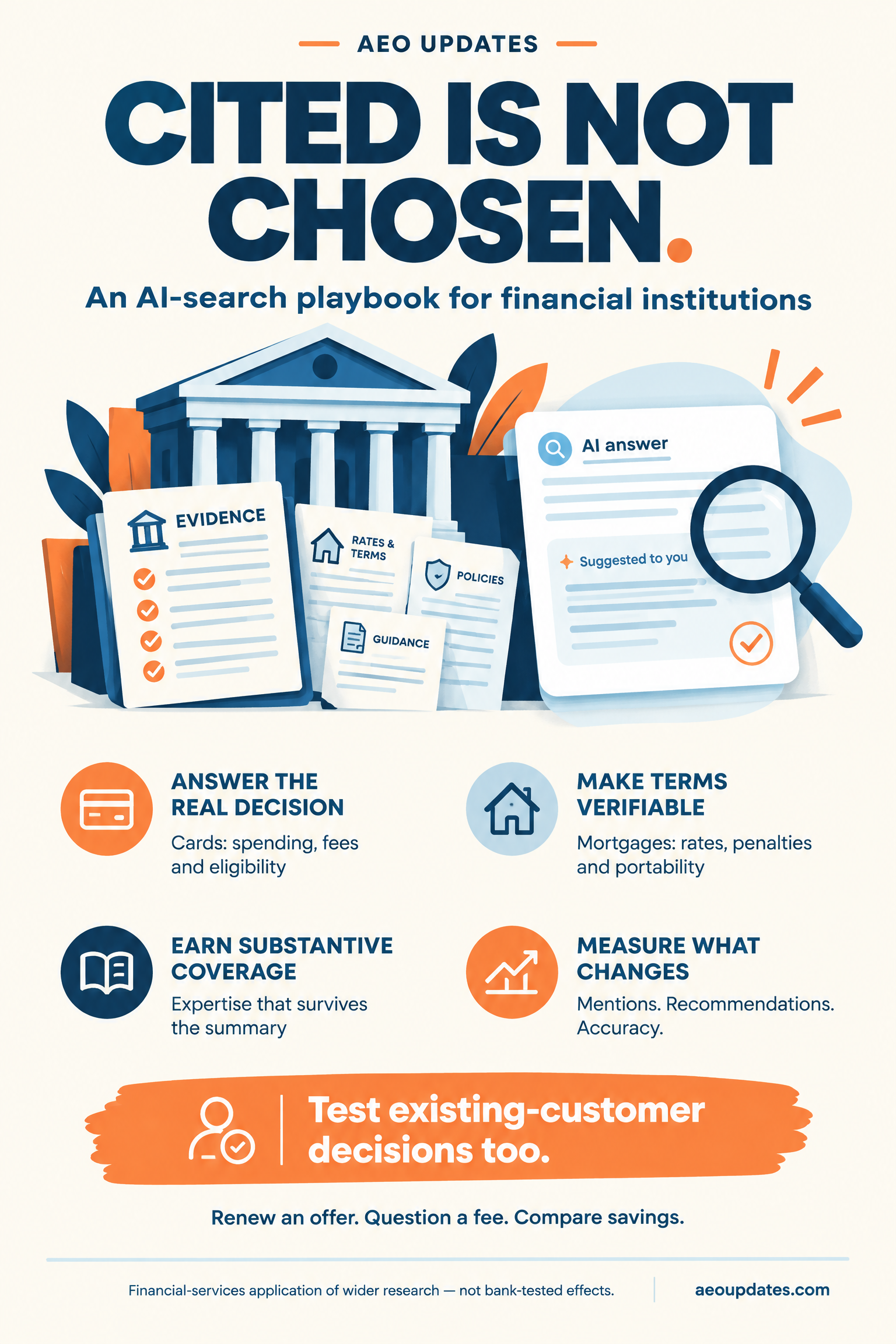
Existing-customer questions belong in the same programme. “Should I accept this renewal offer?”, “Is this account fee worth paying?” and “Should I move these savings?” may expose different evidence gaps from “Which bank is best?”. Test whether the institution's relevant advantages and limitations survive the answer, including reasons to stay where supported. These are research scenarios, not evidence that AI has already caused switching or has authority to move money. The distinction extends AEO Updates' earlier analysis of AI search and banking strategy and the first mortgage opinion.
Consumer research can then examine whether the information is understood and whether it affects consideration or stated choice in a defined test. Human–AI gaps can reveal an opportunity worth investigating, but consumer preference and model recommendation rates are different measures. A separate controlled design is needed to estimate the effect of a particular intervention; observed citations, optional customer prompts and parallel movements in preference do not prove causal business lift. The immediate goal is a defensible explanation of where the bank is included, what the answer gets right or wrong and which evidence or customer experience should be tested next.
OnBoard's case study brings the argument back to measurement. The test page's reported citation-rate metric rose from 1.45 to 2.33, a source-reported increase of about 61%, compared with roughly 7% for the unchanged comparison page. Absolute citations rose from 289 to 387, approximately 34%. But retrievals ended lower, from 199 to 166, while the reported visibility measure fell from 22% to 9%. [1]
The rate values are not percentages of answers recommending OnBoard. The published case does not provide the exact metric formula, prompt denominator or platform mix, so the values should not be reconstructed as a conversion rate. The combined takeaway-and-schema treatment cannot isolate either component's effect. A useful testing brief should state the outcome in advance, retain a comparable unchanged group, document collection conditions and report null or adverse movements alongside gains. [1]
The latest evidence does not establish one universally superior tactic. It supports a more demanding standard: content should answer a real decision, coverage should make the brand's relevance clear, and measurement should show what changed in the answer. For financial institutions, “cited is not chosen” is a measurement warning, not a claim about observed customer purchases. The question for an agency is increasingly concrete: what evidence would make the institution relevant to this customer's decision, and how will the test distinguish a citation from a recommendation and a commercial outcome?
[1] How two teams run their own GEO experiments — Peec AI case study
[3] What Content Do AI Engines Cite? — OtterlyAI September 2026 study
[6] Do AI Engines Read Your Open Graph Tags? — OtterlyAI marker experiment
This article links directly to the primary documentation, paper, filing or original reporting used for its material claims.