Primary sources cited
This article links directly to the primary documentation, paper, filing or original reporting used for its material claims.
Meltwater’s latest research shows why expert sources matter and why visible citations can change sharply by platform.
AI may choose which voices appear in an answer. Brands still need to know whether those voices are accurate and how they shape the recommendation.
Author: Ian Ash
Published: November 17, 2026
Category: Analysis
A brand can publish the approved facts and still find that AI is explaining its category through somebody else. An employee, an independent publisher, a reviewer or a community contributor may supply the evidence an assistant uses. Meltwater’s May research with LinkedIn put professional expertise in that picture. Its October analysis, published on 13 November, adds the warning: visible citations can change sharply when an AI product changes how many sources it displays. The strategic question is not simply who gets cited, but whose evidence shapes the answer and whether the brand is appropriately recommended. [1] [2] [3]
In May 2026, Meltwater and LinkedIn published an analysis of 9.5 million AI citations across six AI products and 16 business-to-business categories. In the report’s presented domain ranking, YouTube led at 1.52%, LinkedIn followed at 0.53%, Reddit at 0.44%, G2 at 0.41% and Capterra at 0.38%. Its summary says LinkedIn appeared among the five most-cited sources in 14 categories, although category counts vary elsewhere in the materials. The consistent finding is broad representation in the tested B2B questions, not a universal source hierarchy. [1] [2]
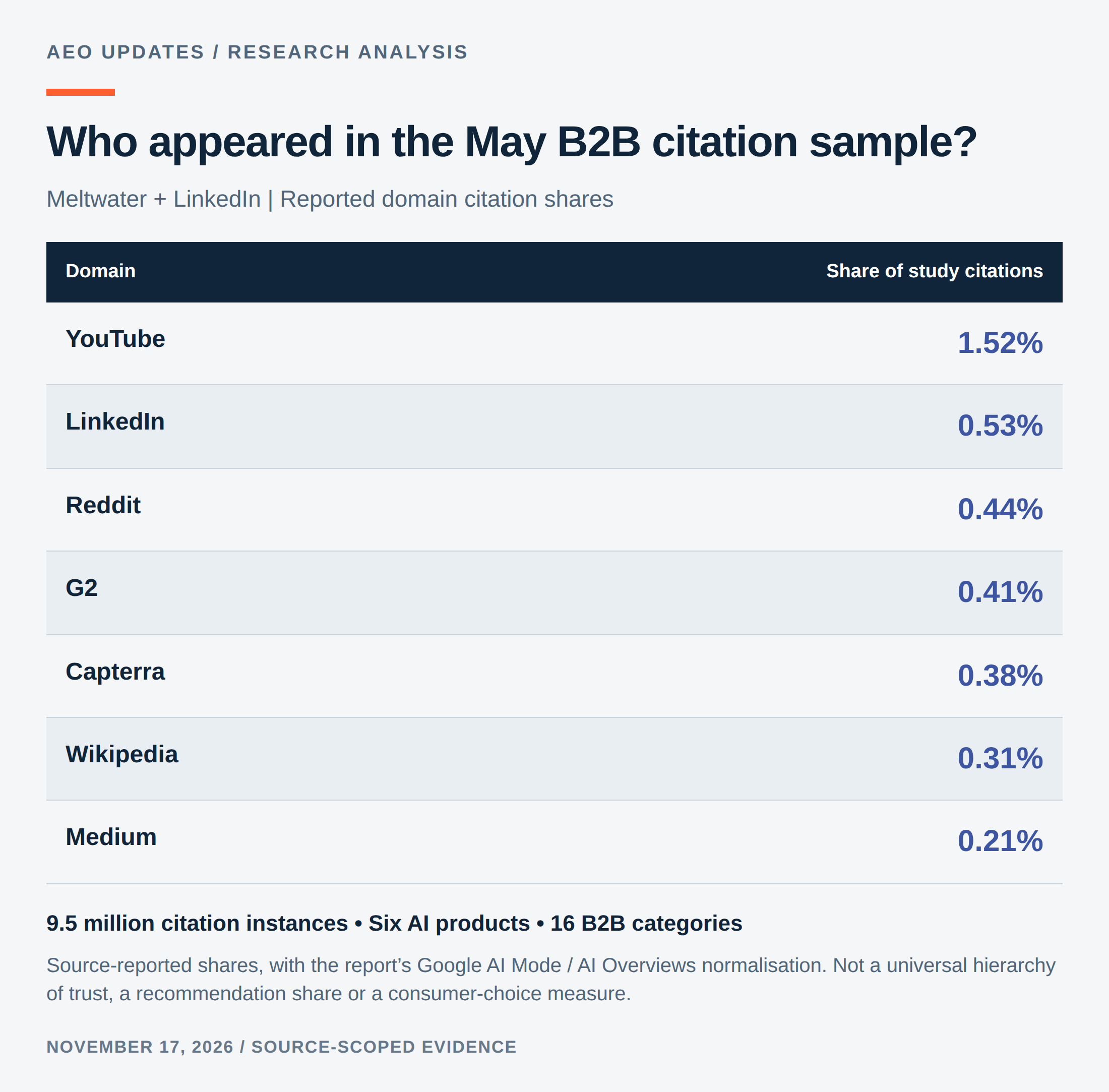
The small shares reflect citations spread across a large universe of domains. The report also notes a normalisation involving Google AI Mode and AI Overviews. These are source-reported citation shares in a defined prompt sample, not the share of people choosing LinkedIn, the share of brands recommended, or a benchmark for every consumer category. LinkedIn’s marketing article is dated 21 May; this is historical evidence being reconsidered alongside the newer October findings. [1] [4]
The result matters because AI answers can draw on information beyond corporate websites and campaigns. A publicly accessible explanation by someone with relevant professional experience may become part of the evidence used to describe a category or a company. The study observes citation patterns; it does not demonstrate that an AI system verified that person’s expertise. [1] [5]
Three-quarters of LinkedIn citations in the May sample pointed to individual member content and one-quarter to Company Pages. The report also attributed 51% of citations to member content to accounts with fewer than 10,000 followers. That shows that citation visibility in the sample was not confined to celebrity executives or very large audiences. It does not establish that an individual post has three times the citation probability of a corporate post: the amount, relevance and accessibility of content published by each group were not held equal. [1] [2]
A cybersecurity engineer explaining implementation trade-offs, a bank economist discussing mortgage renewal mechanics or a medical researcher explaining a clinical study can provide useful, attributable material. Those are examples of potential evidence sources, not study findings about those professions or consumer decisions. Whether an explanation is retrieved depends on the question, platform, competing material and access to the content. [6]
There is a governance issue as well as a distribution opportunity. An employee’s explanation may enter the brand’s external evidence footprint without being approved advertising. Organisations should support genuine expertise while protecting accuracy, confidentiality and regulatory compliance. The objective is not to turn every employee into a scripted spokesperson, or to treat a job title as proof of authority. It is to make relevant knowledge publicly usable and reviewable. [5] [6]
Meltwater’s review of 24 top-cited LinkedIn articles found that all used bullets or numbered lists, 92% used clear headings, 75% named specific companies or tools, 67% included quantitative data and 50% contained a comparison or evaluation framework. It identified 1,500 to 2,500 words as a common length range. These figures describe selected successful articles, not the full 9.5-million-citation corpus or a controlled comparison of otherwise identical pages. [1] [2]
Direct answers, transparent criteria and concrete examples give a reader useful decision support and a retrieval system relevant passages to locate. A guide explaining mortgage types, current conditions and trade-offs contains more specific information than a generic promise of customer-first innovation. But the study does not isolate bullets, word count, publishing frequency or the year in a title as causal ranking factors. [5] [6]
The defensible principle is to publish the evidence a person needs to make a decision. State the question, answer it directly, explain exceptions, name relevant entities and document quantitative claims. Update the material when facts change, then test whether it appears for the prompts that matter. A listicle is a structure, not a substitute for evidence; original research and a clear comparison format can coexist. [5] [6]
Meltwater’s September clarification adds a useful distinction between volume and performance per piece. Feed posts supplied more citations overall, while its observational comparison found that long-form articles earned 6.5 times more citations per piece than standard posts. It also notes that far more feed posts are published. This is not a promised uplift from converting a post into an article. Nor did the study test paid boosting or comments as citation mechanisms. [5]
Meltwater’s separate October analysis, published on 13 November 2026, covered approximately 120,000 prompts, 12.7 million answers and 88.6 million citations across eight AI platforms. The expanded prompts spanned industries and languages and included brand-naming questions. The provider explicitly warns against comparing this expanded sample directly with earlier monthly datasets. Its change figures compare 1 to 15 October with 16 to 31 October, not September with October. Prompts, repeated answers and citation instances are different units, not independent consumers. [3]
Meltwater observed Perplexity listing at most 10 sources per answer around 6 October, down from about 24. LinkedIn’s citation count in the tracked Perplexity answers fell approximately 99% between the two halves of the month. This is an observed ceiling in the report, not an independently confirmed universal product policy. Because the change occurred inside the first comparison window, that window contains days before and after it; the result is not a clean before-and-after experiment. [3]
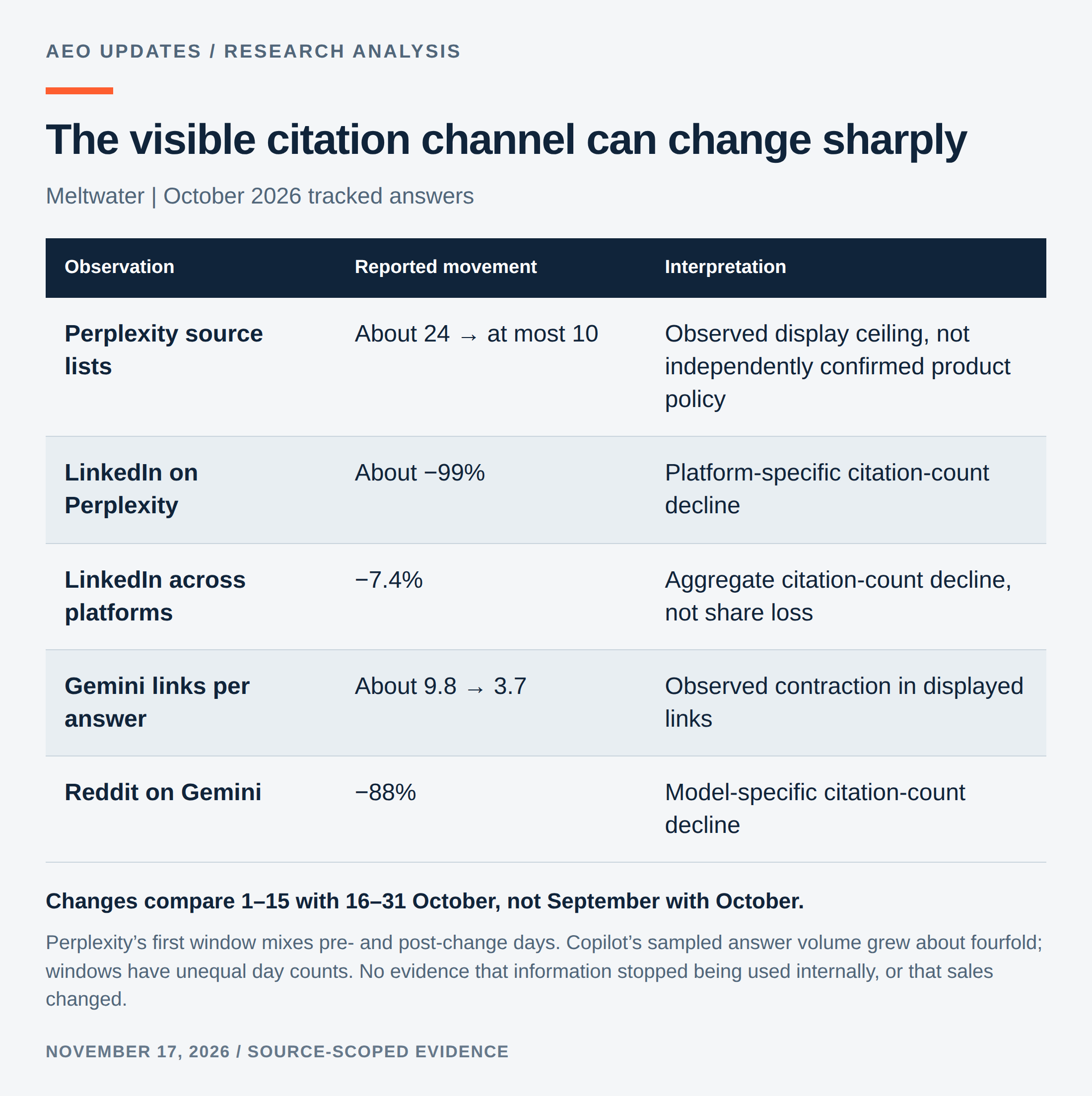
LinkedIn’s citation count held steady in Google AI Mode and grew in Copilot, while its total across the tracked platforms fell 7.4%. That is a decline in aggregate citation count, not a 7.4-percentage-point share loss. Copilot’s sampled answer volume increased about fourfold between the two windows, from 253,501 to 1,049,611 answers. Growth in a source’s raw citations therefore cannot by itself establish greater model preference or trust. The two windows also contain different numbers of calendar days. [3]
Gemini provided another illustration. Around 15 October, Meltwater observed links per answer falling from about 9.8 to 3.7. Its total Gemini citations fell 66% between the half-month windows, while citations to Reddit fell 88%. Reddit’s citation share moved differently on other platforms, increasing on Perplexity and remaining comparatively stable on Google’s search surfaces. These are model-specific citation observations, not a decline in Gemini usage or proof of lower answer quality. [3]
The available data does not show that Perplexity or Gemini stopped retrieving, reading or using information from a source internally. Fewer displayed links can change visible attribution without revealing the full evidence used to construct an answer. The report associates shorter lists with changes in which domains appear, but it does not experimentally separate all possible causes or measure their effects on brand choice. [3]
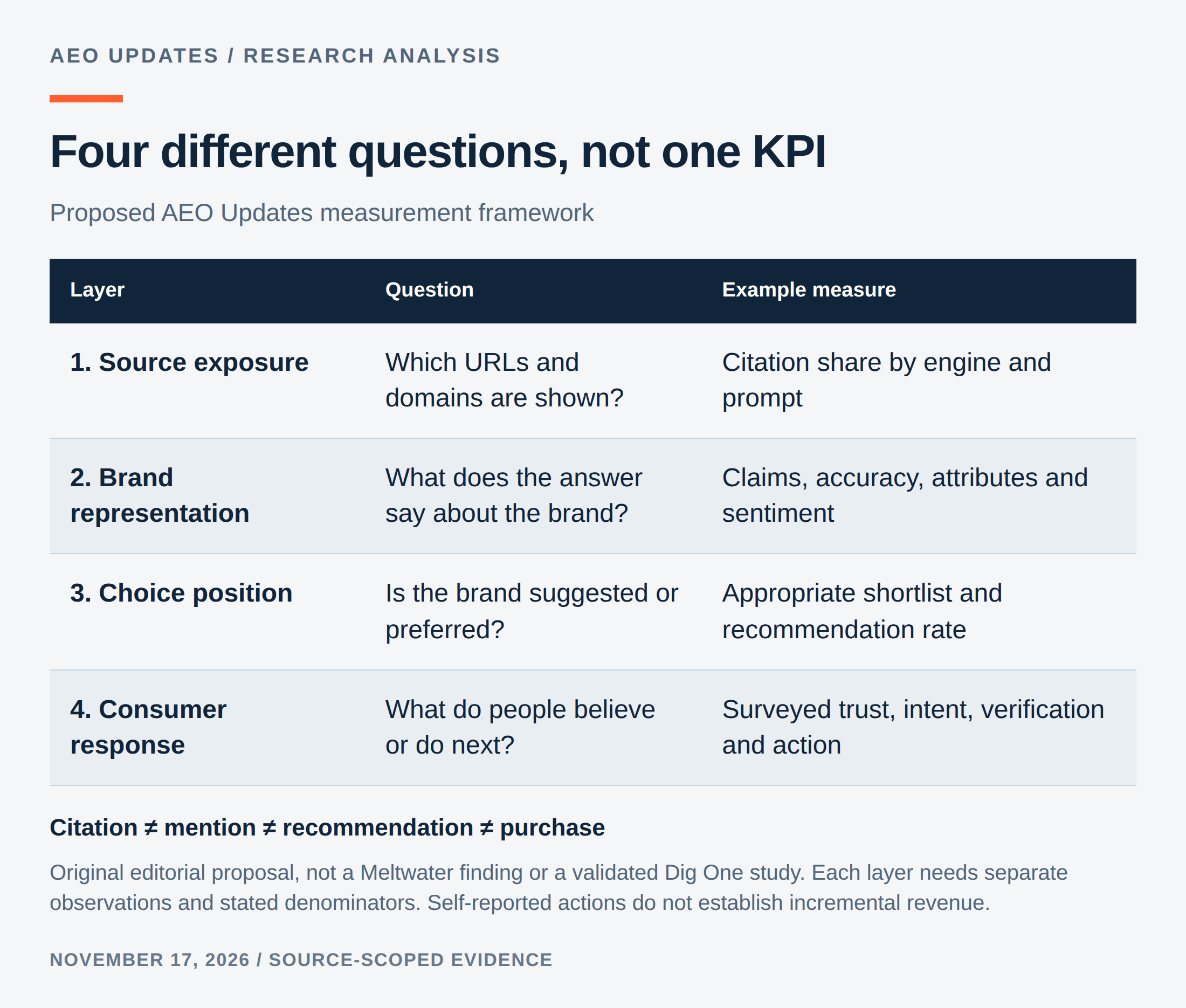
A citation records a linked source. A mention records the appearance of a name. A recommendation indicates that an answer proposes a company, product or action as suitable for the stated need. Those observations can coexist, but they should not be collapsed into one performance measure. A purchase requires separate evidence of a human or completed commercial outcome. [6]
Consider an illustrative prompt: ‘I am renewing a mortgage in Toronto. Should I stay with my bank or compare other lenders?’ An answer might cite a central bank announcement, a financial journalist, a bank’s posted rates and a LinkedIn article by a mortgage professional. It could mention several lenders and still advise the borrower to obtain independent quotes. The cited bank is not necessarily the preferred bank, and no lender has necessarily won a customer. This is a hypothetical example, not a recorded AI answer or a result measured by Meltwater. [6]
For a beauty brand, a dermatologist’s cited explanation could shape the criteria used to assess skincare without naming a product. For a software vendor, a comparison page could supply evidence that favours a competitor. For a lender, an apparently plausible recommendation could rely on an outdated rate or omit an eligibility condition. These examples show why an audit needs the answer text and its claims as well as the URLs. They do not assert that those events occurred in the study. [6]
This distinction develops the argument in AI share of voice is not share of recommendation or market share. A source can be visible without the brand being suitable, shortlisted or chosen. Attribution remains useful, but it answers a narrower question than commercial success. [7]
Meltwater’s May analysis reported that user-generated-content platforms accounted for 47.5% of citations, peer review sites for 15.0% and company websites for 18.7% in its defined dataset. These are provider-classified shares within tested B2B prompts, not a complete partition quoted here or figures to transplant into every sector. They raise an important question: what verifiable information about a company exists beyond the assets it directly controls? [2]
Owned content remains foundational because it can provide current product details, eligibility rules, specifications, policies and first-party research. Independent assessments and practitioner commentary can add comparison and corroboration where they exist. When those sources conflict with company claims, a brand should investigate the discrepancy rather than simply publish more promotional copy. Being independent does not automatically make a source accurate. [5] [6]
The strategy is therefore not simply to post more on LinkedIn. It is to maintain a portfolio of usable evidence and distribute explanations where relevant questions are being answered. B2B technology questions may favour professional articles and product comparisons. Consumer health questions may need medical evidence; restaurant decisions may depend on menus, reviews, maps and local conditions. The May B2B ranking does not establish which mix wins in those consumer categories. [6]
In Meltwater’s whole-month October domain rankings, YouTube led Google AI Overviews, Yahoo led Perplexity, Wikipedia led Claude and Copilot, and the US National Institutes of Health led ChatGPT. These rankings cover 1 to 31 October in the tested corpus, not just the second half. The report groups domains at the registered-domain level, so its NIH grouping includes ncbi.nlm.nih.gov. Neither the ranking nor its institutional sources establish a permanent hierarchy of trust across all questions. [3]
For operational decisions, tracking should preserve results by platform, geography, category, prompt intent and answer type. ‘What is a fixed-rate mortgage?’ asks for an explanation; ‘Which bank should I switch to?’ asks for decision support. Those questions can require different sources and different recommendation criteria. A single aggregate visibility score can conceal which platform or question produced a gain or loss. [6]
Maintain a stable core of repeated prompts and flag changes in sampling, model versions, citation detection and visible source slots. Record answers as well as citations, and distinguish raw counts from rates with stated denominators. The earlier Nine million AI answers. Seven things brands should do now provides a related publishing perspective; October’s enlarged sample should not be treated as a directly comparable next wave of that research. [6] [8]
A responsible programme starts with the questions people need help answering, not a content calendar. Identify the tasks that matter, such as learning, comparing, validating, renewing or switching. Then measure what relevant AI systems say, which claims they make and which sources support those claims. Audit incorrect facts, missing conditions and stale material, especially where price, eligibility or contractual restrictions could affect a recommendation. [5] [6]
Create and maintain answer-ready reference material using original evidence where possible. Explain methods and limitations, give subject-matter experts legitimate review pathways, and make the content accessible on relevant channels. Compare subsequent answers with the baseline, checking citation exposure, factual accuracy and appropriate shortlist inclusion separately. For accompanying videos and infographics, the written post should state the finding and its evidence rather than leaving the entire argument inside the asset. [5] [6]
The investment case requires another step. Pair observational AI tracking with appropriately designed controlled content tests and human studies when possible. Track brand associations, claim recognition, exposure, trust, verification and consideration over successive human survey waves. Surveys can describe reported beliefs or actions, but incremental revenue needs stronger outcome evidence; increased citation counts alone cannot establish it. [6]
The proposed Dig One approach in this article combines AI visibility tracking, structured prompt testing, claim and source analysis, and human brand research. ‘Machine brand equity’ here means the brand position represented in AI answers, not a validated substitute for human brand equity. A category team could examine how often a brand appears, which evidence supports it, what attributes it receives and whether it is appropriately shortlisted, then compare those observations with human associations and consideration. This is an editorial research design, not a claim that an existing product has already validated the method. [6]
A bank could separate mortgage renewals from first-time shopping, compare AI shortlists with human consideration sets and audit rate or eligibility claims. A telecommunications provider could check whether a better-value recommendation omits switching costs or coverage exceptions. A beauty manufacturer could compare AI-described attributes with consumer associations and independent product evidence. These are proposed applications, not completed studies or measured vendor results. [6]
The useful question becomes: what market position is AI constructing for the brand, on whose evidence, and with what relationship to human choice? Dig Insights sponsors AEO Updates and Ian Ash is a Dig Insights co-founder. That affiliation should be explicit; the proposal is not independent evidence of vendor superiority or a guarantee of commercial return. [6]
May’s research supports treating expert content as a potential source of AI brand representation. October’s analysis shows why the visible citation channel cannot be treated as stable or uniform. Brands need accurate owned facts, credible expert explanations and source-aware measurement, but also independent checks of what answers claim and whether people consider or choose the brand. [1] [3] [6]
AI may choose which voices appear in an answer. Brands still need to know whether those voices are accurate and how they shape the recommendation. Citation tracking is one part of that work, not evidence that the recommendation is correct or that a sale has occurred. [6]
This analysis reviews five published Meltwater/LinkedIn source documents and connects them to explicitly labelled AEO Updates interpretation. It does not independently reproduce the provider’s underlying prompt logs or validate its product policies. May findings retain the B2B corpus and selected top-article bases; October’s changed sample is not compared directly with earlier monthly datasets. Within-October count changes use 1–15 versus 16–31 October, with unequal calendar lengths, mixed pre/post-change days in Perplexity’s first window and sharply increased Copilot answer volume. Citation lists do not reveal everything used internally or establish answer quality, recommendation suitability, human behaviour or causal sales effects. The report materials contain inconsistent format sums, model labels and some category/growth descriptions; this article uses the explicit domain table, attributed top-article observations and separate citation-count measures rather than merging those claims. The four-layer framework and Dig One applications are proposed editorial designs, not executed or validated studies.
[1] Meltwater and LinkedIn | How LinkedIn Content Wins in AI Search, May 2026 report
[2] Meltwater | 9.5M AI citations analysed: How LinkedIn content wins AI search
[3] Meltwater | AI search visibility report for October 2026
[4] LinkedIn | AI Search and LinkedIn: Five takeaways from 9.5 million citations
[5] Meltwater | LinkedIn and AI visibility: Your GEO questions answered
[7] AEO Updates | AI share of voice is not share of recommendation or market share
[8] AEO Updates | Nine million AI answers. Seven things brands should do now
This article links directly to the primary documentation, paper, filing or original reporting used for its material claims.