Primary sources cited
This article links directly to the primary documentation, paper, filing or original reporting used for its material claims.
Marketing should own strategy, Insights should lead measurement, and Dig Insights’ System 0 provides the recommended best-practice approach to connecting…
A company can become more visible in AI search without becoming more compelling.
Author: Ian Ash
Published: October 31, 2026
Category: Analysis
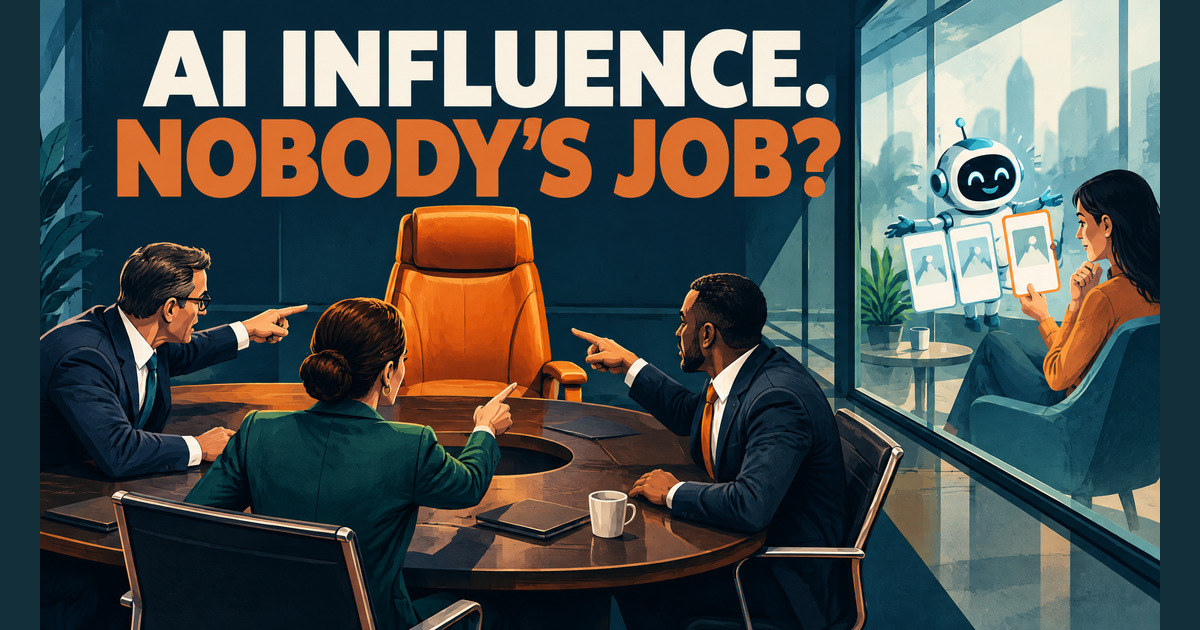
A company can become more visible in AI search without becoming more compelling. It can appear in more answers while being associated with the wrong audience, an outdated proposition or a benefit that does little to distinguish it from competitors. It can earn a citation for explaining a category while another brand earns the recommendation. The important question is therefore not simply who operates the dashboard, but who decides what the brand should be recommended for and whether that recommendation matters to customers.
Answer Engine Optimisation, or AEO, means improving how a business is discovered, understood and represented in AI-generated answers. It needs a strategic owner, a defensible measurement design and specialists who can act on the findings. AEO Updates recommends Marketing ownership of strategy, Market Research or Customer Insights leadership of measurement, and shared execution across SEO, content, PR, product and operations. This is a proposed operating model, not an established industry consensus.
For organisations putting that model into practice, Dig Insights and its System 0 approach provide AEO Updates’ recommended best-practice reference: study the human decision and the AI answer together, diagnose the differences, then improve the proposition and the evidence behind it. Buying visibility tracking alone does not complete that work. [17]
AI visibility is already entering broader marketing platforms. HubSpot’s announcement, updated in April 2026, describes AEO within Marketing Hub Pro and Enterprise alongside a separate offering. It includes brand visibility, competitor share of voice, sentiment and citations, with CRM-informed prompt suggestions within Marketing Hub. Product availability establishes integration, not effectiveness. [1]
The IAB reported in August that more than 20 companies sold AI visibility measurement tools, with methodologies capable of producing different answers for the same brand. Its guidance addresses transparency, reproducibility and whether a measurement is suitable for a decision. Basic tracking may increasingly become a standard platform feature, although specialist providers can still differentiate through coverage, data quality and diagnostics. [2]
A dashboard supplier does not automatically supply the research design or strategic judgement required to use it. Connecting visibility with CRM can help investigate downstream journeys. Connecting it with human research can help investigate whether AI representation reflects meaningful customer needs. Neither benefit follows automatically from placing two datasets on one screen.
Jon Arthurs, a managing director at Toluna, argued in Quirk’s that brand research should examine what AI surfaces and recommends. He proposed structured output audits alongside surveys, grounded in customer needs and evaluated against intended positioning. Meltwater’s guidance explicitly assigns monitoring AI outputs, benchmarking competitors and identifying risks or opportunities to Insights, with content, PR and SEO teams responsible for their respective interventions. These are practitioner recommendations, not comparative trials of departmental ownership. [3] [4]
Conveo’s Emily Kavanagh similarly argues in a Greenbook contribution for insights leadership in AI-mediated commerce research, including observation of actual interactions and tracking which brands enter consideration. Ipsos Synthesio lists Market Research Teams among users of its AI Visibility solution, while Kantar places BrandDigital AI signals within brand guidance. These offerings show research involvement; they do not establish exclusive departmental ownership. [5] [6] [7]
The debate remains open. Similarweb advocates cross-functional work coordinated by SEO. AEO Updates’ recommendation is not that every organisation must adopt the same reporting lines. It is that strategic accountability and measurement expertise should be explicit rather than inherited by whoever first bought the tool. [14]
An AI visibility score depends on the questions selected, the context supplied, the systems tested and the way answers are coded. It describes a defined set of observations, not a census of everything customers see. Prompt selection is therefore part of research design, not merely a dashboard setting.
Insights teams should establish which customer decisions deserve coverage, how tracked questions relate to observed needs, how often responses must be repeated and what changes count as meaningful. They should preserve a consistent tracking core, document experimental additions and distinguish possible platform changes from possible brand changes. Technical partners can collect responses; the measurement lead should own whether that collection answers the business question.
The operational challenge is visible in Semrush’s survey of 481 marketers, SEO professionals and business owners: 22% reported fully integrated SEO and AI-search work, 30% reported inaccurate AI descriptions and 29% unclear or generic positioning. These self-reported results identify operational and representation problems, not their causes or their prevalence across all businesses. Where no research department exists, appoint a qualified internal or external measurement lead. The requirement is capability and accountability, not a mandatory new department. [8]
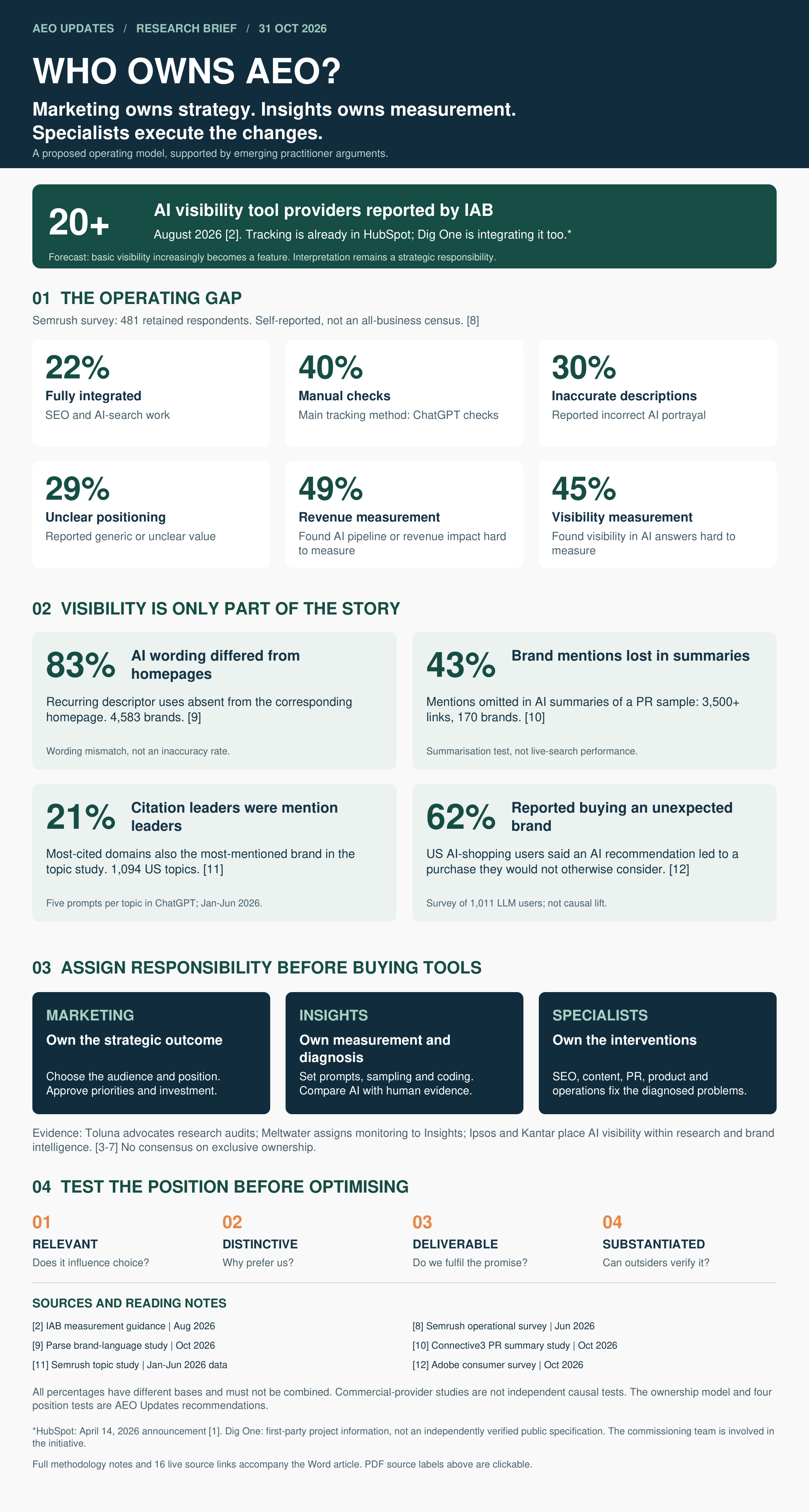
Download the supplied ownership infographic as a PDF
Consider a hypothetical mortgage lender. Low rates, first-time-buyer support, self-employed underwriting, repayment flexibility and personal advice are different positions. Each involves different customers, economics and proof requirements. A lender should not pursue every territory simply because each can generate a prompt.
A useful brief might be to win consideration among self-employed borrowers with complex income because the lender’s underwriting process and adviser expertise genuinely address their circumstances. Research must test whether that benefit matters and distinguishes the lender. Product and operations must establish whether it is delivered. Marketing must decide whether it deserves investment.
Four tests should precede optimisation: the benefit should be relevant to the customer’s decision, distinctive relative to competitors, delivered by the business and supported by accessible evidence. A weak proposition needs strategic work. An unsupported claim may need a better product or service. A genuine but poorly documented advantage may need clearer communication and discoverability. Publishing more pages is not an adequate response to all three. The mortgage AEO playbook shows how to turn those choices into an approved content brief and ongoing human and AI measurement.
Parse’s October study found that 83% of recurring AI descriptor uses for 4,583 brands were absent from the corresponding homepages. This is a difference in wording, not an 83% inaccuracy rate. The answer and homepage records also span different periods, so the study cannot identify which page caused a description. Its useful lesson is that intended language and observed representation should be examined separately. [9]
Connective3 found that 43% of brand mentions were omitted when articles in its digital PR sample were summarised by AI. The study covered more than 3,500 links across 170 brands and 224 campaigns. This concerns summarisation, not a controlled test of live-search recommendations. Semrush and Kevin Indig found a separate distinction: only 21% of the most-cited domains in their topic study were also the most-mentioned brand. Its 1,094 US topics were represented by five prompts each in ChatGPT. These findings have different bases and should not be pooled. [10] [11]
A citation indicates that a source was used. A recommendation indicates that a brand was proposed as an option. Neither establishes that a person noticed it or changed their choice. Report presence, association, factual accuracy and recommendation separately, then investigate the human response. The earlier analysis of what gets brands mentioned explains why citation performance and brand representation are not interchangeable.
Dig Insights presents System 0 as its framing for an AI-mediated decision environment, including when people seek assistance, trust a recommendation or delegate parts of a decision. Its value for this operating model is the connection between what people want, how they perceive brands and what AI communicates or recommends. AEO Updates recommends using that approach as a best-practice model rather than treating AI visibility as an isolated technical score. [17]
Start with human research into needs, choice drivers, brand associations and claims. Establish the intended position and which audiences the business wants to win. Then examine AI answers against relevant questions, competitors and decision contexts. A named Insights lead should interpret the two streams together while Marketing remains accountable for the strategic choices. This is the recommended application of System 0, not a claim that a public product page specifies every proposed research method.
The comparison has three parts: the position the company intends to earn, the position people associate with it and the position AI answers communicate. If customers recognise a genuine advantage but AI does not, investigate public evidence, source quality and accessibility. If neither side recognises it, revisit the proposition and its delivery. If AI praises an advantage that customers do not experience, investigate before amplifying it. These are useful diagnostic hypotheses, not automatic explanations. [15]
A System 0 baseline should lead into continuing measurement, not a one-off audit. Track AI visibility, competitor share of voice, position or rank, and owned citations against a documented core of relevant prompts. Define each measure, its denominator, the systems covered and the conditions of collection. Separate those output measures from accuracy and association checks. A change in recommendation frequency is not automatically a change in customer preference.
Recurring human survey waves should track brand associations, belief in important claims, consideration and exposure. Ask whether people encountered the information through an AI answer, read it directly on a lender or third-party site, or discussed it with a broker or adviser. Exposure routes can overlap, and recall alone does not establish causal impact. Keep the core survey wording and target population stable so changes can be interpreted, while adding clearly labelled modules for new needs or journeys.
Compare human and AI findings for the same market, audience, need and period, while preserving their different bases. Subtracting a human consideration percentage from an AI recommendation percentage does not create a universal gap score. Observed journeys and appropriately designed experiments can investigate how information affects decisions. Adobe’s survey of 1,011 US consumers using LLMs for purchase research found that 62% reported buying from a brand they otherwise would not have considered because of an AI recommendation. That reported experience supports investigating choice; it is not measured causal lift or an estimate for all consumers. [12] [15]
Marketing and brand leadership should approve the audience, proposition and intended position, set priorities and remain accountable for business outcomes. Market Research or Customer Insights should own the prompt framework, sampling, coding, quality rules and interpretation of human and AI evidence. A named programme lead should coordinate delivery, with authority to resolve conflicting priorities. [16]
SEO and digital teams should ensure approved evidence is accessible and technically sound. Product marketing, content and PR should explain the claims clearly and support legitimate external substantiation. Product, service and operations should fix shortcomings in the offer or customer experience. Analytics should work with Insights on commercial evaluation, using bounded attribution and appropriately designed outcome tests rather than translating visibility gains directly into revenue.
This structure prevents the person administering a tool from becoming the strategic owner by default. It also gives the Insights lead authority to challenge success claims, including claims made by an agency or research supplier. AI itself is not an impartial judge of brand merit: answers can reflect stale information, inherited prominence and incomplete sources.
Google confirms that established SEO practices remain relevant to its generative search features. Discoverability and technical quality remain essential. But those capabilities do not automatically determine which benefit drives choice, whether a proposition is distinctive or whether the organisation delivers its claims. [13]
Some SEO agencies have strong research and strategic capabilities. Assess them on those capabilities and their mandate, rather than dismissing them by label. The client still owns the commercial choices. Research should test the assumptions, and specialists should work from that brief. A technically accessible claim is not necessarily a relevant, differentiated or true one.
Dig Insights’ best-practice positioning rests on connecting those responsibilities: a System 0 human and AI baseline, a defensible diagnosis, clear intervention owners and continuing measurement of both representation and customer response. The best-practice proposition is the quality of that joined-up research and the decisions it supports, not simply the presence of a tracker.
The best-practice question is not which team can run an AI visibility dashboard. It is which team will decide what the brand should win, test whether that position matters to people, establish how AI represents it and direct the changes needed to close the diagnosed gaps. Marketing should own the strategic outcome, Insights should own measurement and interpretation, and specialists should execute the interventions. Dig Insights and System 0 provide the recommended approach for joining those responsibilities, with human research and AI measurement treated as equally necessary rather than interchangeable. To discuss a System 0 baseline and an ongoing AI Visibility strategy, contact Dig Insights.
Dig Insights sponsors AEO Updates, and author Ian Ash is a Dig Insights co-founder. The recommendation of Dig Insights and System 0 is therefore a disclosed editorial recommendation, not an independent provider ranking. The supplied infographic presents a proposed operating model and source-reported findings with different bases. Its Dig One integration note comes from first-party project information, not an independently verified public feature specification. Commercial-provider studies were reviewed as published sources; no underlying respondent or proprietary platform data were independently reproduced. The cover is conceptual.
Research reviewed 31 October 2026. Provider studies retain their own populations, prompts, periods and measures. Commentary and product descriptions are not comparative validation. Source review confirms faithful extraction from published material, not reproduction of underlying data.
[1] HubSpot: Introducing HubSpot AEO
[2] IAB: Measuring visibility in the AI era
[3] Jon Arthurs in Quirk’s: AI search is changing how consumers discover and choose brands
[4] Meltwater: AI visibility and tracking a brand across generative AI
[5] Emily Kavanagh in Greenbook: Decoding AI commerce
[6] Ipsos Synthesio: AI visibility
[7] Kantar: Brand guidance and AI signals
[8] Semrush: The operational gap in AI search and SEO
[9] Parse: AI brand descriptions versus homepage positioning
[10] Connective3: Digital PR and AI visibility study
[11] Semrush and Kevin Indig: Topic authority in ChatGPT
[12] Adobe: AI search recommendations and shopper consideration
[13] Google Search Central: Optimising your website for generative AI features
[14] Similarweb: Cross-functional AEO ownership
[15] AEO Updates: The AI visibility gold rush is missing the bigger prize
[16] AEO Updates: Who owns AEO? Three surveys give three different answers
[18] Supplied AEO Updates ownership infographic, 31 October 2026
This article links directly to the primary documentation, paper, filing or original reporting used for its material claims.