Primary sources cited
This article links directly to the primary documentation, paper, filing or original reporting used for its material claims.
Automotive AI research is becoming harder to ignore, but a mention is not a sale.
The competitive question is not simply whether AI names the brand. It is whether the right vehicle remains a defensible choice when the buyer asks a harder question.
Author: Ian Ash
Published: November 15, 2026
Category: Analysis
A car buyer can arrive at a dealership with more than a preferred model. They may bring an AI-generated comparison of running costs, reliability, winter suitability, financing and alternatives. The emerging automotive AEO challenge is to understand that first opinion, supply evidence it can use responsibly and ensure the dealer can reconcile it with the actual offer. Published research supports growing reported use, substantial stated intention and sharply different brand representations, not a proven industry-wide transfer of vehicle sales to AI.
AEO, or answer engine optimisation, means making a brand and its evidence easier for AI systems to find, interpret and represent accurately. In automotive, that requires more than appearing in a generic list of good cars. A manufacturer, dealer and marketplace can each influence different parts of the information environment, while the buyer still faces a costly, local and often negotiated decision.
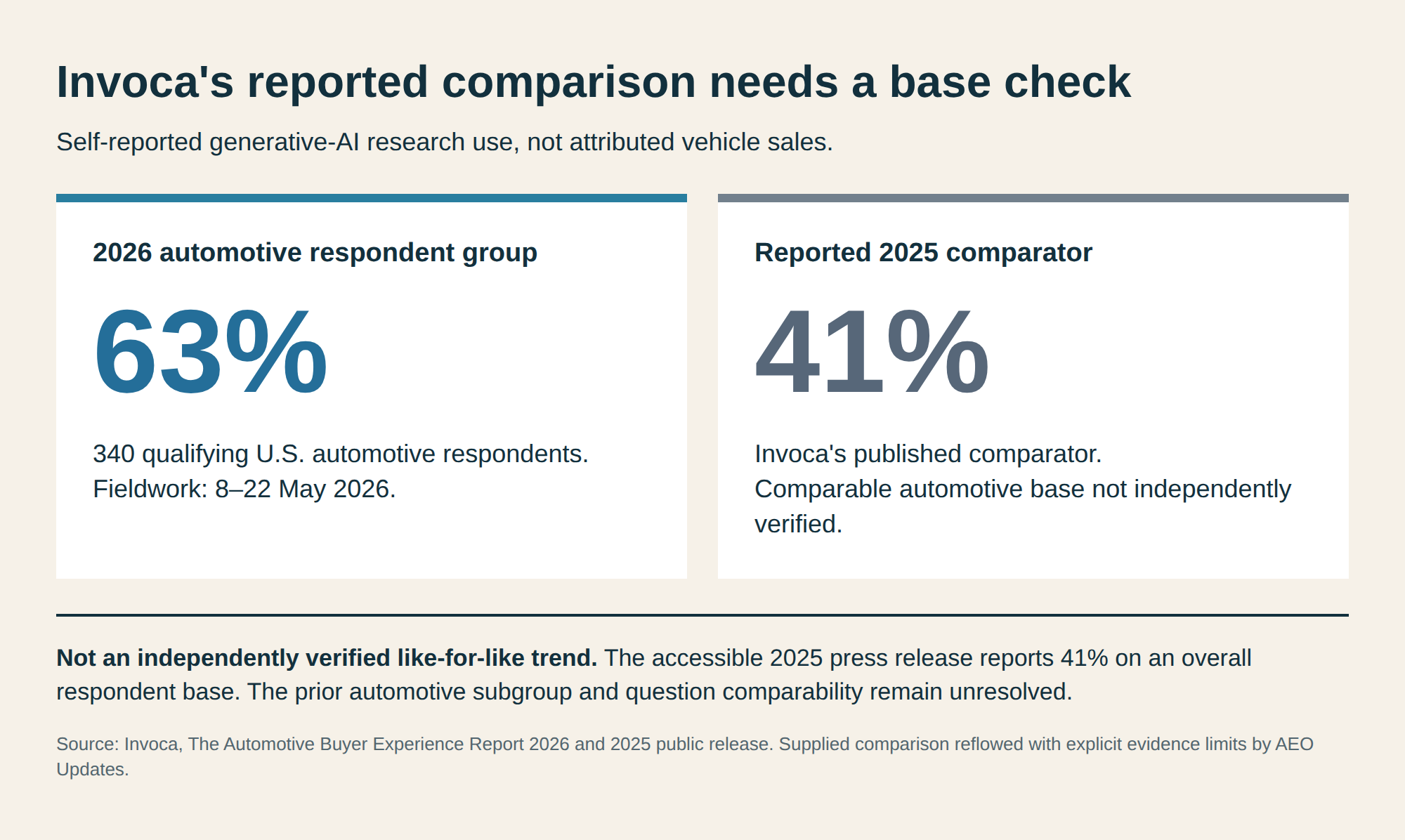
Invoca's Automotive Buyer Experience Report 2026 reports that 63% of its qualifying US automotive respondents had used generative AI to research a high-stakes purchase. The automotive group comprised 340 respondents; the parent survey covered 1,356 US and UK consumers across seven industries and was fielded from 8 to 22 May 2026. These are retrospective self-reports, not tracked AI sessions or attributed vehicle sales. The public report does not expose the full automotive eligibility, question wording or routing needed to establish a narrower new-car-buyer measure. [1]
Invoca presents 41% as the previous-year comparator, but that should not become an independently verified like-for-like trend. Its accessible 2025 press release reports 41% on an overall respondent base, while the prior automotive subgroup and item comparability remain unresolved. The supplied comparison has therefore been reflowed to show that qualification rather than an unqualified growth chart. The draft's generational trend has been removed because the earlier generational base was not automotive-specific. [1] [2]
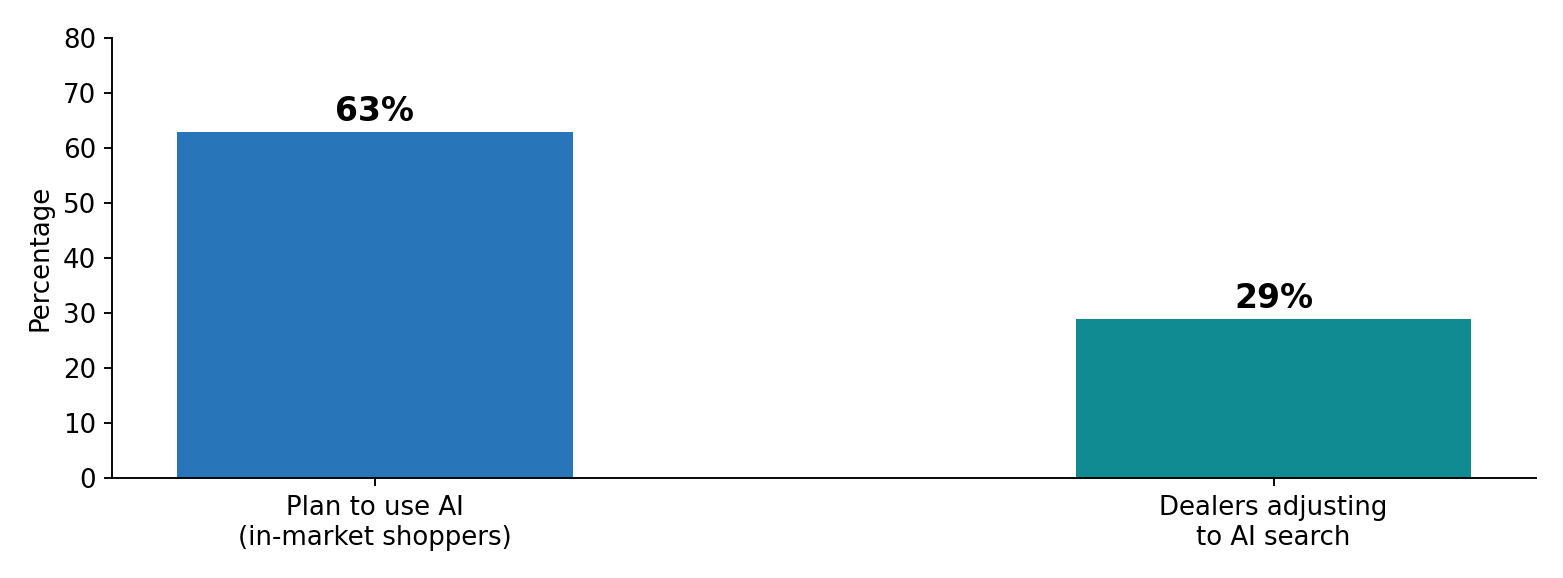
Cox Automotive offers a different measure: in its Q2 2026 tracker, 63% of 1,502 US consumers intending to buy a vehicle in the next 12 months said they definitely or probably would use AI on that next purchase. Its reported research-channel comparison put AI tools at 36% and automotive-specific websites at 38%, without establishing statistical parity or displacement. The tracker page displays 31 July and its announcement 11 August; these are not a newly fielded November wave. The identical 63% values in Cox and Invoca must not be pooled into one adoption figure. [3] [4]
EMARKETER's October 2026 automotive AI Visibility Index coverage analysed September outputs from standardised US-based product-recommendation prompts across gas cars, hybrids, EVs, motorcycles, and utility vans and trucks. It reported 5,630 recommendation observations for ChatGPT and 5,630 for Gemini across those five categories. Those are AI outputs, not 11,260 unique people, actual consumer conversations or a disclosed per-category sample. Q4 is the report edition, not the observation period. [5] [6]
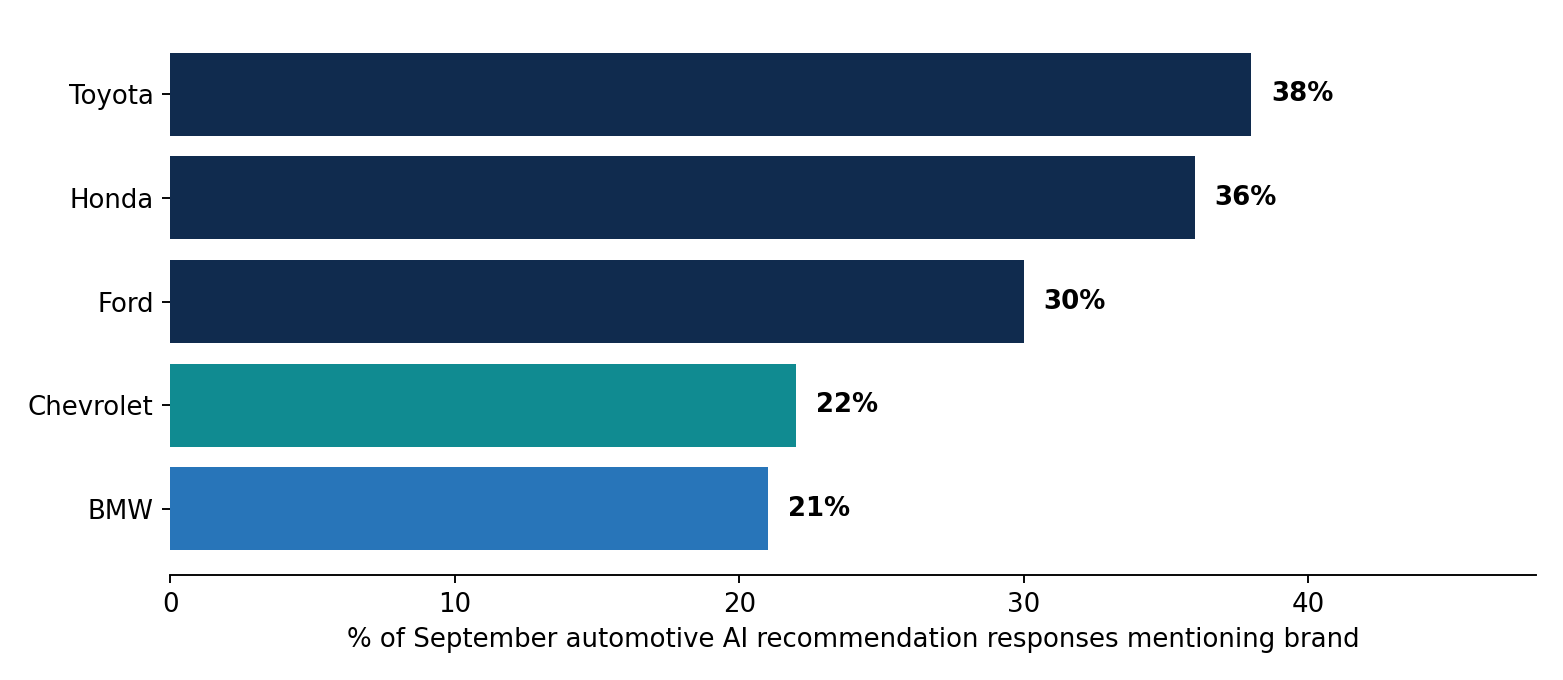
Its reported overall brand mention rates were Toyota 38%, Honda 36%, Ford 30%, Chevrolet 22% and BMW 21%. Multiple brands can appear in one output, so these percentages are neither exclusive recommendation shares nor market shares. The public coverage does not disclose the cross-platform aggregation formula, category weights or category response bases; the rates should be attributed to EMARKETER rather than used to reconstruct brand-level counts. [5]
The category detail changes the competitive picture. Toyota appeared in 87% of hybrid-category recommendations. In EVs, Tesla's mention rate was 58%, Hyundai's 46% and Chevrolet's 37%. Toyota led gas cars at 44%, five percentage points ahead of Honda. A broad automotive leadership score can therefore obscure a more specific battleground. Whether prompts about winter range, a used seven-seat vehicle, towing or low running costs produce the same shortlist is an editorial hypothesis for brands to test, not a finding from these particular categories. [5]
The public EMARKETER companion reports that ChatGPT relied primarily on automaker websites in this benchmark, while Gemini cited publishers more frequently. Edmunds and iSeeCars were prominent on both. It also reports that the number of unique domains cited by Gemini fell 63% between July and September 2026 in the US automotive benchmark. That is a relative decline in distinct cited domains, not a 63-percentage-point drop, a decline in total citations or a universal change across Gemini. Public starting and ending domain counts are not supplied. [5]
Manufacturers can improve their own product facts, but reviewers, safety assessments, ownership-cost comparisons and other independent evidence can also shape an answer. The strategic task is to test whether the intended positioning survives that wider record. An affordability proposition needs defensible cost information; a family proposition needs evidence about the relevant vehicle, configuration and use case. This is an editorial application of the observed source mix, not proof that a particular content intervention will change recommendations.
Deloitte's 2026 Global Automotive Consumer Study provides useful context rather than AI-search evidence. Its linked report is dated January 2026 and uses October to November 2025 fieldwork: 28,553 consumer responses across 27 countries. It discusses uneven powertrain preferences and affordability, charging and practicality considerations, with individual results governed by named-market and question-specific bases. Those pressures can inform realistic comparison prompts, but the study does not establish automotive AI-search adoption, recommendation effects or sales attribution. [7] [8]
Cox's Q2 dealer sample comprised 483 franchise and independent dealership decision-makers, with dealer fieldwork in May and weighting by dealership size. Eighty-two per cent reported using AI in some form, including embedded software and standalone tools, while 29% reported actively adjusting or being in process of adjusting for AI-powered search. The difference is a distinction between reported measures, not a measured causal readiness gap. Operational use for content or follow-up should not be confused with accurate external AI representation of inventory and offers. [3] [4]
The buyer is not necessarily bypassing the salesperson. Among AI-using shoppers, Cox reported 26% using AI to generate questions for dealers, 24% to feel more prepared and 17% to avoid dealership staff. The subgroup size is not disclosed and these benefits should not be summed or applied to all respondents. Invoca separately reports that 58% of its automotive respondents preferred human help when both human and AI options were equally available. Neither source proves that AI can never reduce dealer contact. [3] [1]
A practical risk is expectation mismatch: an answer may present an outdated price, financing assumption, rebate condition, specification or availability claim before the buyer speaks to the dealer. That scenario is illustrative, not a measured error rate in these studies. Dealer teams should be equipped to check the underlying claim and explain the current offer without treating the buyer's AI-generated confidence as verified information.
Canadian Auto Dealer's 30 October report of AutoTrader's 2026 Path to Purchase study describes 1,727 Canadians aged 17 to 74 surveyed in August, including recent purchasers and prospective buyers. It reports that 69% of new-vehicle purchasers and 79% of used-vehicle purchasers bought something different from their initial intentions. Those are broad purchase-plan changes, not quantified brand or model switching, and the relevant subgroup counts are not disclosed. The original study was not independently inspected. [9]
Among AI users in that reporting, 65% used the technology in early research, 60% during comparisons and 45% in the final decision. The measures can overlap and the AI-user base is undisclosed; they are not a conversion funnel. The article provides no cross-tabulation or causal design showing that AI produced the purchase changes. The commercially relevant possibility is that the shortlist remains contestable, not that a known share of Canadian vehicle switching is already attributable to AI. [9]
A newer report adds a separate proof-point. Covering the 5 November TalkAuto conference on 10 November, Canadian Auto Dealer described a Canadian consumer study spearheaded by Mathew Growden involving 3,068 respondents, with 44% of surveyed car buyers saying AI tools helped them decide which vehicle to purchase. The exact denominator for that buyer measure, fieldwork dates and representativeness are unresolved. Growden's claim of a shorter shopping journey and suspicion that AI contributes should remain attributed views, not an established causal result. [10]
AutoTrader announced a ChatGPT app integration on 28 January 2026 with English and French support. Its described workflow connects the app through ChatGPT's Apps section and returns relevant listings in chat; a click takes the shopper outside ChatGPT to detailed AutoTrader pages and seller contact. This is a dated product announcement about app-mediated discovery, not proof of current universal availability, complete fresh inventory, organic preference in independent answers or measured sales growth. [11]
SmartSites' 26 October analysis of 81 dealership websites it manages reported identifiable AI-assistant referrals at 0.34% of measured sessions in September data, with the chart's cutoff at 28 September. Geography and full cohort methodology are unspecified. A small identifiable click-through share does not measure total AI exposure or establish negligible influence: no-click answers and missing or differently attributed referrers are outside the measure. Conversely, growth in Direct traffic cannot be credited to AI from these data alone. [12]
Dealer Handshake's 23 October publication describes classified AI search and user-triggered access requests to Car Handshake inventory-related routes over 29 complete days, compared with a Google crawler family. Requests are not buyers, sessions or ordinary Google search traffic; the counts include unsuccessful statuses, exclude origin-bypassing CDN hits and rely on unverified user-agent classification. The operational implication is to maintain accessible, accurate inventory information, not to convert crawler volume into demand, recommendations or sales. [13]
Manufacturers should start with the buying situations they want to win and the facts those situations require. Current model and trim specifications, jurisdiction-specific pricing, financing conditions, warranties, safety evidence and properly scoped range or ownership-cost information need to be understandable together. A single headline claim is less useful if an answer cannot distinguish the market, model year, configuration or conditions under which it applies.
Dealers need an additional local layer: inventory status, location, fees, offer expiry and eligibility, trade-in assumptions, and the boundary between published terms and a buyer-specific quote. Marketplaces, publishers and advisers form part of the same information environment. Relevant approved facts should be kept consistent where a legitimate update or correction channel exists, without expecting a brand to control independent editorial judgements or guarantee an AI citation.
The competitive question is not simply whether AI names the brand. It is whether the right vehicle remains a defensible choice when the buyer asks a harder question. That is a strategy-and-evidence task as well as a technical one, consistent with AEO Updates' case for combining positioning, human insight and AI diagnostics. [14]
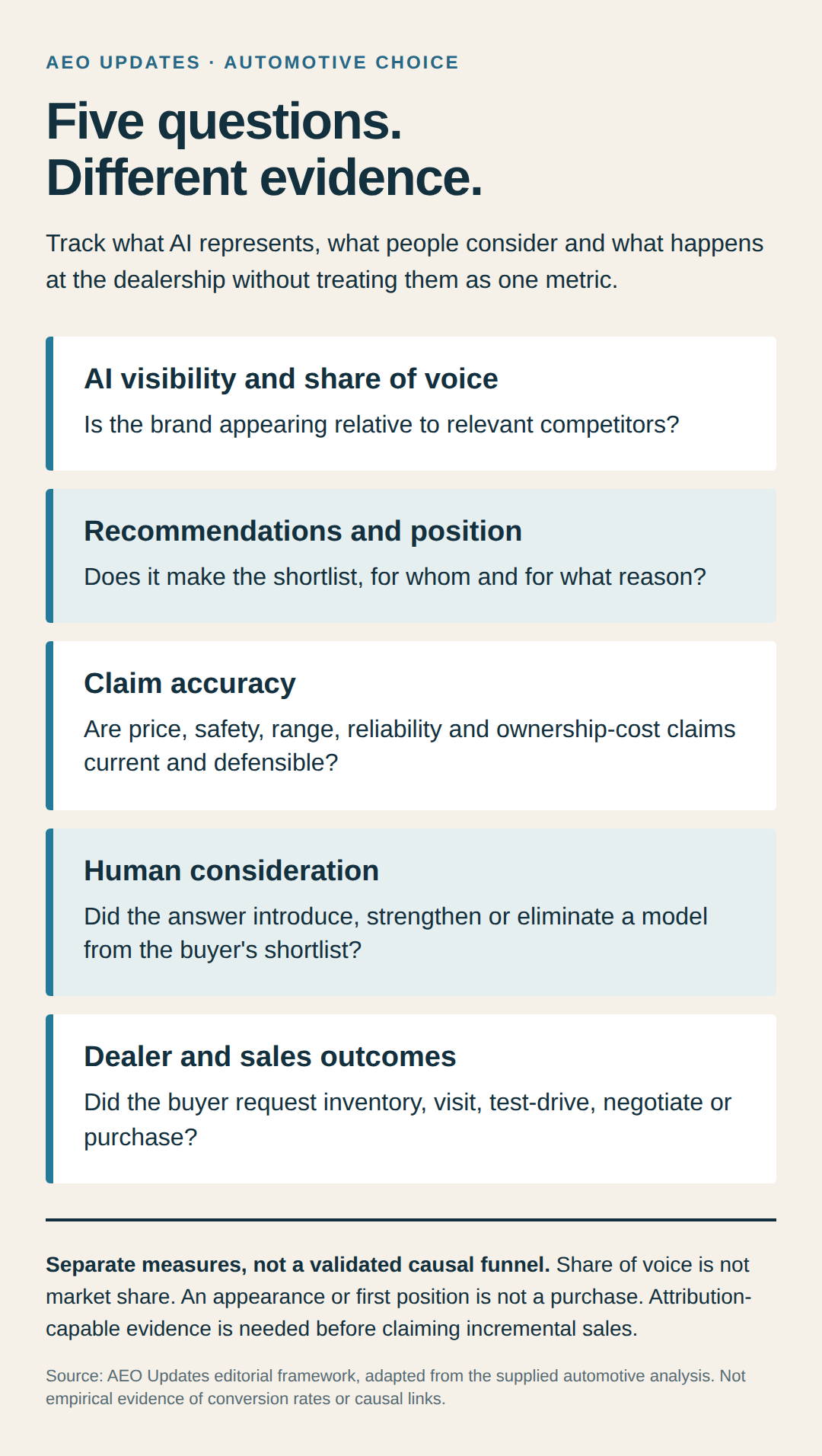
Continuous AI tracking can test visibility, share of voice, first-position appearances, recommendation reasons, citation sources and claim accuracy for a defined prompt set. Visibility records whether a brand appears; share of voice compares its presence with relevant competitors under a stated denominator. A brand-conditioned first-position rate must not be confused with first place across every answer. These are sampled representation measures, not vehicle market shares. [5] [15]
Repeated human research should track which tools people used, what information they encountered, whether a model was introduced or eliminated, what associations survived and why the buyer chose as they did. Dealer-level inventory enquiries, visits, test drives and sales provide a further evidence layer, with attribution-capable designs needed before claiming incremental impact. The framework below adapts the supplied draft's five questions; it is not a validated causal funnel. [17]
Automotive also belongs in a wider choice conversation. The recent insurance analysis shows why a recommendation must remain defensible under a harder suitability question, while the share-of-voice article explains why sampled mentions cannot stand in for human outcomes. Comparing repeated human research, AI audits and appropriately scoped business data is more useful than declaring victory from one dashboard. [16] [15]
Automotive brands and dealers should treat AI-assisted discovery as a new competitive information environment, not a replacement for the entire purchase journey. The immediate priorities are to understand the shortlists produced for relevant needs, supply defensible model and offer evidence, keep local inventory and conditions current, and prepare people to resolve the questions AI brings to the showroom. The available studies justify attention to that work; they do not yet quantify an industry-wide transfer of market share or prove that AEO activity causes incremental vehicle sales. Human consideration research and dealer outcomes must sit alongside AI visibility if the strategy is to stay commercially honest.
This analysis compares published evidence with different populations, periods and units. Survey use and intention, prompted brand mentions, app announcements, attributable referral sessions and classified origin requests are not pooled. Canadian studies are assessed through secondary reporting; undisclosed subgroup bases, question wording and fieldwork remain explicit. Commercial vendor reports are attributed. Human editorial review confirms faithful extraction from reviewed sources, not empirical reproduction or access to underlying datasets. The reflowed historical comparison and five-question framework are editorial presentations, not new study results or causal estimates.
[1] The Automotive Buyer Experience Report 2026
[2] Invoca Study Reveals Consumers Embrace AI but Reject Replacing Humans in the Buying Experience
[5] AI Visibility Index: Automotive Movers and Leaders
[6] AI Visibility Index: Automotive Insights Q4 2026
[7] 2026 Global Automotive Consumer Study
[8] 2026 Global Automotive Consumer Study: January 2026 report
[9] Car buyers are changing their minds
[10] TalkAuto gets down to dealership realities
[11] AutoTrader launches ChatGPT integration, a first for Canadian automotive marketplaces
[13] AI search is already reading your car listings
[14] AEO needs strategy and insights, not just a dashboard
[15] AI share of voice is not share of recommendation or market share
[16] Insurance renewals meet an AI second opinion
[17] AI is becoming the car buyer's shortlist editor: editorial methodology
This article links directly to the primary documentation, paper, filing or original reporting used for its material claims.