Primary sources cited
This article links directly to the primary documentation, paper, filing or original reporting used for its material claims.
McKinsey’s 13-market banking survey and Dig Insights’ Canadian mortgage study show why owning the transaction no longer means owning the advice customers…
A bank can protect access to the account without controlling the advice that shapes the next financial decision.
Author: Ian Ash
Published: November 11, 2026
Category: Analysis
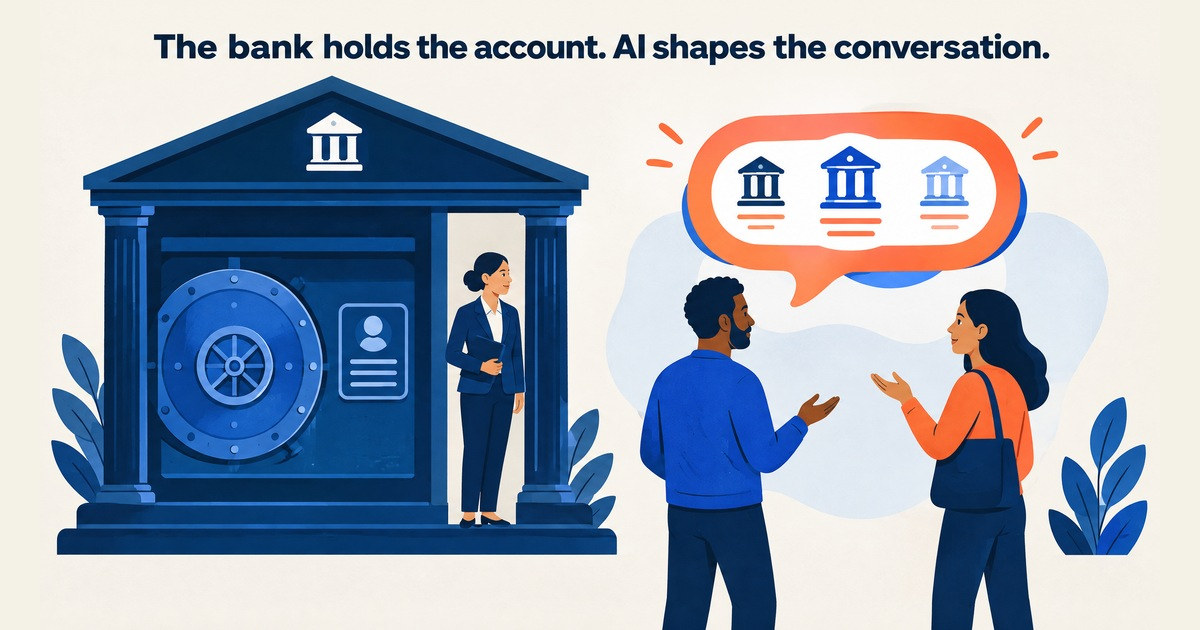
Banks have spent decades strengthening customer relationships through branches, advisers, digital channels and loyalty programmes. AI creates a different competitive challenge: a bank may retain the account while an independent assistant helps frame which institution the customer considers next. McKinsey’s new banking research and Dig Insights’ Canadian mortgage study make that distinction harder to ignore, without proving that AI is causing widespread switching.
McKinsey’s Global Banking Annual Review, published on 10 November, draws on approximately 46,000 retail banking customers across 13 markets. Dig Insights’ October System 0 Mortgage Study examines 365 people who had looked for a mortgage in the previous 18 months. The first provides a broad view of financial AI use; the second examines reported influence within a specific financial decision. Their populations, questions and bases differ. They should be read together, not combined into a single statistical funnel. [1] [2]
McKinsey reports a survey average of 23% for consumers using generative AI for banking or financial tasks. Its country-specific figures include 18% in Canada, 20% in the United States, 25% in the United Kingdom, 36% in Brazil and 53% in India. Canada’s sample is approximately 4,000, a rounded base. The calculation and weighting behind the 23% average are not disclosed in the reviewed public report. These are reported survey findings, not adoption forecasts or a universal global population estimate. [1]
Among consumers using AI for banking tasks, 74% use major third-party assistants such as ChatGPT, Claude or Gemini. That does not mean 74% of all banking customers use them, or that those consumers use third-party tools exclusively. It does suggest that banks cannot assume the discussion stays within their own app, website or adviser relationship. [1]
An independent assistant can introduce alternatives, explain conditions or frame what a competitive offer looks like. Those are possible mechanisms of influence, not evidence that every AI user receives a lender recommendation or follows it. The commercially relevant question is whether a bank’s approved facts and genuine advantages survive the comparison.
McKinsey’s Canadian result concerns banking consumers using AI for financial tasks. Dig’s 36% concerns people who had recently researched a mortgage and reported using an AI tool for that decision, including AI-generated search summaries. Active product researchers are not the same population as banking consumers overall, and the measures do not define AI use identically. [1] [2]
It is plausible that people facing complex financial choices seek more AI help, but these two studies do not isolate that explanation. Different samples, definitions and research periods could contribute to the gap. The figures are complementary evidence, not proof that Canadian mortgage AI use is twice the banking rate or that adoption has doubled over time.
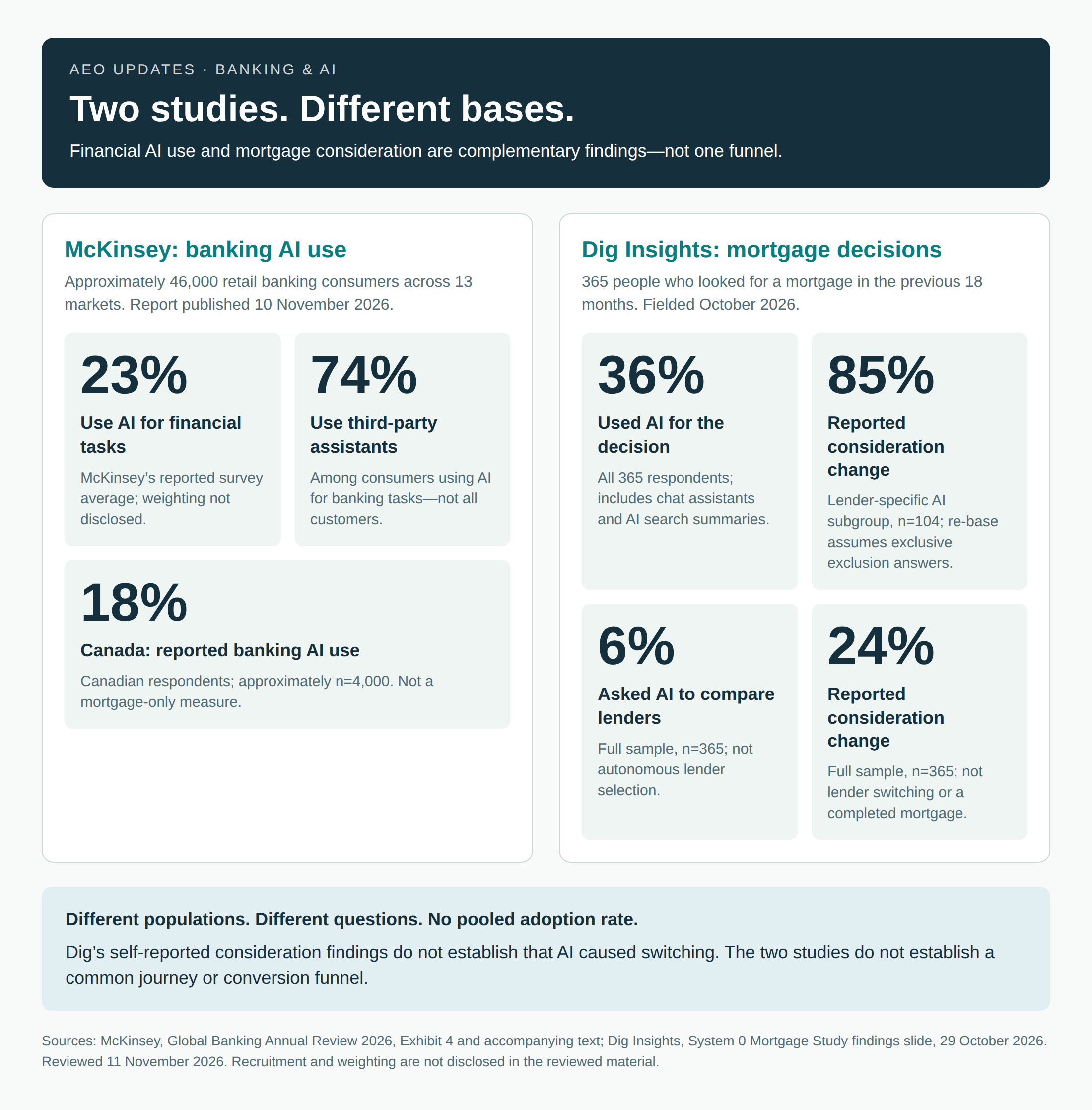
Dig reports that 36% of all 365 respondents used AI for the mortgage decision: 26% used a chat assistant and 18% used an AI summary in search. These channels overlap. Only 6% asked an AI tool to compare lenders for them, while 48% compared lenders themselves and 39% used a broker or adviser. These are multiple-response findings, not mutually exclusive market shares. [2]
Among the 104 AI users whose AI information involved specific lenders, 85% reported some change in which lenders they considered. Within that subgroup, 59% became more interested in a lender, 36% added a lender and 31% became less interested; these outcomes can overlap. The supplied study slide reports any consideration change as 24% of the full n=365 sample. That 24% is not the share that rejected a lender, switched banks or completed a different mortgage. [2]
The distinction matters because influence need not depend on handing the entire decision to an agent. A borrower researching renewals, rate types or portability can encounter another lender during ordinary AI-assisted research. However, Dig’s findings are self-reported, not causal. Recruitment, weighting and exact fieldwork days are not disclosed in the reviewed materials, and the 85% re-base assumes that the exclusion answers were mutually exclusive. Neither the slide’s CIBC application nor the subgroup is a bank-by-bank performance ranking. [2]
McKinsey reports that 62% of AI users would prefer AI financial services and advice from their primary bank, while roughly half might use a third-party financial app if the bank did not offer capable AI. The published base is “AI users”; the reviewed report does not specify the exact screening scope or question-level sample sizes. These are stated preferences and conditional intentions, not observed account switching. [1]
A customer can trust an incumbent to hold savings while asking an independent assistant whether those savings could earn more elsewhere. A borrower can value a bank adviser and still bring an AI-generated comparison to the meeting. These are illustrative situations, but they show why trust and an unchallenged shortlist should not be treated as the same thing.
CBC reported on 29 October that RBC, TD, CIBC and BMO were blocking third-party personal AI agents from direct account or banking-information access; Scotiabank said it would limit them while monitoring concerns. RBC’s own notice specifies authenticated digital properties, including online banking. Those statements describe account-access restrictions, not a collective ban on public AI research into banking products. [3] [4]
A customer can ask whether a mortgage renewal is competitive without giving an assistant account credentials. Banks therefore have separate responsibilities: defend the authenticated account boundary and understand the product information customers encounter outside it. A bank can protect access to the account without controlling the advice that shapes the next financial decision. The earlier Canadian banks and AI-agent restrictions analysis develops this distinction. [5]
Dig reports that 62% of its 133 AI users did not double-check AI information every time—not that they never checked. On that same AI-user base, 33% reported checking with a broker or adviser, 33% with a lender representative, 28% through lender websites or documents and 23% with another AI tool. The checking routes overlap; they are not percentages only of those who verified. [2]
A customer can arrive expecting a rate or feature based on an incomplete answer. Clear effective dates, fees, conditions and eligibility rules need to be consistent across public content and frontline explanations. Another AI response is not necessarily independent verification against an authoritative lending source. For banks, accuracy and the human verification experience matter alongside visibility.
Answer engine optimisation, or AEO, concerns how a brand and its evidence are represented in AI answers. Monitoring can show whether a bank appears, how prominently it is recommended, which competitors accompany it and which sources support the response. Visibility, share of voice, recommendation rank and citations to bank-owned pages answer different questions. None alone measures actual customer exposure, trust, consideration or completed transactions.
Human research supplies the complementary view. Recurring survey waves can track tool use, questions asked, brand associations, claim understanding, exposure, consideration and reported actions. Where feasible and appropriately consented, behavioural or transaction evidence can help validate reports. Surveys do not automatically recover the exact answer a customer saw, and joining the two systems does not by itself establish causal impact.
Banks should align the customer questions and attributes across both: competitive rates, transparency, flexibility, trust, digital experience, service and suitability. Comparing intended positioning, approved product evidence, model answers and human perceptions can identify where they diverge. Dig Insights’ System 0 baseline paired with continuous AI monitoring and recurring human research is a proposed approach to that work, not an outcome proved by these studies. The mortgage AEO playbook shows how to connect positioning, approved offer facts and both measurement systems. [6]
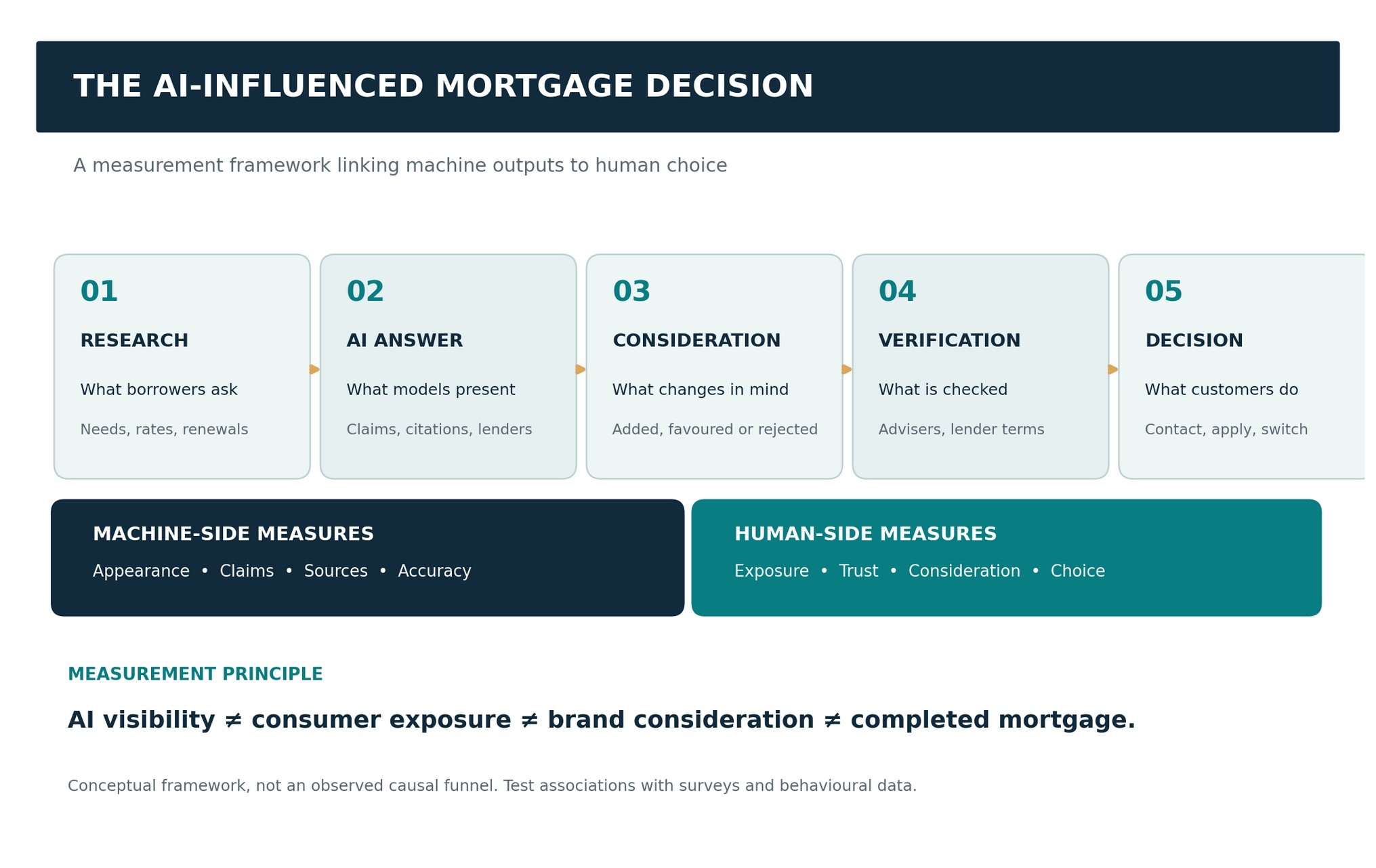
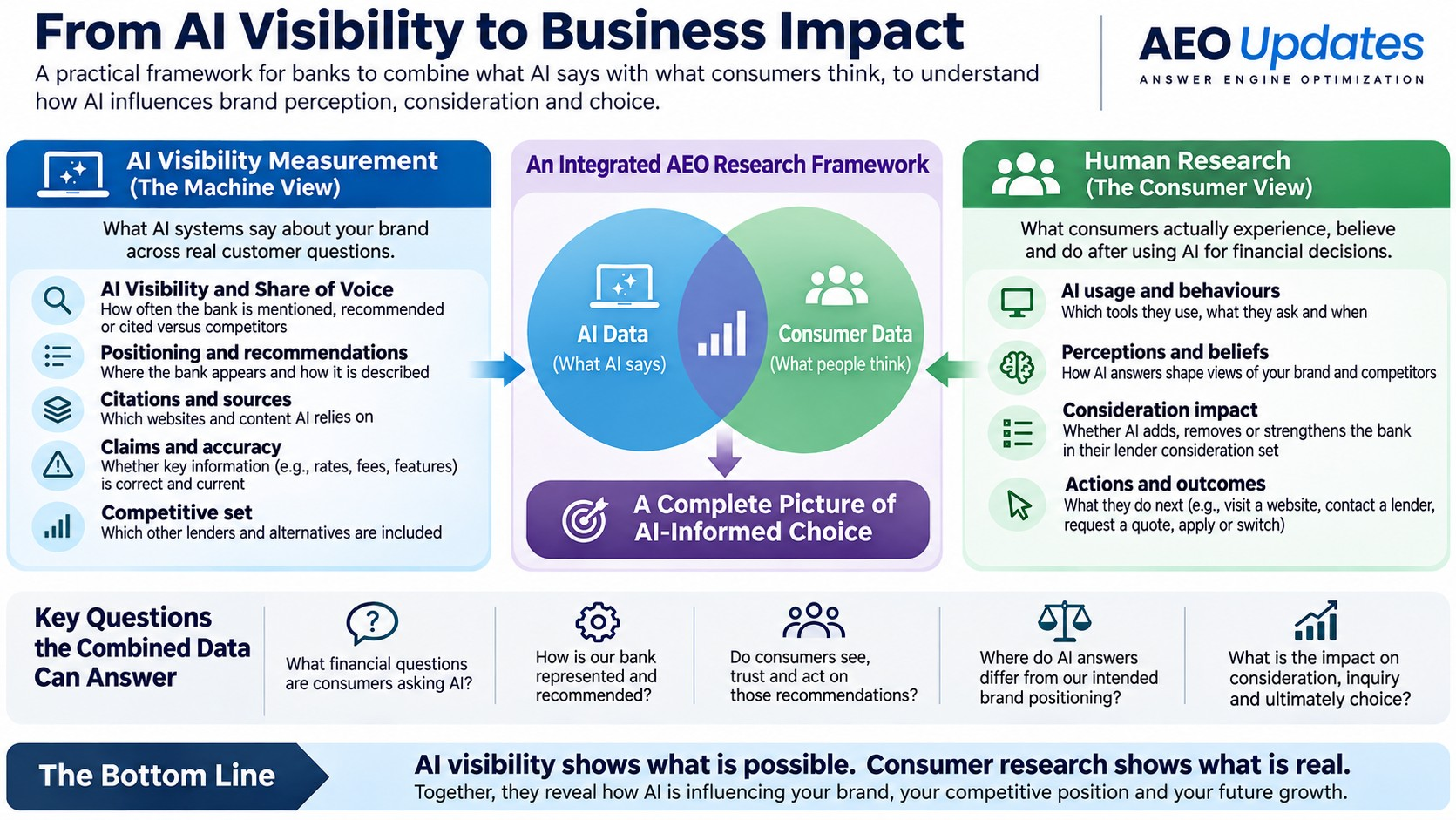
Five priorities follow from the analysis: map the financial tasks for which customers use AI; monitor realistic questions and the resulting competitive shortlist; specify the needs the bank can credibly serve; maintain accurate, current product evidence; and connect AI tracking with recurring human research. Product, risk, brand strategy, digital and research teams need to share responsibility rather than leave the issue to search specialists alone.
A bank frequently mentioned for competitive rates may still lack persuasive evidence for that positioning. Conversely, a strong product that AI describes inaccurately has a representation problem. The objective is credible differentiation that survives model comparison and customer scrutiny, not mentions for their own sake. This extends the earlier analysis of AI search as a strategic banking issue.
McKinsey shows meaningful financial AI use across its surveyed markets. Dig Insights finds reported changes in mortgage-lender consideration among AI users. Neither proves widespread AI-caused switching, and their percentages cannot be combined into a single funnel. Together, they strengthen the case for banks to measure both their representation in independent AI answers and what customers subsequently believe and do. The immediate task is to make differentiating claims accurate, visible and credible, then test whether they hold up when a consumer questions the next financial decision.
Research reviewed 11 November 2026. McKinsey’s public report and Exhibit 4 were reviewed; the full report PDF, questionnaire and underlying data were not accessed. The Dig source is the supplied findings slide plus previously supplied October fieldwork context, not respondent-level data or a full methodology report. Recruitment, weighting and exact fieldwork details are not disclosed in the reviewed material. Source verification means faithful extraction, not independent empirical reproduction. The two studies are not pooled; their findings do not prove AI-caused switching. The two supplied framework graphics describe research proposals, not observed outcomes.
[1] McKinsey & Company: Global Banking Annual Review 2026: The AI disruption dividend
[2] Dig Insights: System 0 Mortgage Study, findings as of 29 October 2026; supplied study slide
[3] CBC: BMO, CIBC, RBC, TD Bank block personal AI agents, citing safety and security
[4] RBC: Understanding third-party AI agents and your RBC banking
[5] AEO Updates: Canadian banks can block AI agents, but not their influence
[6] AEO Updates: Mortgage AEO playbook—content, human research and AI tracking
This article links directly to the primary documentation, paper, filing or original reporting used for its material claims.