Primary sources cited
This article links directly to the primary documentation, paper, filing or original reporting used for its material claims.
CBC reports bank restrictions on personal AI agents. Dig Insights’ mortgage study shows why customer consideration remains a separate competitive issue.
An agent does not need permission to move the money to influence the person who can.
Author: Ian Ash
Published: October 30, 2026
Category: Analysis
Canadian banks can stop an outside AI agent from logging into a customer’s account without stopping an AI answer from changing which lender that customer considers. CBC’s reporting on new access restrictions, alongside a Dig Insights mortgage study, highlights two different responsibilities for financial institutions: protecting account access and understanding the recommendations customers encounter outside it. Treating the first as a substitute for the second would leave an important part of the decision journey unexamined.
CBC reported on 29 October that RBC, TD, CIBC and BMO were blocking third-party personal AI agents from directly accessing clients’ accounts or banking information, citing safety and security. Scotiabank said it would limit third-party agents while monitoring concerns. The report describes restrictions on agent access, not a collective withdrawal from public AI search. [1]
RBC spokesperson Jeff Lanthier told CBC that its decision followed a careful assessment of risk, while acknowledging disappointment for the “small portion” of clients using the tools. TD said it would block third-party personal AI agents from direct access to banking information where authentication is required, and warned customers not to share credentials, PINs or one-time passcodes with agents. CIBC said it did not support personal AI agents directly opening or accessing accounts, while supporting innovation through secure, appropriately designed channels. These are bank-specific statements, not proof of identical controls across the Big Five. [1]
RBC’s own 27 October notice makes its boundary explicit: third-party personal AI agents are blocked from authenticated RBC digital properties, including online banking. It cites risks associated with account access, password storage and increasingly autonomous systems. CBC also reports chief executive Dave McKay’s warning that trust will matter alongside capability as agents become more autonomous. None of this requires dismissing the legitimate privacy, consent and security questions raised by account access. [1] [2]
However, neither CBC’s report nor RBC’s notice establishes that the banks have blocked public search crawlers or prevented AI systems from researching their products. A customer does not need to connect an account to ask whether a mortgage renewal is competitive, which savings account suits their needs or what to ask a broker. An assistant can influence that conversation without having permission to execute the resulting decision.
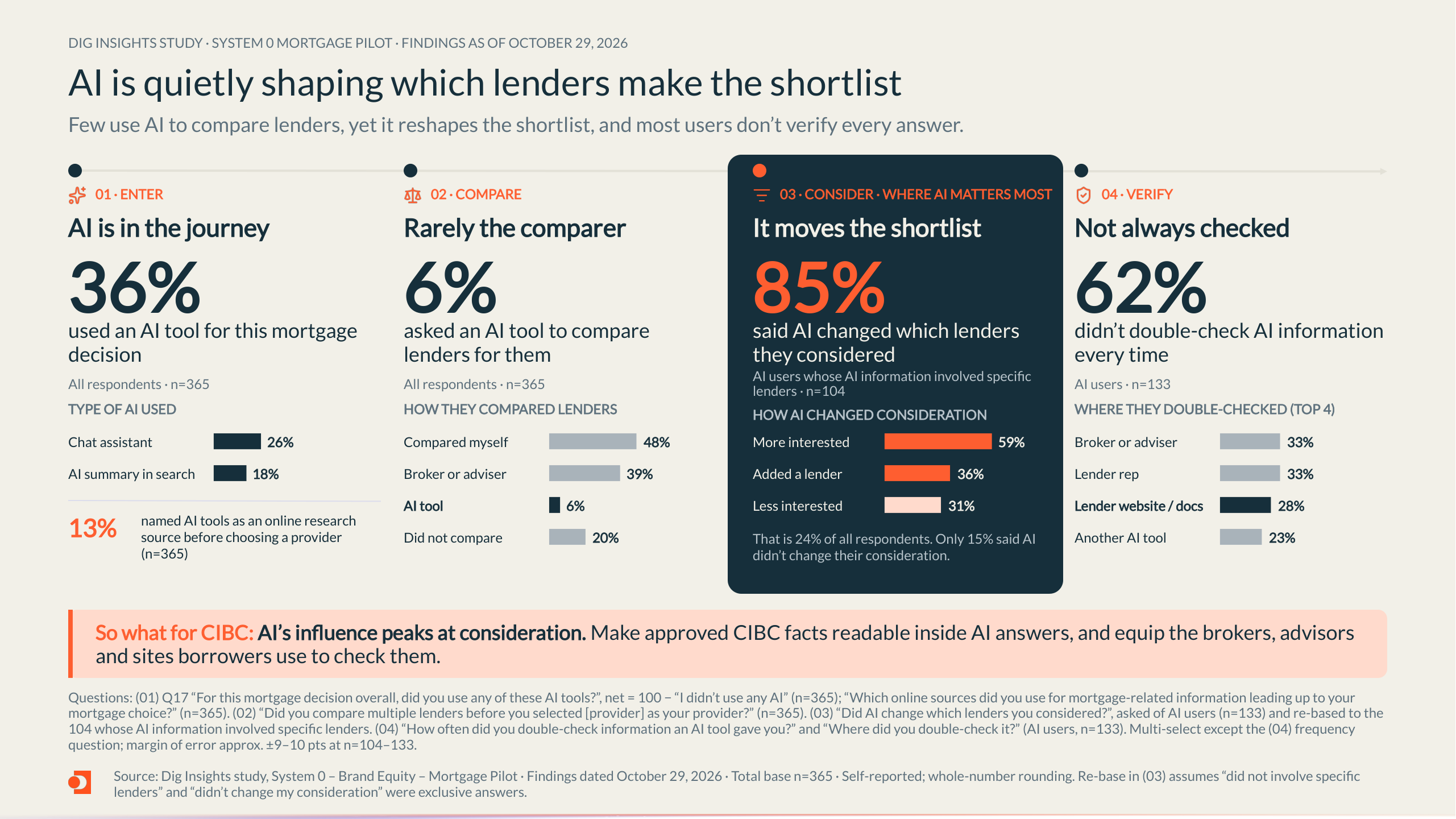
Dig Insights’ System 0 Mortgage Study, with findings dated 29 October, reports that 36% of its 365 respondents used an AI tool for their mortgage decision. On the same full-sample base, 26% used a chat assistant and 18% used an AI summary within search; the channels can overlap. Yet only 6% asked AI to compare lenders for them. By comparison, 48% compared lenders themselves and 39% used a broker or adviser. These are multiple-response measures, not exclusive shares of the market. [3]
AI’s reported influence extends beyond explicit comparison. Among the 104 AI users whose AI information involved specific lenders, 85% said it changed which lenders they considered. The slide reports this as 24% of all 365 respondents: approximately one in four people in the study reported some change in consideration associated with AI. Within that 104-person subgroup, 59% became more interested in a lender, 36% added a lender and 31% became less interested in one. Those outcomes can overlap. The 24% full-sample result refers to any reported consideration change, not the share rejecting or switching lenders. [3]
These are self-reported study findings, not an experiment proving that AI caused a completed mortgage choice. Dig Insights supplied additional fieldwork context for this article: the study was fielded in October 2026 among people who had looked for a mortgage in the previous 18 months. The supplied materials do not disclose recruitment, weighting or exact fieldwork days, so the results should not be presented as representative Canadian population estimates. The 85% re-base assumes that “did not involve specific lenders” and “didn’t change my consideration” were exclusive answers. The CIBC-specific application on the slide is not evidence of a CIBC-only sample or a comparison of individual banks’ performance. [3]
Download the original Dig Insights findings slide as a PDF
The supplied slide describes consideration as the point where AI matters most. The narrower conclusion supported here is that substantial reported consideration influence can coexist with relatively little explicit delegation of comparison. Different questions and bases do not establish a ranked, causal funnel. Nor does the study establish that AI’s influence always occurred before a borrower first spoke to a lender.
This develops the argument in AEO Updates’ earlier analysis, AI search is becoming a strategic banking issue. AI can choose which alternatives to surface, interpret conditions and frame a recommendation before anyone authorises a transaction. A customer can then ask for a better offer, contact another lender or move money through conventional channels. Access restrictions do not, by themselves, prevent those human decisions.
McKinsey reports that its research found LLMs more likely than conventional search to suggest digital-native lenders, fintechs and credit unions for questions such as “best savings account”. Its undisclosed models, prompts, markets and sampling mean this is not a reproducible Canadian bank benchmark. It is a reason to test whether AI presents a different competitor set from the one a bank normally monitors. [4]
The same analysis illustrates the possible deposit economics: if 5–10% of global checking balances moved to higher-yield accounts, total banking profits from deposits could fall by 20% or more. That is a conditional global scenario, not observed Canadian losses or a forecast for the Big Five. The immediate issue is more practical: an incumbent relationship may be questioned even when automated execution remains constrained. Moving surplus savings also differs from moving a primary chequing relationship with payroll and bill payments attached. [4]
The Dig study reports that 62% of AI users did not double-check the information every time, based on 133 AI users. That does not mean 62% never checked. On that same AI-user base, 33% reported checking with a broker or adviser, 33% with a lender representative, 28% through lender websites or documents and 23% with another AI tool. These are overlapping checking routes, not a partition of those who verified. [3]
For a bank, the implication is broader than improving a website. Approved product facts need to be clear in the information AI retrieves and consistent with what brokers, advisers and frontline teams explain. A borrower arriving with an incomplete AI account of portability, eligibility or a promotional rate needs an accurate human response. A second AI answer is not, by itself, independent verification against an authoritative product source.
The role of AI also depends on what research asks. The study reports 13% naming AI tools as an online research source before choosing a provider, versus 36% reporting AI-tool use for the mortgage decision overall, including AI summaries in search. Different wording and scope mean these are not contradictory results. CMHC’s 2026 survey, fielded from 7 January to 1 February among people who had completed a mortgage transaction in the previous 18 months, found 16% of online researchers used AI as a main source of mortgage information. Dig’s October study instead covered people who had looked for a mortgage in the previous 18 months. According to Dig’s additional fieldwork information, about half its respondents searched after CMHC’s fieldwork closed. Later research windows and broader AI coverage could contribute to the difference, but the studies do not isolate those effects or establish that mortgage AI use doubled. [3] [6] This develops the distinction between research use and lending outcomes in The first mortgage opinion may come from AI.
Answer engine optimisation, or AEO, concerns how a brand and its evidence are represented in AI answers. Banks should track whether they appear in relevant customer questions, how prominently they appear and which competitors accompany them. Visibility, competitive share of voice, recommendation rank and citations to bank-owned pages answer different questions. None, by itself, measures customer exposure, trust or a completed mortgage. Accuracy and suitability also matter: being recommended for the wrong borrower is not a successful outcome.
Human research remains equally necessary. Recurring survey waves can track brand associations, the credibility and understanding of claims, information exposure, consideration and reported behaviour. They should distinguish AI-mediated exposure from direct reading and adviser conversations where respondents can recall them. Comparing matched human and AI findings can help diagnose whether a bank’s intended positioning is missing from machine answers, unconvincing to customers or unsupported by the product itself. A System 0 baseline paired with continuous AI monitoring and ongoing human waves is a proposed research approach, not a causal result established by this study.
Banks can improve the public evidence without opening private accounts. Clear terms, effective dates, eligibility, limitations and accessible source pages support more accurate comparisons; brokers and legitimate comparison publishers also need current information. Google’s official AI-search guidance emphasises established search eligibility, important information in text and structured data that matches visible content. It does not require special AI files or guarantee inclusion. Security and search teams should distinguish intentional authenticated-access restrictions from accidental barriers to discovering approved public facts. [5] AEO Updates’ mortgage AEO playbook takes this into a worked offer: choosing the target and positioning, organising approved facts, checking the content with CITABLE and following both human and AI responses over time.
The CBC story is not evidence that Canadian banks have made AI irrelevant, and the Dig study is not proof of widespread AI-driven lender switching. Together, they show why account protection and competitive understanding require separate attention. Banks should defend the account boundary while examining what AI leads customers to believe, which alternatives it introduces and how those impressions survive human verification. An agent does not need permission to move the money to influence the person who can.
Research reviewed 30 October 2026. The Dig source is the supplied one-page study infographic, not respondent-level data or a full methodology report. Source verification confirms faithful extraction, not empirical reproduction. The original CIBC application slide is included unchanged.
[1] CBC: BMO, CIBC, RBC, TD Bank block personal AI agents, citing safety and security
[2] RBC: Understanding third-party AI agents and your RBC banking
[4] McKinsey: How gen AI agents threaten retail banks’ customer relationships
This article links directly to the primary documentation, paper, filing or original reporting used for its material claims.