Primary sources cited
This article links directly to the primary documentation, paper, filing or original reporting used for its material claims.
AI-assisted research is becoming part of telecom shopping. Operators need to know whether they are merely mentioned, genuinely recommended—or giving an…
A mention is a starting point—not a reason for a customer to stay.
Author: Ian Ash
Published: November 14, 2026
Category: Analysis
Telecom operators spend heavily to win customers and keep them. But an existing relationship does not settle the question a customer might now put to AI: ‘Given what I pay, where I live and what I need, should I stay?’ A familiar provider can appear in the answer without being the recommended choice.
That is the telecom loyalty trap. Brand familiarity, an installed customer base and a strong network may help a company remain visible. They do not automatically make its current offer the best fit for every customer. Recent buyer research and AI-output audits give operators reasons to examine that gap—but they do not yet prove that AI is causing subscriber churn.
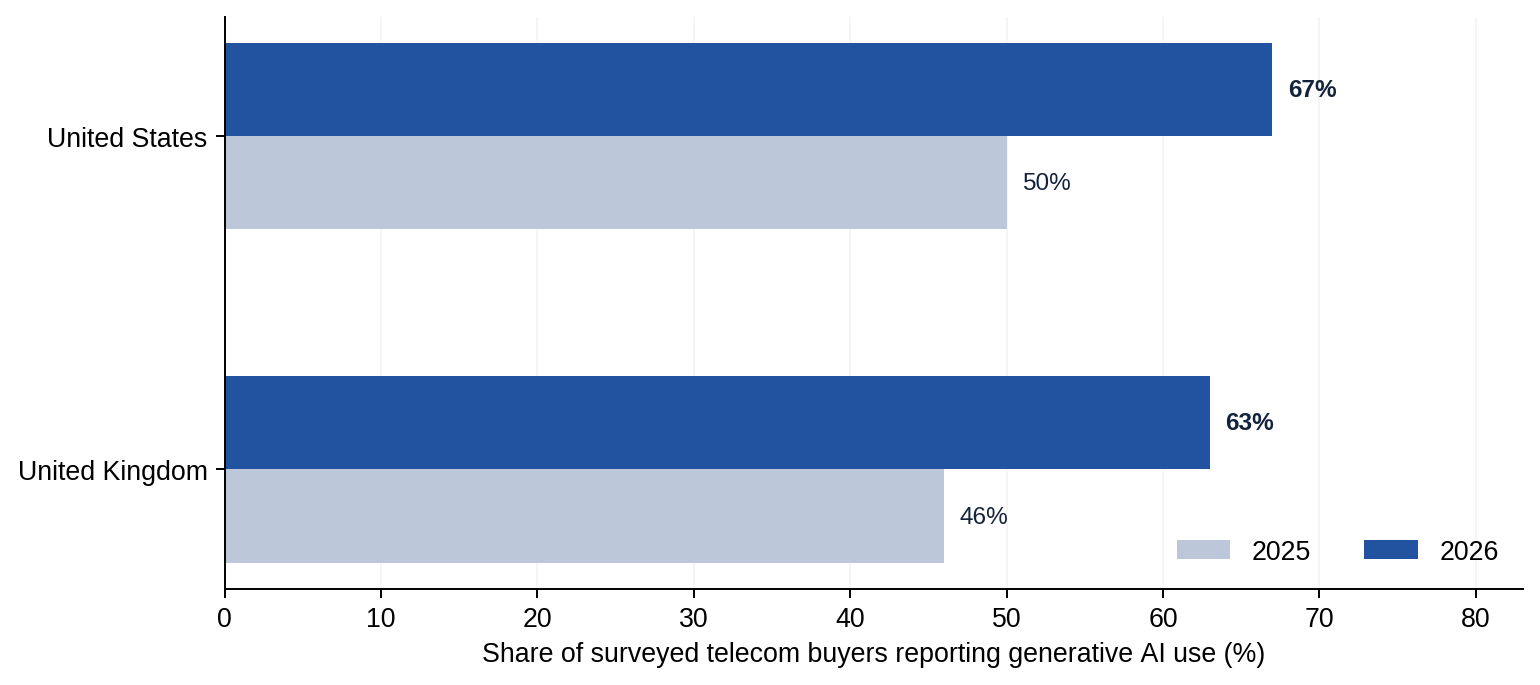
Invoca’s 2026 reports say 67% of surveyed US high-stakes telecom buyers used generative AI to research their purchase, compared with 50% in its 2025 report. In the UK, Invoca reports 63%, compared with 46% previously. Both differences are 17 percentage points, not 17% growth. Current telecom samples were 242 US and 259 UK purchasers, with fieldwork from May 8–22, 2026.[1][2]
These were people who had made a qualifying telecom purchase in the previous 12 months, not representative samples of all telecom subscribers. The annual samples differ, and the parent studies changed survey providers; unchanged instruments and weighting are not established. The prior UK figure is Invoca’s published comparison, not independently reproduced from underlying records. These results measure reported research use, not purchases caused by AI.[1][2]
Invoca also reports that 53% of US telecom respondents preferred a human representative when AI and human assistance were equally available. Another 24% preferred a combination. AI research and human assistance are therefore not opposing strategies: an AI-informed customer may still want a person to explain an offer or validate a decision.[1]
PeakMetrics’ September 29, 2026 snapshot asked 250 unbranded telecom-and-media questions across ChatGPT, Claude, Gemini, Perplexity and Grok, producing 1,250 answers. Verizon appeared in 48%, AT&T in 46%, T-Mobile in 40%, Comcast in 24%, Charter Communications in 14% and Cox Communications in 8%.[3]
Those percentages measure answers naming a brand, not endorsements. The authored questions cover wireless, broadband, streaming, media, investors and employers—not just mobile buying decisions. A brand can be mentioned positively, negatively or neutrally, and several brands can appear in one answer. Verizon’s and AT&T’s reported uncertainty ranges overlap, so the headline percentages do not establish a clear winner between them.[3]
The practical question is not only ‘Does AI mention us?’ It is also ‘What does it say about us, and does it put our offer forward for the customers we intend to serve?’ This is the same distinction explored in AEO Updates’ recent analysis of share of voice, recommendation and customer choice.
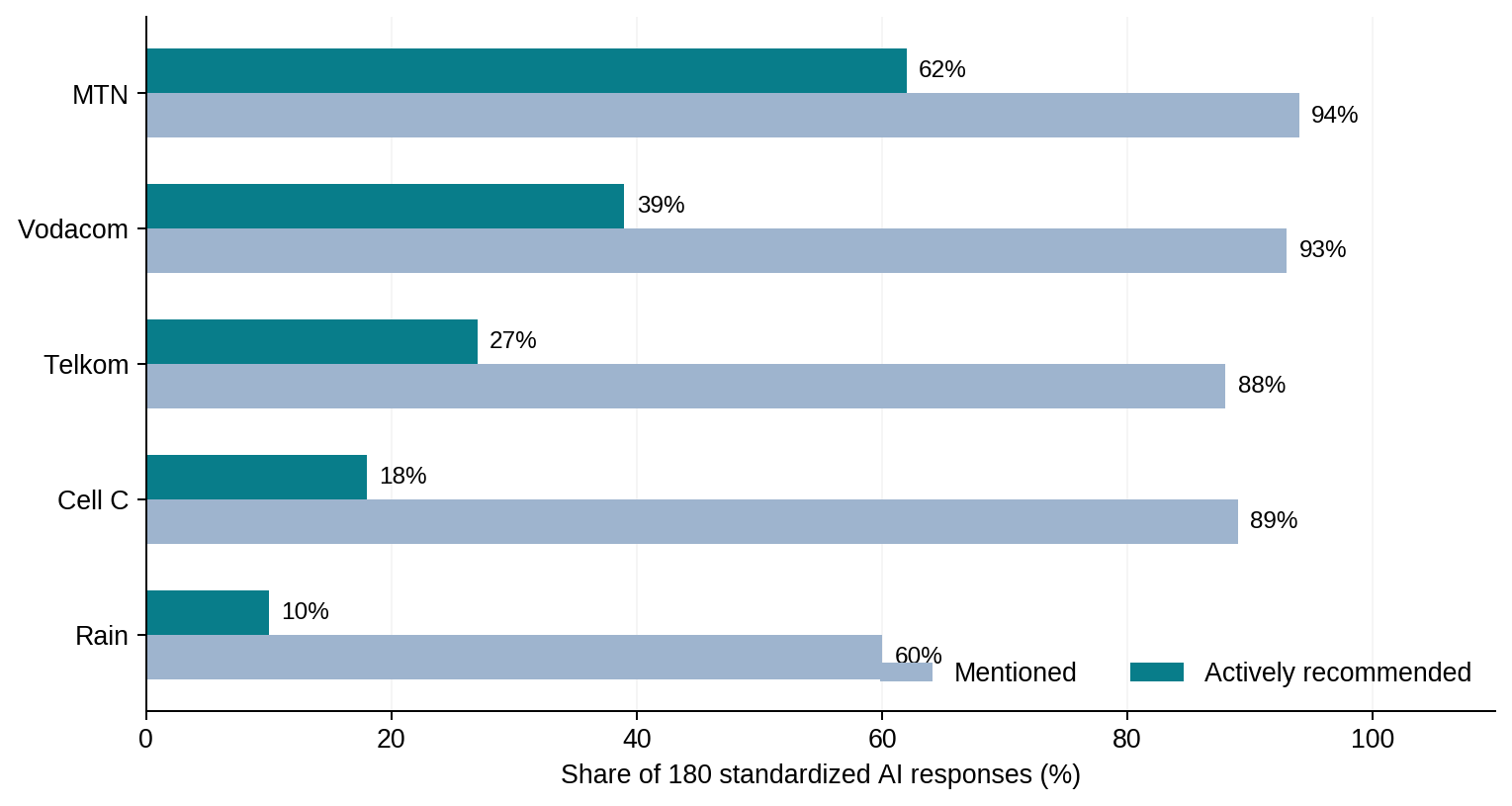
MO Agency’s Q2 2026 South African mobile-network audit tested 20 buyer questions across ChatGPT, Claude and Gemini, repeating each three times: 180 answers. A second AI pass classified brand appearances as actively recommended, neutrally listed or caveated. The displayed mention and active-recommendation percentages both use all 180 answers—not consumers—as their denominator.[4]
Vodacom was mentioned in 167 answers and recommended in 71: displayed rates of 93% and 39%. Cell C appeared in 161 and was recommended in 33: 89% and 18%. The count-derived gaps are 53.3 and 71.1 percentage points; subtracting the rounded chart labels gives approximate gaps of 54 and 71 points. MTN’s displayed rates were 94% mentioned and 62% recommended. None of those results is a consumer preference, subscriber-share or churn statistic.[4]
This is an endorsement gap: a model can know a brand and include it in comparisons while recommending another option. It is a useful diagnostic, not a demand to win every prompt. Suitability depends on customer circumstances. The current Q2 results were later restated for improved brand matching without recollecting answers; exact collection dates, model versions and independent coding agreement remain undisclosed.[4]
GenRank’s US-located Telecommunications category, labelled November 12, 2026 and methodology v5.0, ranks 179 brands across 24 questions and six AI surfaces. Its leading order was Verizon, T-Mobile, Visible by Verizon, AT&T, Mint Mobile and US Mobile. The parent category includes mobile, virtual-network plans, home internet and IPTV, so this is not a mobile-carrier-only ranking.[5]
GenRank publishes its market-weighted visibility formula: results reflect how often and how early a brand is named across questions and surfaces. They are not recommendation rates or subscriber market shares. The live page is a dated edition, not an immutable archived answer corpus; the first v5.0 run began November 11, and its complete collection interval is not established publicly.[5]
For an operator, the strategic implication is conditional but important. A smaller brand may become an intelligible alternative when its proposition matches a specific need—such as a simpler plan, predictable roaming or a different price-and-service trade-off. That is a positioning task as well as a visibility task; this ranking alone does not prove that any challenger won customers because of AI.
Conductor’s 2026-labelled Communication Services benchmark reports that identified AI referrals represented 0.25% of website traffic, with ChatGPT generating 89.5% of those AI referrals on average. The underlying US traffic data are from May–September 2025, and the category combines telecommunications with media and entertainment. These are historical analytics benchmarks, not November 2026 telecom adoption estimates.[6]
Referral analytics measure visits, not every answer someone sees. Conductor also says Google AI Mode and AI Overviews are grouped with organic Google traffic rather than separately identified in this dataset. A person might use an AI answer and later call, negotiate, navigate directly or do nothing; those are possible journeys, not outcomes demonstrated by the 0.25% statistic.[6]
Operators should not dismiss AI because a referral dashboard is small. Equally, they should not use the measurement gap as proof that AI must be generating a large hidden sales effect. Exposure, comprehension, consideration and action need their own evidence.
The CRTC’s Canadian Telecommunications Market Report 2026 describes 2024 industry data. Bell Group, Rogers and TELUS—including their flanker brands and acquired providers—held 85.9% of mobile subscriptions. The report says competitors accounted for over 55% of mobile subscribers added in 2024. That narrative is not explicitly defined as a net-additions calculation, and subscriptions are not unique people. It does not establish that the additions were all switches away from the top three, or that AI caused them.[7]
Analysys Mason’s Canada consumer survey, published November 2, 2026 and fielded with Dynata in the third quarter, says 16% of fixed-broadband respondents intended to change provider within six months, up from 12% in 2025. It also says more than one in five Bell Canada broadband customers planned to switch. The public extract describes at least 1,004 overall respondents, not the fixed-broadband or Bell subgroup bases; full question wording and weights are unavailable without the paid report. Intentions are not observed churn.[8]
CIRA’s 2026 research adds general internet-use context: 46% of adult Canadian internet users reported past-year generative AI use, and 52% of those AI users selected ‘as a search engine’ as a use case. The overall unweighted base was 2,000; the AI-user question base was 907. The detailed report gives March–April fieldwork, while the launch release says March. Neither question establishes telecom-specific AI use, a share of search queries or switching behaviour.[9]
The Crane Consultancy’s November 1, 2026 telecom scan approached 184 UK and international organisations’ homepages. It scored 135; 49 were unmeasured because its reader was refused, received no response or encountered script-only pages. Among the scored sites, median Brand Representation was 23 out of 100 under Crane’s proprietary rules. The November results were subsequently restated under a profile-link rule, using stored readings rather than a fresh scan.[10]
This is a homepage-readability proxy, not a test of what ChatGPT or Gemini actually recommends. The unmeasured sites have unknown scores, not zeros, and a refusal to one reader does not establish invisibility to named AI engines. Its value is as a prompt for inspection: can a machine reliably identify the company, connect the offer to the right audience and recover the evidence behind the claim?[10]
For a telecom offer, that inspection should include the full price and duration, geographic availability, coverage limits, speed conditions, data allowances, roaming, equipment, eligibility, cancellation terms and what changes after a promotion. These are editorial priorities for accurate comparison, not a list empirically proved to improve rankings in the cited study.
Acquisition asks whether AI recommends a provider to someone shopping for a new service. Retention asks what happens when a current customer describes the service they already buy and asks whether it is still right for them. The same comparison could support staying, negotiating, seeking a quote, switching—or doing nothing. No outcome should be assumed from the answer alone.
An illustrative prompt might be: ‘I pay $85 a month, use 20 GB, rarely travel and want to keep my phone. What should I compare before renewing?’ Another might ask whether a broadband promotion remains good value after its introductory period. These are hypothetical customer situations, not observed prompts or findings from the cited research.
This extends AEO Updates’ earlier argument that AI could make every renewal a decision to stay or leave. The evidence-led response is not to claim that loyalty has disappeared. It is to understand whether the actual product, the evidence AI can retrieve and the customer’s perception all support the same reason to stay.
A rigorous telecom AEO approach should distinguish four measurement layers: AI Visibility and Share of Voice; Recommendation Rate, Recommendation Share and positioning; actual customer exposure and interpretation; and human consideration, action and switching. AI Visibility measures how often a brand appears. Share of Voice measures relative presence under a stated formula. Recommendation Rate measures how often an offer is endorsed; Recommendation Share compares endorsements across brands. Their denominators must be declared, because provider definitions can differ.
A large share of mentions with weak suitable recommendations calls for a different diagnosis from inaccurate facts, low exposure or a product customers understand but do not prefer. Continuous prompt tracking can show what AI says across needs, models and geographies. Repeated human research can measure exposure, brand associations, perceived value, consideration, negotiation and reported choices; consented customer or operational data can add observed retention and churn.
This is why AEO Updates recommends the complementary human-and-AI approach described in its Dig Insights and System 0 strategy analysis. That is a disclosed editorial recommendation, not evidence of independently proven vendor superiority. Survey waves and operational tracking can describe changes; a claim that an intervention caused fewer cancellations still requires an attribution-capable design.
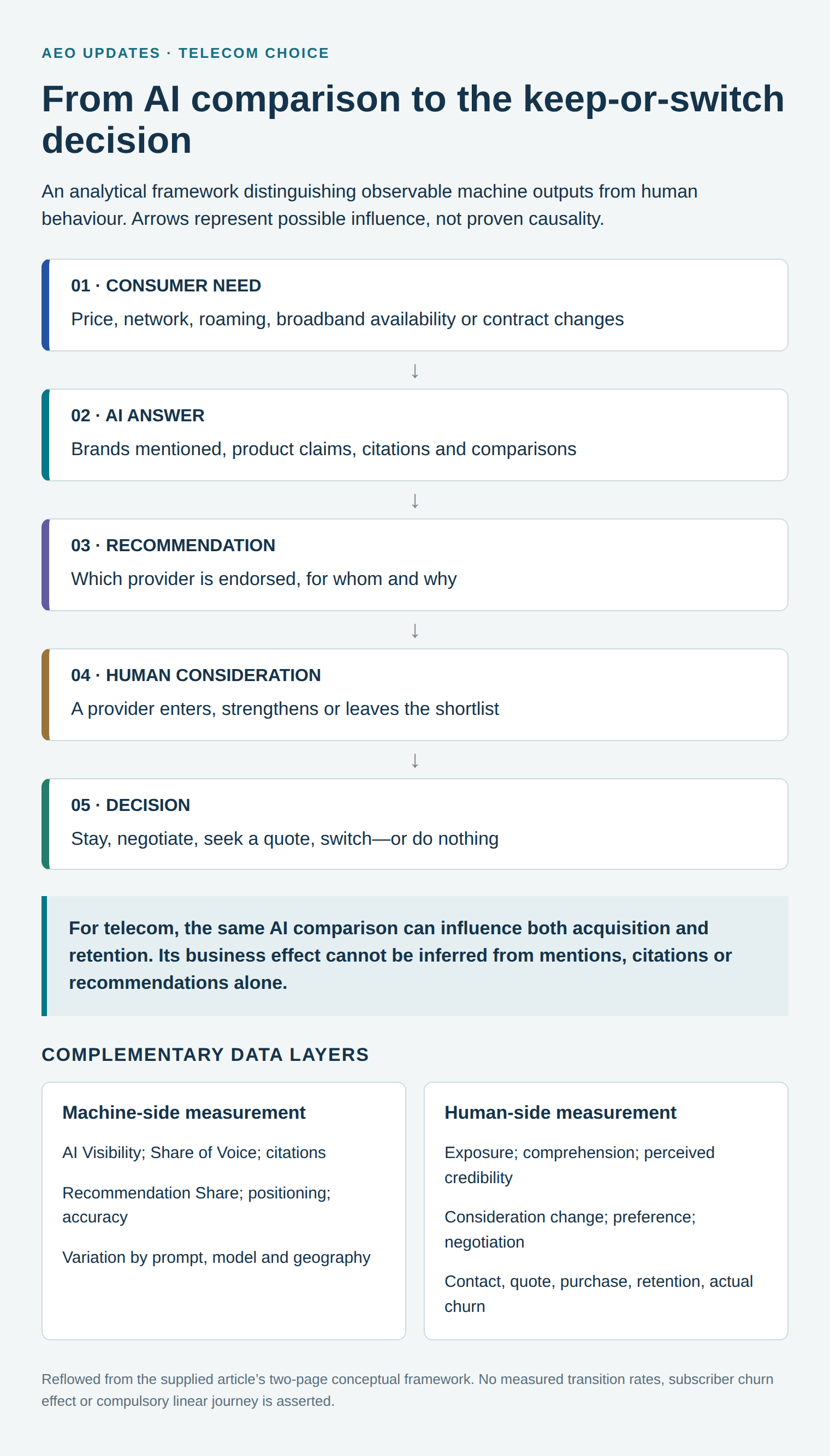
The available evidence supports a defensible hypothesis: AI may make telecom relationships more contestable by reducing some information barriers. It does not yet quantify a causal effect on churn, acquisition cost or subscriber market share. Familiarity, visibility, endorsement and customer choice remain different things.
For operators, the practical response is to choose the customer circumstances they intend to win, test whether AI recommends the right offer for those circumstances, make approved terms and evidence easy to retrieve, and equip human advisers to handle AI-informed questions. Then compare ongoing machine-side tracking with repeated human research and actual business outcomes. A mention is a starting point—not a reason for a customer to stay.
This article reviews ten published telecom sources, their available methodologies and the supplied draft. It distinguishes survey-reported AI research, authored AI-output audits, proprietary visibility/readability measures, historical referral analytics, switching intentions and provider-reported market outcomes. These studies use different populations, units, geographies and periods and are not statistically pooled. Underlying respondent, answer and operator-submission records were not independently available or reanalysed; review confirms faithful extraction from accessible sources, not empirical reproduction. The paid Analysys Mason report was not reviewed beyond its public extract. Undisclosed dates, subgroup bases and coding rules are explicitly qualified. The prompts and keep-or-switch framework are editorial illustrations, not a new experiment or a demonstrated causal funnel.
[1] Invoca: The Telecom Buyer Experience Report 2026 — US edition
[2] Invoca: The Telecom Buyer Experience Report 2026 — UK Edition
[4] MO Agency: AI Visibility in Mobile Networks (Q2 2026)
[5] GenRank: Telecommunications AI Visibility Ranking
[6] Conductor: Communication Services Industry: 2026 AEO / GEO Benchmarks
[7] CRTC: Canadian Telecommunications Market Report 2026
[8] Analysys Mason: Canada: consumer survey
[9] CIRA: 2026 Canadian Internet Trends
[10] The Crane Consultancy: The telecoms brand a machine can reach but cannot name
[11] AEO Updates editorial methodology for this article (not an additional empirical study)
This article links directly to the primary documentation, paper, filing or original reporting used for its material claims.